#514: About the Murder of a Startled Lady (1935) by Anthony Abbot
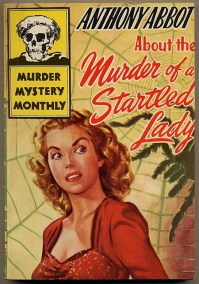


This is another title brought to my attention via the Roland Lacourbe-curated list of one hundred (well, 114) notable impossible crime novels. If I’m honest, I still don’t know what to make of that list — containing as it does some wonderful books that aren’t impossible crimes, some poor books that aren’t impossible crimes, and some thoroughly glorious impossible crimes that would otherwise have passed me by. This one is…fine. While the impossibility isn’t up to much, there’s enough interest in the approach taken to commend it if you can find a copy. Would I put it among the hundred best, however? Er, no…
Continue reading
#513: Minor Felonies – The Case of the Missing Message (1959) by Charles Spain Verral

The Three Investigators had Jupiter Jones, the Five Find-Outers had Fatty, and the Benton and Carson International Detective Agency had Barclay ‘Brains’ Benton. Welcome to the first of their six cases, from the same Whitman stable that brought us The Power Boys from a fortnight back.
Continue reading
#512: Policeman’s Lot – Ranking the Edward Beale Novels of Rupert Penny
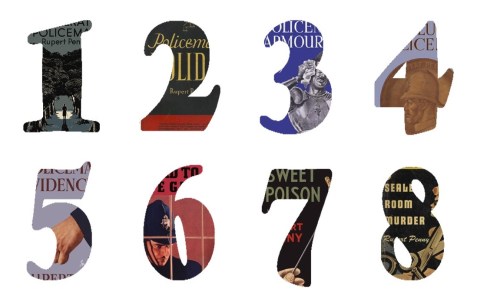
Thanks to the recent reprints by Ramble House, a few years ago I discovered the Chief Inspector Edward Beale books written by Ernest Thornett under the nom de plume Rupert Penny. Puzzle-dense and complex beyond belief, they were a joy to my pattern-obsessed brain and, having now read all eight of them, my mind immediately moves to the concept of placing them in a hierarchy.
Continue reading
#511: The Stingaree Murders (1932) by W. Shepard Pleasants
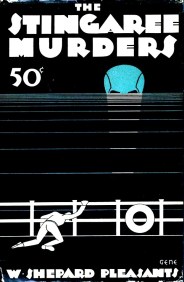
Thirteen people — a publisher and his two grown children, a newspaper editor, a retired General and his wife, a career politician and his bodyguard, a scientist, a lawyer, two servants, and our Everyman narrator — on a houseboat in the Louisiana bayou, intent on a few days of fishing, swimming, and relaxation. Though, naturally, the worries of everyday life never really vanish: a threat against the state Governor hangs over his head, as does his professional association with the scientist, which seems a little strained. With just enough time to get complacent, tragedy strikes, and then there were twelve. And then there were eleven…
Continue reading
#510: Minor Felonies – The Mad Scientists’ Club [ss] (1965) by Bertrand R. Brinley
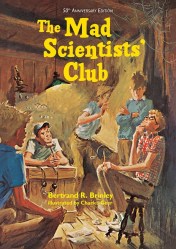
This collection is composed of seven fun, light-hearted stories of youthful shenanigans perpetrated in the smalltown Americana of Mammoth Falls. Sure, it’s not strictly detection, but the prospect of actual, y’know, science in the Mad Scientists’ Club’s adventures seemed to warrant investigation.
Continue reading
#509: Fair-Play/Cipher – The Baffle Book (1930) by Lassiter Wren and Randle McKay [ed. F. Tennyson Jesse] Problems 1 to 7

You like puzzles, you like detective fiction, so you’d love a puzzle book about detective fiction. Lo, I give you The Baffle Book — originally running to at least three volumes from what I can ascertain, and here boasting two authors and an editor for reasons that will soon become clear.
Continue reading
#508: Sweet Poison (1940) by Rupert Penny
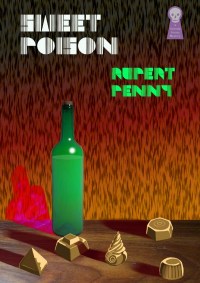
The plan for April, since I was off gallivanting around during March and got virtually no reading at all done, had been to dig through some obscure books on my TBR and bring to light titles perhaps unjustly forgotten. But one, two, three duds passed in a row, and so instead I leap into the welcoming arms of Rupert Penny. Cue the swift vanishing of a box of chocolates and a bottle of potassium cyanide at Anstey Court boarding school, and the roping in of Chief Inspector Edward Beale by Assistant Commissioner Sir Francis Barton — whose son is a pupil — to figure out what malice, if any, is behind it all.
Continue reading
#507: Minor Felonies – The Mystery of the Haunted Skyscraper (1964) by Mel Lyle

After March was filled with more social engagements than a debutante’s coming out Season, I’m back with a series that sounds like — though thankfully is not — some sort of Alt-Right recruitment pamphlet.
Continue reading
#506: The Men Who Explain Miracles – Episode 9.2: Laying Down the Laws – The Knox Decalogue & Detection Club Oath


