-
Subscribe
Subscribed
Have a WordPress.com account? Log in now.
 There are times when it’s possible to pinpoint the exact moment when a novel doesn’t fulfil its promise, and given the intricacy of many novels of detection these can sometimes be very keenly felt. Perhaps the detective is an absolute duffer (an accusation frequently levelled at Freeman Wills Croft’s Inspector French), or the guilty party comes disappointingly out of nowhere (as in John Dickson Carr’s The Blind Barber), or perhaps the solution offered up to a brilliant problem is a shade on the simplistic side (the disappearance from the locked bathroom in John Sladek’s otherwise-superb Black Aura springs to mind). For this second novel by husband and wife team Kelley Roos, I’d say the main problem is in the selection of the victim: the setup is excellent, the characters are a delight, and come the murder…the most obvious victim is selected and the book never quite recovers.
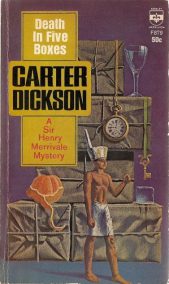 Four people are discovered sitting around a table as if at a dinner party, each with only a glass in front of them. Three of the four have been poisoned into a catatonic state and the fourth has been murdered by being run through with a narrow blade. Of the three who remain alive, one has two bottles of poison in their bag, one has the workings of an alarm clock in their pocket, and the third is carrying four pocket watches in various pockets about their person. At this point you are three chapters into the eighth Sir Henry Merrivale novel written by John Dickson Carr under his Carter Dickson byline and we haven’t even touched upon the revelation that greets you at the end of that chapter…suffice to say, boy are you in for a ride!
 Children, incarnations of The Doctor, phases of the moon…generally I try not to play favourites. But if I had to pick one crime fiction conceit above all others it would undoubtedly be a group of people on an island getting killed off one by one. Sure, isolate them in some ancestral mansion via thunderstorm or on a train via unexpected snow and the effect is arguably the same, but there’s something about the island in itself that renders the idea all the more thrilling to my senses. And so this Japanese island-set puzzle, the second collaboration between Locked Room International’s John Pugmire and translator and crime fiction blogger Ho-Ling Wong after last year’s excellent The Decagon House Murders, would be just what the doctor ordered if the medical profession ever thought of prescribing books for those of us with the thrill of fictional murder in our hearts.
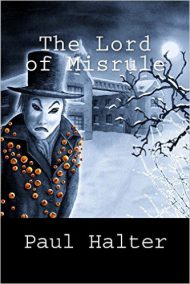 One dark and snowy night, a mysterious figure who is observed entering the home of an upright citizen commits a murder in an inaccessible room and vanishes without leaving so much as a footprint to tell of their presence, only for a second murder to then be committed outside in the snow but leaving only the victim’s footprints in evidence…you can’t tell me the similarities between Paul Halter’s The Lord of Misrule and John Dickson Carr’s The Hollow Man (a.k.a. The Three Coffins) are anything less than an absolute fanboying homage to the master. And Halter would know the risk he was running, but having established himself as an artisan of the impossible crime by this stage in his career (this was, by my estimation, his tenth published novel – though the first to be translated into English by John Pugmire) it was clearly a task he was happy to take on.
 “If a man’s mind be wandering,” said Francis Bacon, “let him study the mathematics”. Well, the mathematics take up an unreasonably large amount of my time as it is, and for me nothing helps my wandering mind quite like classic detective fiction. So, with 2016 having been an underwhelming year in books so far, and coming back off a 2 month hiatus with my hand injury, I’m keen to get a bit of enthusiasm back into my reading. Hence I shall spend the next little while focussing on the sure-fire hits in my collection: expect much Max Afford, Leo Bruce, John Dickson Carr, Agatha Christie, Paul Halter and others, as well as some classic locked room nonplussing, in the weeks to come while I try to reorient myself within my chosen enthusiasm.
 Animals and their involvement in impossible crimes enjoy a long history, from the works of Edgar Allan Poe and Arthur Conan Doyle all the way up to the Jonathan Creek episode The House of Monkeys. Approximately halfway between these two we have Roman McDougald’s mandrill Geva, resident of your classical American Millionaire’s Household and on hand when said millionaire is found murdered in frankly baffling circumstances: in his office, stabbed in the back, with both doors into the room unlocked. Yes, unlocked. And yet he failed to leave the room while being attacked – the trail of blood he left leads from his desk to one door, then the other, and halfway back again – or raise the alarm in any way before the killer escaped.
 A little charm goes a long way – ask any bank teller or helpline operative, or indeed any fan of Golden Age crime fiction. Because, while a lot of absolutely wonderful books came out of this genre at that time, the fact is that a lot of what was published then and is popular now adhered to a particular school of writing and runs on very familiar rails. But the key thing is that so much of it is charming without having to innovate, and once you jettison any notions about every single book from the Golden Age being a complete game-changer you find a lot of joy there. Which astonishingly back-handed praise brings us to my first (but the chronological second) Hildegard Withers mystery by Stuart Palmer, possibly the first book I’ve really enjoyed for a long time in 2016 even though it does very little new or surprising.
 You’ll be aware by now, I hope, that I’m quite the fan of a locked room murder. That quantal aspect of something that can’t have happened but nevertheless did tickles me greater the more I read, and so the republication of anything from the classic era is always a cause for celebration. The British Library continue their excellent Crime Classics series with this, their first impossible crime, in which elderly spinster Mary Gregor is found dead in her locked and bolted bedroom (a nice touch with the door lock forestalls the prospect of jiggery, and indeed pokery, there) with no sign of a weapon and the blow that killed her containing the scale from a herring and so stirring up superstitious rumours of merman-like ‘swimmers’ finding their way in to dispatch her.
 I am from a televisual generation and so struggle to comprehend the power radio held in its pomp – people actually believing that Orson Welles’ radio broadcast of The War of the Worlds was genuinely detailing an alien invasion of Earth, for instance. So, to me, the idea of presenting the haunting of a Spooky Old House as a radio show seems a bit…pointless. Nevertheless, Jack Hartley and his BBC radio chums descend upon Cold Stairs, the ancestral home of Sir John Harman (5 bed, 2 bath., stunning aspect in own woodland), to record ghostly goings on and bumps in the night with the intention of making a broadcast of it. Or that should really be ‘bumping offs in the night’ as some poor soul is murdered by the evil spirit that resides in the vicinity – the same spirit that shocked his housekeeper’s son so badly he fell down the stairs and crippled himself – and then it turns out that Harman’s introverted, reserved niece has been communing with something calling itself the King of the Forest, and that’s really the beginning of everyone’s problems.
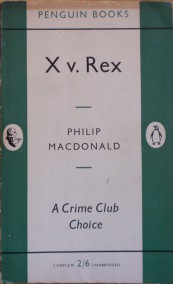 Philip MacDonald first came to my attention for having written a handful of impossible crime novels but this is not one of them, and nor does it feature his series sleuth Anthony Gethryn. I stumbled across my copy of X v. Rex in a second-hand bookshop a good while ago and, as he was out of print at the time (one Gethryn novel, The Rasp, has since been republished by Collins) I picked it up for future perusal. And so, with the Crimes of the Century at Past Offences dipping into 1933, here we are – with policemen in and around London being targeted by a killer, and a government sliding into disarray as the previously unimpeachable bastion of order is attacked seemingly at will.

