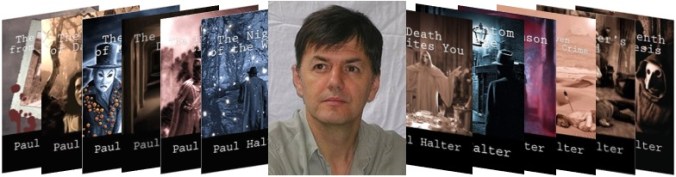
#98: One week until Paul Halter Day!

Paul Halter Day

I have absolutely no doubt that Kate, Rich, Puzzle Doctor, and many others will do jobs far superior to anything I ever could in summarising yesterday’s hugely enjoyable Bodies from the Library and so I’ll leave that to them.

Instead, I’d like to remind anyone still considering it that next Sunday will be Paul Halter’s 60th birthday and so Paul Halter Day will come into effect.  If you’re posting anything Paul Halter-related on that day, put the link in the comments of this post and I’ll do a wrap-up later in the evening.

My thanks in advance to anyone getting involved, really looking forward to what people come up with…!

#95: Character v Plot 2 – Atmosphere v Redundancy
relevance

As you’re no doubt aware, the internet is currently ablaze with my self-inflicted #9booksin9days challenge on Twitter in which, well, I’m reading 9 books over the nine days of my half term break.  It’s been fun and slightly intense – I’ve read books in a single day before, even on consecutive days, but never nine in a row – and has caused me to reflect upon my post from last week on the topic of the character/plot threshold in detective fiction (which has already been reflected upon by Brad at AhSweetMysteryBlog). In light of this, I wanted to explore it a bit deeper.  You are, of course, invited to come along with me.

Continue reading

#92: Character v Plot

Character v PlotSo here’s a starting point that doesn’t belong on a blog about crime fiction between 1920 and 1959 with frequent diversions into apparent impossibilities: I freakin’ love Batman. The whole Bruce Wayne/Batman duality in almost any form is an absolute joy to me – I’m not going to geek out here over the many, many years I’ve spent reading the comics nor the sundry disappointments of the various cinematic fusterclucks (I’m looking daggers at you, Schumacher…Burton, you’re borderline), and shall instead make the following observation: the second I heard Batman v Superman: Dawn of Justice was announced, I’d practically bought my ticket on the fact of it being a new Batman incarnation.

Continue reading

#86: Where has all the classic detective fiction gone…?
Unavailable classics

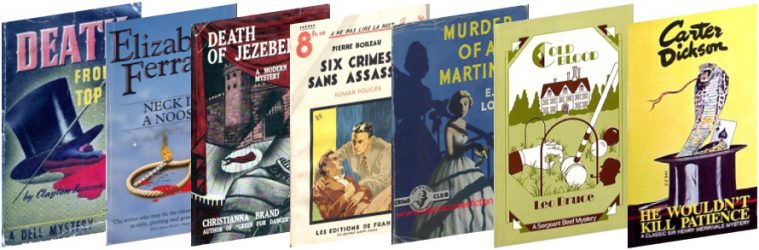
If you’re anything like me, well, firstly my condolences, but also you have a list of books not printed any time in the last few decades that you spend hours scouring secondhand bookshops, book fairs, online auction sites, and other people’s houses in the hope of finding.  A lot of them – in my case, say, The Stingaree Murders by W. Shepard Pleasants – are rather obscure and so their lack of availability is understandable, but in other cases it just seems…baffling.

Continue reading

#84: The Tuesday Night Bloggers – The Sherlockian Impossibilities of John Dickson Carr – II: ‘The Adventure of the Sealed Room’ (1953)
TNBs JDC

I’m guilty of sedition here: this isn’t technically part of the Tuesday Night Bloggers – they’re looking at travel in classic crime this month – but rather my own delayed TNB post on John Dickson Carr from March before I was sidelined.  But, y’know how it is, it’s the second one looking at Carr’s Sherlock Holmes stories and so I feel I should probably post it on a Tuesday if only for internal consistency…my apologies for any confusion (though I suppose I cam writing about a Carr trip…).  Just look upon this as my Never Say Never Again.

I talked about the origin of these stories in my first post on this topic, so let’s get straight on with it: this story is built on the reference to a case “of Colonel Warburton’s madness” made at the start of ‘The Engineer’s Thumb’ and so it’s appropriate that it begins in much the same way: someone in distress seeks out Watson (then for his doctoring, now seemingly because he knows Holmes) and is thus ushered into the Great Presence.  It’s here that the story plays its most interesting card, as Holmes is rather short with the unfortunate Cora Murray who has just had a Colonel Warburton seemingly shoot himself and his wife while locked together in his study in the house where they all reside:

Continue reading
#83: “One gets to remembering things in a place like this…” – a meta-analysis of Agatha Christie’s At Bertram’s Hotel (1965)

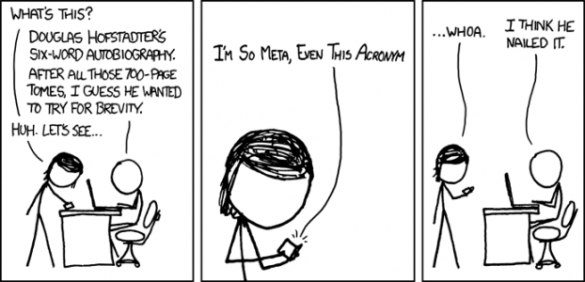
It is a truth universally acknowledged that as Agatha Christie approached the twilight years of her career the quality of her output dipped somewhat.  And yet, as I’ve said elsewhere, what these novels appear to lack in merit from a plot perspective they arguably make up for in a kind of critical self-analysis of her own position in the firmament of crime fiction.  And At Bertram’s Hotel, the tenth Miss Marple novel, provides yet more opportunity to potentially read too much into her writing from this perspective.  I mean, don’t get me wrong, she’s no Douglas Hofstadter, but who’s to say this is a completely bad turn of events*?

meta Continue reading

#81: Paul Halter Day – Call for submissions!

Paul Halter Day

According to my impeccably-researched sources, it is two months today until Paul Halter’s 60th birthday.  Now, I’m quite the fan of this French locked room maestro – his publication in English by John Pugmire under the guise of Locked Room International has provided no small amount of delight in my house – and so I’ll doubtless try to post something to mark this occasion.

And then I thought, “Hell, I’m just one guy – and not a very impressive one at that,” and figured that it wouldn’t be much of a 60th birthday if it’s just me on the stage on my own.  So, with the intent of making it something more of an occasion, I throw it open to you and your interwebs: can I interest anyone in joining me and posting something Paul Halter-related – a book review, an opinion piece, a collection of his cover art…whatever, go crazy – on your blog on 19th June 2016?

Continue reading

#79: The Tuesday Night Bloggers – The Sherlockian Impossibilities of John Dickson Carr – I: ‘The Adventure of the Highgate Miracle’ (1953)

TNBs JDC

In the early 1950s, John Dickson Carr collaborated with Sir Arthur Conan Doyle’s youngest son Adrian on six stories featuring Sherlock Holmes and Dr. John Watson. These were published in various magazines before being collected together and published as either The Exploits of Sherlock Holmes (as my edition – featured below – is, also containing six stories solely from the pen of Conan Doyle, Jr.) or The Further Exploits of Sherlock Holmes, separate from Conan Doyle, Jr.’s stories which were themselves published as The Exploits. Are you keeping up?

Continue reading

#77: The Tuesday Night Bloggers – An appeal to the senses in Carter Dickson’s ‘Blind Man’s Hood’ (1938)

The Tuesday Night Bloggers, you’ll doubtless be aware, is an opt-in group of Golden Age crime fiction enthusiasts who look at the work of a different classic author each month.  And with (Colonel) March being dedicated to John Dickson Carr – the single finest proponent of detective fiction ever to take up the craft, no arguments – I thought it about time I rolled up my sleeves and contributed something to this superb endeavour (also, two people asked me if I was going to get involved and I am nothing if not helpless in the face of my own vanity).

The difficulty is knowing quite where to start.  I am an avowed disciple of Carr, but a lot of his work is still ridiculously out of print and so if I’m recommending something you then have to search for months to find it may dampen your enthusiasm for it somewhat.  And then I remembered that the recently-published compendium of impossibilities that is The Black Lizard Big Book of Locked Room Mysteries contains two stories by Carr and that the second of these – ‘Blind Man’s Hood’, first published in 1938 under his Carter Dickson pseudonym – highlights much of what I love about his writing.

Continue reading

#74: “Old people know how valuable life is, and how interesting…”, portrayals of age in Agatha Christie’s A Caribbean Mystery (1964)

Agatha Christie was 74 years old when she published her ninth Miss Marple novel, A Caribbean Mystery, by which time – as I said in my review of The Mirror Crack’d from Side to Side – she would have known a lot about the procedures of ageing.  There were still 13 books to come from her pen (well, 11 really, since the final Marple and Poirot books had famously been written some years previously) and this belief in her own abilities is echoed in the treatment of her beloved elderly spinster as, in spite of the infirmities she suffers and the attitude others take towards her, she continues to outfox murders left, right, and centre.

Christie, of course, had less to prove by now than she would have done in her younger days and so this isn’t a “We’ve Still Got It” Oldies v. Whippersnappers cage match – the Clint Eastwood movie Space Cowboys comes to mind, and can thankfully be dismissed – but is instead a moderately elegiac reflection on old age, youth, and the folly of both (contrast it with the far earlier Partners in Crime, where Bright Young Things Tommy and Tuppence prove their worth at a range of investigative styles).  And since I’ve been in a bit of a reading funk for a few weeks now (which I promise I’ll not mention again) I thought I’d try a bit of a textual analysis on this theme to see if it got me anything interesting.

Continue reading