
Author: JJ
#561: Thinking Too Precisely on th’ Event – Clued and Unclued Detective Fiction, or: The Active and the Passive Detective-Reader

August is my summer holiday, and I’m contributing to the slow death of the planet by taking a few breaks here and there, so might not be as hot in the comments as usual. But the nature of what we mean when we say “GAD” has been on my mind for a while, so here goes nothing.
Continue reading
#560: Inspector French’s Greatest Case (1924) by Freeman Wills Crofts
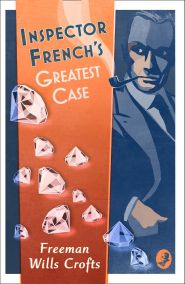


Cometh the hour, cometh the man. After a debut that laid the cornerstone of a new genre and three succeeding works exploring the principles of that genre from varying perspectives, now begins Freeman Wills Crofts’ 30-novel (plus however-many short stories) relationship with Inspector Joseph French. At this stage it’s difficult to judge how French differs from his antecedents Burnley, Lafarge, Tanner, Willis, Vandam, and Ross, but I guess we’ll never know whether French was ever initially conceived as more than a one-book man like those others. The title certainly suggests so, but history shows otherwise.
Continue reading
#559: Little Fictions – Curiosities from Adey: ‘Murder at the Automat’ (1937) and ‘All at Once, No Alice’ (1940) by Cornell Woolrich
The final two stories for this month to be plucked out of the listings in Robert Adey’s reference bible Locked Room Murders (1992) sees a return to the work of Cornell Woolrich, who was discussed on this site only a few weeks ago.
Continue reading
#558: Spoiler Warning – Coming in October: Postern of Fate (1973) by Agatha Christie
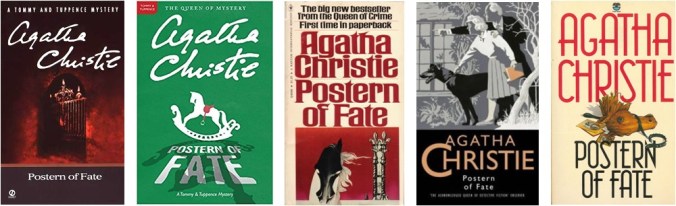
With the most recent Spoiler Warning post now out in the wild — it’s on The Moving Toyshop (1946) by Edmund Crispin if you’re interested — it’s time to prepare for the next.
Continue reading
#557: The Gilded Man, a.k.a. Death and the Gilded Man (1942) by Carter Dickson
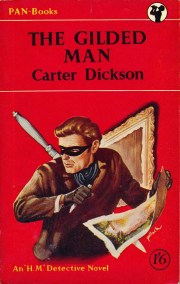
It had been my intention to review a book by a new-to-me author this week, but thankfully I was able to get to it a little ahead of time and watch disconsolately as, after a bright start, it fizzled out to nothing (man, some Silver Age stuff has a lot to answer for…). Instead, here’s another from John Dickson Carr’s era of tight, house-set puzzles which range from masterpieces (The Reader is Warned (1939), The Seat of the Scornful (1941)) to very good (The Crooked Hinge (1938), The Emperor’s Snuff-Box (1942)) to, er, Seeing is Believing (1941). And with The Gilded Man (1942) being somewhat overlooked, I wasn’t entirely sure what I was going to get…
Continue reading
#556: Little Fictions – Curiosities from Adey: ‘The 51st Sealed Room’, a.k.a. ‘The MWA Murder’ (1951) and ‘The Glass Bridge’ (1957) by Robert Arthur

Over the last couple of years, I’ve been slowly working my way through the Alfred Hitchcock and the Three Investigators series, the first tranche of which were written by Robert Arthur, Jr.
Continue reading
#555: Oh, What a Tangled Web We Weave in The Mystery of the Silver Spider (1967) by Robert Arthur
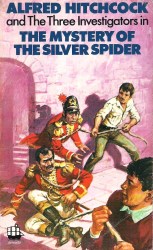
Thus far in my reading of the Alfred Hitchcock and the Three Investigators books, the clear pattern of The Odd-Numbered Ones Are the Good Ones has emerged…so how did this, the eighth title, fare?
Continue reading
#554: The Case of the Solid Key (1941) by Anthony Boucher
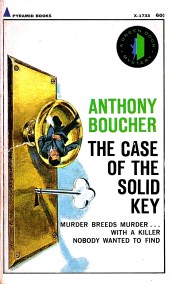
Several years ago, discovering that the impossible crime novel was a thing, I read Anthony Boucher’s Nine Times Nine (1940), originally published as by H.H. Holmes, and loved it. I then discovered TomCat’s list of favourite impossible crime novels and was intrigued by the fact that, eschewing the accepted classic that Nine Times Nine is, Boucher’s later, less discussed The Case of the Solid Key (1941) was included there instead (TC, it must be said, is something of an iconoclast…). More Boucher followed, some of it disappointing, and last year I finally ran to ground a copy of TCotSK in a secondhand bookshop in Philadelphia and — at long, long last — here we go.
Continue reading
#553: Little Fictions – Curiosities from Adey: ‘Murder Game’, a.k.a. ‘The Gemminy Crickets Case’ (1968) and ‘Upon Reflection’ (1977) by Christianna Brand
 The Invisible Event