
#59: On Locked Rooms and Impossible Crimes in fiction – something of a ramble

footprints

I was recently reading a book on the promise of it providing a locked room murder, to which I am rather partial.  When said murder arrived, it took on this approximate form: a large indoor hall with a free-standing stone chapel inside it which has one door and no windows or other points of ingress, a crowd witnesses a lady entering said chapel – which is deserted – alone and the doors are shut, only for them to be opened some time later and said lady found beaten, bruised and devoid of life.  It’s moderately classic in its setup and should therefore provide some interest, but once I read the details of the crime I gave up on the book and will not return to it (in fact, it’s already down the charity shop).

This is not due to any squeamishness on my part, or a particular problem I had with the writing or the characters – both were fine, if unexceptional – but rather just because it just wasn’t interesting.  It is hard to put this in words, which is why I imagine this post may run rather longer than usual, but there were simply no features of intrigue to me in that supposedly impossible murder.  And so I got to thinking…forget plot or prose or atmosphere, take away all the context of an impossible crime, particularly forget about the solutions: what makes an interesting fictional impossibility? Continue reading →

#58: The Problem of the Green Capsule, a.k.a. The Black Spectacles (1939) by John Dickson Carr

Green CapsuleMarcus Chesney doesn’t have much faith in human observation.  To prove his point, he arranges to put on a short demonstration for three witnesses, after which he will ask them questions about what they saw – secure in the knowledge, he says, that they’ll get the answers wrong.  The demonstration goes ahead, as part of which a disguised figure enters the room…and poisons Chesney in front of everyone before vanishing.  It swiftly becomes apparent that the murderer must not only be responsible for a spate of recent poisonings in the village but must also have somehow been one of only four people.  The only problems are that one of them has a rock-solid alibi and the other three were all watching the performance…
Continue reading →

#57: It’s 2016, and the rules are changing…

batman

It may come as some surprise to you that I am the Batman of classic crime blogging.  Not merely because this blog represents my true face that must remain hidden beneath a socially-acceptable façade, nor due to all posts being despatched from a convoluted series of secret caves beneath my gigantic mansion on the outskirts of a fictional city.  No, rather because for the opening couple of months of this undertaking I have stuck, dramatically, to a single rule – an immutable and unyielding precept that has underpinned practically everything I have posted.

Continue reading →

#56: End of 2015 Review – My Reading in Pictograms

As I’ve only been blogging for a few months there doesn’t seem to be much point in a full blog review, but I thought I might look at my overall reading this year.  And who doesn’t love a pictogram?  No-one trustworthy, that’s who.

To begin with, here’s how my TBR at the start of the year fared:

 TBR 2015My book-by-book breakdown of tree books and ebooks throughout the year looks like this, including the nine I borrowed having finally joined the library:
Continue reading →

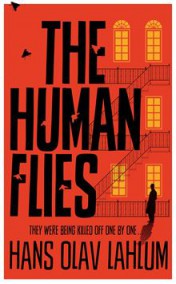
#55: The Human Flies (2010) by Hans Olav Lahlum [trans. Kari Dickson 2014]

Human FliesFor those of you who lament the decline of the modern detective novel – and we are legion, to be sure – I have three words: Hans Olav Lahlum.  The Human Flies, his debut novel, is by no means perfect – it’s in need of a good edit, as there’s a tendency to repeat ad infinitum information gleaned and interpreted elsewhere – but it’s honestly about as close to a classically-motivated, -structured, and -executed novel as I imagine you’ll find in the 21st century.  The fact that it has almost the exact same setup as the likes of The Wooden Overcoat, The Black Shrouds and Our First Murder with a killing in a guest-house (here a small apartment block) of which one of the denizens is undoubtedly guilty certainly helps, but Lahlum is also smart enough to build on this base in very classical ways.  But for a few dates and key events – it is set in 1968 – this could almost have been written in the late 1940s.

To add to the fun, it also starts with an impossible murder: gunshots heard in an apartment, people rush to the scene before the killer would have chance to get away, and upon opening the locked door there’s a dead body but no killer, no weapon, and no other exit.  Cue detective Kolbjørn Kristiansen – that and his being blonde is pretty much all you’re told about him, so the nickname K2 may purely be a result of his initials rather than also his physical size – who swiftly finds himself out of his depth, as everyone in the building seems blameless, even given the victim’s relative celebrity and potential for enemies.  And then he gets a phone call…

Continue reading →

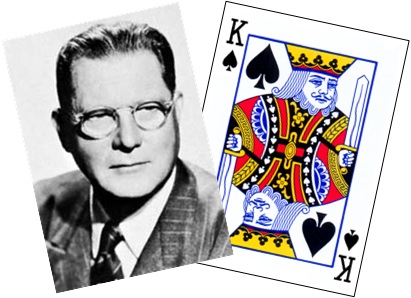
#54: The Kings of Crime – IV: Erle Stanley Gardner, the King of Spades

King Gardner

Bookends: The Case of the Sulky Girl (1933)/The Case of the Postponed Murder (1973)

Books published 1920-59: 97

The Case for the Crown

Diversity: Yes, you read that correctly: by my count (and I’ve cross-checked a couple of times just in case) Erle Stanley Gardner published ninety-seven books in the space of 39 years, and that’s not including short story collections and without considering the individual stories themselves – somewhere in the realm of 200 of them (Wikipedia informs me that Gardner set himself a target of 1.2 million words a year – 100,000 a month, approximately the total word-count of The Adventures of Sherlock Holmes – while writing short fiction for the pulps, many of them under pseudonyms).  With that much output comes one of two things: the same story, worn infinitely thin and threadbare through retelling, or a range of styles, approaches, forms, characters, and ideas that tell of an imagination on fire, quenched only by its own overflowing.

Continue reading →

#53: Merry Christmas!

Book TreeA quick word from me before the festive craziness starts to wish a very happy, safe, peaceful, and relaxing Christmas to you all.  Many thanks for dropping by and getting involved in the few months The Invisible Event has been running – it’s been an absolute joy, and I feel immensely privileged to have had the discussion I’ve had with such passionate, knowledgeable, entertaining, and discerning people as yourselves.
Long may we continue!

#52: The Picture from the Past (1995) by Paul Halter [trans. John Pugmire 2014]

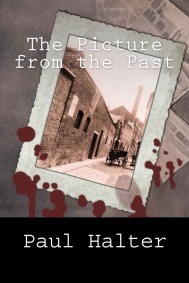
Picture from the Past largeA man seeing an old photograph of an unremarkable street scene on the cover of a book and being struck by an overpowering reaction of uncertain origin doesn’t sound like a promising start to an impossible crime novel.  However, it turns out that such an opinion is simply a sign of your lack of inventiveness, as Paul Halter can spin one hell of a tale from just that.  Well, okay, not just that, as there’s also the notorious Acid Bath Murderer going around destroying the remains of murder victims by pouring acid on them – and John Braid, our photo-phobic protagonist, is curiously unwilling to tell his young, trusting and rather new wife what he gets up to every day when he leaves the house.  And he’s rather keen on not letting his briefcase out of his sight…

Of course, Halter then complicates things further by throwing in a parallel narrative set some years previously in which the wife of a wealthy resident of a down-at-heel London suburb is murdered, tracing the impact of that murder upon the woman’s husband and children.  Clearly the two stories must be related, but how?  And who is responsible for the deaths in each thread? Continue reading →

#51: Two novellas – The Single Staircase (2012) and WDYG (2013) by Matt Ingwalson

Single Staircase WDYG

“Self-published” is, I’d wager, the phrase most likely to strike fear into the heart of even the most ardent book-lover.   After all, that’s how we had Fifty Shades of Grey inflicted upon us, and the rise of ebooks (a great thing as far as I’m concerned, as look at the number of classic crime titles now available via that medium) has given new scope to the possibilities for getting a book out to an audience without first taking a detour via editors, proof-readers, fact-checkers, or any of the countless bastions of velleity that could previously be taken as read upon picking up a book.

However, just as Patrick Ness has shown us that not everything labelled YA need be treated disdainfully, so self-publishing will produce the odd gem, and Matt Ingwalson’s duo of impossible crime novellas featuring detectives Owl and Raccoon definitely fall into this category.  And, as it’s Christmas and you’re likely to be busy people, I’m flashing them up now as a recommendation for a couple of quick reads to fit in between the chaotic scenes of this festive period (or, y’know, any other time that suits).

Continue reading →

#50: The Kings of Crime – III: Anthony Berkeley, the King of Diamonds

King Berkeley

Bookends: The Layton Court Mystery (1925)/Death in the House (1939)

Books published 1920-59: 21

The Case for the Crown

Diversity: Anthony Berkeley Cox’s commitment to the crime novel is evinced from his first appearance on the scene with the publication of locked-room stumper The Layton Court Mystery (1925) for which he didn’t even bother to make up a nom de plume.  Early versions of the book simply had the author listed as “?” – message: you want a puzzle, here’s a puzzle.  You were getting – before Carr, before Queen, before Christie was anything close to a household name – the promise of something that had mystery not just in its title but at its very heart (and the follow-up, The Wychford Poisoning Case (1926), was published as by The Author of The Layton Court Mystery!).  Sure, it was demystified shortly thereafter with the American publication (as Noah Stewart points out, it makes you wonder where it went on library shelves prior to that, doesn’t it?), but for a little while it was doubtless quite an intriguing notion – the crime novel as we know it was still in its very nascent stages, don’t forget, and while the content may not have quite matched the cover in that regard…well, more on that later. Continue reading →