Author: JJ
#16: Why I love… being able to give up on a book

Unless you’re an English Literature student or a Holocaust denier, you probably read for enjoyment. If you’re a book blogger, you probably do that in order to spread the joy of those books you read; well, or you’re trying to find someone who shares your interest given that most of your time is spent inside with people who don’t exist and you’ve forgotten how to make real friends (hey, that’s my excuse…). However you look at it, books are a source of release or relief to you, a fount of fascination and excitement that can and should be shared with others that they might spread that love and you can somehow become wealthy, or at least get some free review copies, on the back of it.
Noble aims, aims I both celebrate and promote, but let’s not overlook the fact that some books are shite. It comes down to personal tastes, obviously – for whatever reason, a stone-cold classic fails to fan the flames of your heart, or Matthew Reilly’s full bore insanity doesn’t quite tickle your fancy in the manner intended – but it remains an inevitability: someone who claims to enjoy everything they read is either a) lying or b) illiterate. To take a recent example, John Williams’ Stoner has enjoyed an unprecedented resurgence in interest, and at the time of writing has 660 five-star reviews on Amazon; I tried to read it this summer and cannot believe that ink was wasted on reprinting that which would have been far better utilised by those hateful weekly celebrity ‘gossip’ atrocities in pointing out that a woman in her fifties has cellulite or an older rich man has a younger partner, and I say that as someone who considers those magazines a threat to the toilet paper industry.
Continue reading
#15: Buried for Pleasure (1948) by Edmund Crispin
 Do anything for long enough – spelunking, chicken farming, marriage, presenting live television – and you’re bound to make some mistakes. Thus, no novelist with more than a few books to their name is going to have a perfect run, even allowing for the subjectivity of readers’ opinions; class being permanent and form being temporary, everyone writes a dud now and then. Which brings us to Buried for Pleasure, the sixth of Edmund Crispin’s nine detective novels based around Gervase Fen, Professor of English Literature at a fictional Oxford college, sometime detective, and springer spaniel in human form. A more likeable, enthusiastic, and chaotic protagonist you are unlikely to find, and here the joys of Don-ship have worn off and so Fen has decided to stand for parliament as an MP for an out-of-the-way country constituency in the upcoming General Election. And then there’s a murder, and then another murder, and our springer spaniel is suddenly up to his bloodhound tricks again…
Continue reading
#14: Agatha Christie is 125 today…

It is very difficult for me to explain the influence that this woman’s writing has had on me over the last 15 or so years. Since I’m neither famous nor important no-one will be that interested, either, so I shall not try. I’m going to leave it up to you, the discerning reader – if you understand, you understand – but I wanted to at least mark the occasion.
#13: Five to Try – Non-series Christie
With 80 crime novels and story collections to her name, it’s perhaps unsurprising that Agatha Christie had quite a few repeating characters to call upon: Hercule Poirot, Jane Marple, Tommy and Tuppence Beresford, and Superintendent Battle all got to be the focus of several books. Ariadne Oliver, Colonel Johnny Race, and Mr. Satterthwaite cropped up a few times each, as arguably did James Parker Pyne and Mr. Harley Quinn through their short stories. But then what about the others, the one-offs, those sleuths who strutted and fretted their hour upon the stage and then were heard no more? What immortality do they get? Well, since you ask…
#12: The Mirror Crack’d from Side to Side (1962) by Agatha Christie
 “Write what you know” is the kind of aphorism doled out to aspiring authors like public money at a bank’s board meeting, and aged 72 Agatha Christie – world’s biggest-selling author of crime fiction, with a West End play entering its eleventh consecutive year – knew a lot about being old and a lot about crime. So is it any surprise that this return to crime-solving elderly spinster Miss Jane Marple is so damn good? It’s the first Miss Marple book to actually feature the wily old fox with any regularity since They Do it with Mirrors (1952) as she only really put in a cameo in both A Pocket Full of Rye (1953) and 4:50 from Paddington (1957). Of the 16 books Christie would publish from this until her death six of them would feature Marple, composing practically half of the canon, and arguably a familiarity with her subject helped; it’s an impression reinforced by the opening pages of The Mirror Crack’d… wherein the indignities of old age are charmingly laid out from Aunt Jane’s perspective and you can almost see Christie winking at you while she writes.
Continue reading
#11: Five to Try – Non-Carr impossible murders
Simple criteria: novels only, readily available, not conceived in the fertile ground of John Dickson Carr’s imagination. I’ve also restricted the impossible crime to being the comission of the murder – people stabbed or shot while alone in a room, effectively – more to help reduce the possible contenders than anything else. Several stone cold classics are absent through the inclusion of other invisible events but that’s a future list (or five…).
Carr – doyen of the impossible crime, responsible for more brilliant work in this subgenre than any other three authors combined – will eventually get his own list (or five…), I just have to figure out how to separate them out; restricting it to five novels was hard enough for this list, but if you’re looking to get started in locked room murders these would be my suggestions:
Continue reading
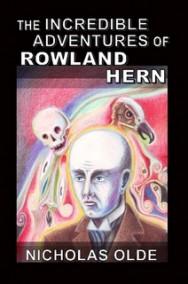
#10: The Incredible Adventures of Rowland Hern [ss] (1928) by Nicholas Olde (Part 2 of 2)
Credit: Facsimile Dust Jackets

 The Invisible Event