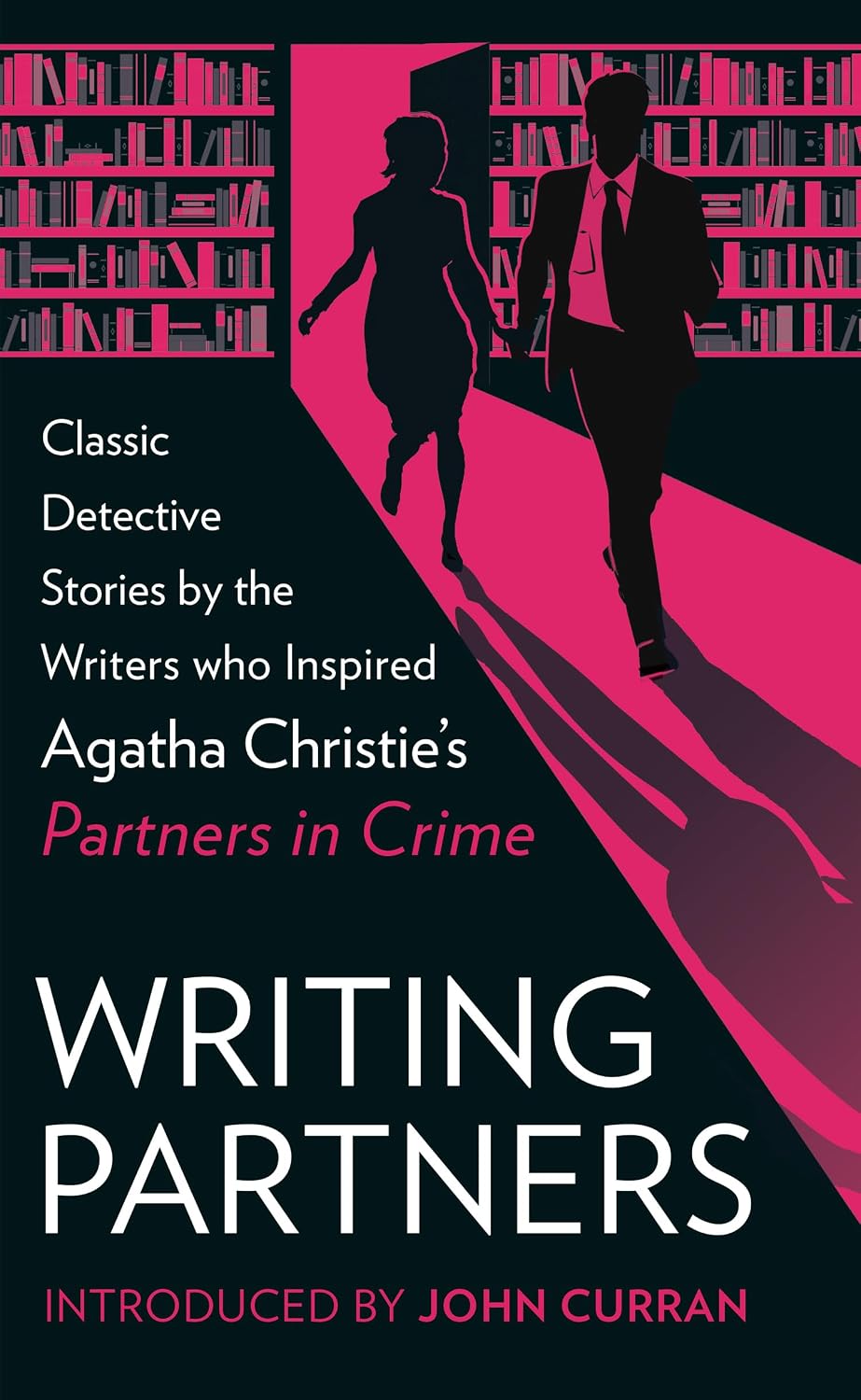
Soon after I started blogging I thought it might be a fun activity to try and figure out which authors Agatha Christie had parodied in her Tommy and Tuppence collection Partners in Crime [ss] (1929) and look at stories by them to see how they compared to Christie’s take. Well, 11 years later, John Curran has beaten me to it — look, I’ve had a lot on — and so we have Writing Partners [ss] (2026) doing more or less exactly that.
The fourteen stories herein, then, are the best reasonable guess at what Christie may have been pastiching as she got to grips with the trappings of the nascent detective fiction genre. As Curran points out in his introduction, some of the stories post-date Partners in Crime, but the idea is to show “a good indication of [the authors’] overall work”. Curran also takes time in a little afterword for each tale to compare it to the equivalent entry in Partners in Crime, so I’m not going to do that — we’ll just look at the stories in isolation from what may have inspired them.

Opener ‘The Strange Case of Mr Challoner’ (1918) by Herbert Jenkins finds our eponymous country gentleman shot dead in his locked library after an argument with his hot-headed nephew. Sleuth Malcolm Sage is called in and seems to rub along with the professional police okay…
He had never been known to speak disparagingly, or patronisingly, of Scotland Yard. On the other hand, he lost no opportunity of emphasising the fact that it was the headquarters of the most efficient police force in the world. He did not always agree with its methods, which in many ways he regarded as out-of-date.
…though is not above the odd wry dig:.
“I wonder what the local inspector will think.”
“He won’t,” remarked Malcolm Sage; “that is why he assumed it was suicide.”
What’s here is hardly going to blow the mind of any fan of detective fiction, but Jenkins deserves credit for the clever principles he lays — the position on a bunch of keys, the position of a single key — as if the notion playing fair is tickling his consciousness. You can feel the genre grasping the idea of clever detection, without yet knowing how to bring the reader in on it, highlighted none better than Sage demonstrating the method with a “rough sketch” which we are not shown.
Add in some nice phrasing (“He referred to his pocket rather than to your feelings, I take it?”) and you really do get a sense of the Golden Age marshalling its troops to improve on such promising beginnings. If it was indeed Jenkins who caught Christie’s eye, one can understand her reasons.
I had previously read ‘The Mandarin’s Pearl’ (1909) by R. Austin Freeman in John Thorndyke’s Cases (1909) and apparently didn’t have much to say about it. A “traveller’s tale” revolving around an apparently illicitly-acquired valuable pearl and the Sinister Chinese who dogs its possessors, this is emblematic of its time and doesn’t show the genre or the wonderful Freeman at their best.
Still, some nice turns of phrase are showcased — Fred Calverley is summed up as “the stuff out of which prophets and devotees, martyrs, reformers, and third-rate poets are made” — and the workings are ingenious for the time. It’s to be wondered why Thorndyke said nothing if he was able to divine the scheme so clearly from Calverley’s description, and we again get a detective making sketches which the reader is not shown, but such are the trappings of the era. The brief of this volume is that the story mirror the T&T story it inspired, and on those grounds it’s perfectly adequate, but Freeman has written some masterpieces and should be examined much further than this is you don’t know his work.
I have encountered Valentine Williams only twice before now, so ‘The Mystery of the Missing Finger’ (1920) was a chance to enjoy his atmosphere as a crime-infested quarter of Paris disgorges a recent suicide who has had his middle finger amputated — the third such corpse in ten days.
Williams displays a light touch with era trappings, a passing mention of “men at the front” lending itself to later considerations as Secret Service man Desmond Okewood does all his investigating off-page. This is a quick, Pulp-y confection that doesn’t hang around, displays some solid reasoning in Okewood’s methods, speaks movingly of the First World War, and resolves itself on an enjoyable note. Forgettable, but fun while it lasts.
And in this one we are finally shown an image of some evidence, though lord knows why…
Two chapters from the novel Annihilation (1924) by Isobel Ostrander follow under the title ‘Midnight Marauders’ (1924). Because we’re a bit of a way into the novel, there’s an abundance of names dropped and lots of previous happenings referred to early on, and — despite an attempt to summarise the plot prior to where we join — it proved rather discombobulating to this reader and he never really got his footing in the undertaking.
Mainly this seems to be determinedly Oirish types doing a lot of talking and telling each other things that they both already know. Twenty years earlier this might have passed as something, but for 1924 this is hard going and I didn’t care for it.
A chance to highlight one of the forgotten lights of detective fiction’s past now with ‘The Disappearance of Lady Frances Carfax’ (1911) by Arthur Conan Doyle featuring the obscure character — Shamrock Bones, was it? I’m working through the Holmes catalogue one-by-one, but since I won’t get to this for a while I thought I’d reread it for this volume. And I didn’t remember a single thing about it, so that was…something.
With the eponymous middle-aged spinster absent travelling and suddenly out of touch, Holmes has cause to fear the worst:
“One of the most dangerous classes in the world,” said he, “is the drifting and friendless woman. She is the most harmless and often the most useful of mortals, but she is the inevitable inciter of crime in others… She is lost, as often as not, in a maze of obscure pensions and boardinghouses. She is a stray chicken in a world of foxes. When she is gobbled up she is hardly missed.”
With another, “savage” man looking for her, what chances of a happy end to the story? Especially as our sleuth and narrator are growing long in the tooth (Watson complains early of having “been feeling rheumatic and old” for a “few days”). There’s a particularly nightmarish image in this one, but it’s fairly standard as Holmes goes and an indicator that there wasn’t perhaps much of a timeline left to him. Perfectly fine, but in no-one’s top ten Holmes stories (cue claims to the contrary — no accounting for taste, is there?).
My first encounter with blind sleuth Thornley Colton comes via ‘The Flying Death’ (1913) by Clinton H. Stagg, and our sleuth here acquits himself as admirably as have Max Carrados and Duncan Maclain elsewhere. We’re in the early days of this ilk of detective, so while Colton doesn’t feel quite as real as those two gentlemen, there’s still much good writing in this story of two people killed by a gun which shot them with no hand — and, no, no thread — on the trigger.
When Colton faced them again there was a curious expression on his face; the expression of a man who has seen a thoughtless boy destroy a priceless work of art by his clumsiness.
There’s also a neat line drawn between the amateur and professional police, the latter necessarily concerned with evidence over vibes:
The case, to him, had ceased to be one of human emotions, of sorrow and tragedy; it was a matter of proof, of conviction. Such is the policeman’s philosophy of life — and death.
What unravels here is pure hokum, but incredibly difficult not to enjoy — indeed, the genre needed to go through this sort of juvenilia in order to develop as brilliantly as it did, and enthusiastic puppies deserve as much love as well-trained dogs. Bravo for this nonsense, and much more of it, please!
‘The Mask of Midas’ (1936) is a Father Brown story by G.K. Chesterton not included in the usual collections, and written in the year of the author’s death — hinting, Curran posits, at a planned sixth tranche of stories. This is remarkably unvoluble for Chesterton, but does it make any sense? There actually was an escaped convict, right? And what was the thinking behind the personation on both sides? And, frankly, what???
I think I made a mistake jumping into the novels of Edgar Wallace, because his short stories seem to be where the fun is. ‘The Jewel’ (1927) concerns two confidence men who are going to fleece a wealthy man who is travelling to Paris to pick up a valuable gewgaw for his lady love and…to be honest, that’s as complicated as it gets.
You’d never accuse Wallace of subtlety and, for all its nice details — the mark sleeping with the case they’re trying to steal tied to his leg, for one — there’s a moderate amount of hand-waving in this quick little story. But then the punchline hits and it’s quite a good one, lovely to discover that you’ve been in a very different story all along.
‘The Mysterious Tragedy in Bishop’s Road’ (1924) by Baroness Orczy was originally included in Unravelled Knots [ss] (1925), a collection I did not complete when I read it — so this was a new story to me. Alas, I think Orczy did her best work in the first two volumes of this series, as this is far too prolix on the way to an obvious solution and I don’t really see what the point of it is, if I’m honest.
Was Orczy’s best detective work The Case of Miss Elliot [ss] (1905) and The Old Man in the Corner [ss] (1908)? I found Lady Molly of Scotland Yard [ss] (1910) tedious, and haven’t sought out anything else by her as a result. But it feels to me like she tailed off badly after those first two Old Man compendia.
Having previously struggled to maintain interest through The House of the Arrow (1924) by A.E.W. Mason, I was a little disconsolate to learn that ‘The Affair at the Semiramis Hotel’ (1917) was a solid 20 pages longer than anything else in this collection. And, yes, that is too long for how simple this story of a theft and its solution turns out to be.
I didn’t, however, bemoan any of the extra length, and if you’d told me this was half its actual number of pages I’d’ve believed you. Somethiong about Mason’s writing — it reads like a translation, and a second-rate one at that — is undeniably charming, and really speaks to me (the same was true of his story ‘The Ginger King’ (1940), the best thing in Bodies from the Library 5 (2022)). This may not evince proper detection — the main clue comes first from a dream and then essentially a word-association test — decent clewing, or compact telling, but somehow it really, really works.
And if you wanted to read this volume out of order, I reckon following this with the Herbert Jenkins story which opened things would give an excellent sense of the genre gathering its skirts and preparing to make the leap into something quite wonderful.
I have not yet really gotten in the short fiction of Freeman Wills Crofts — the Crippen and Landru collection aside — and ‘The Affair at Saltover Priory’ (1952) awaits me in The Mystery of the Sleeping Car Express [ss] (1956). But that’s a little while off, so why not take the opportunity of a little preview now, eh?
On holiday in Devon, Inspector Joseph French becomes aware of the death of local magnate Sir Charles Goodliffe at the eponymous country pile and immediately leaps into actio–
French frankly was not interested… [H]e explained that he had to deal with that sort of thing for forty-nine weeks in the year and was now on holiday…
I love French already, but I especially love the attitude he takes here — though he does eventually end up involved, of course, giving local man Sergeant Headley a lesson in “proper routine” as murder is discovered and plans are put in place to capture the killer. It’s far from complex, naturally, though shares that in common with every other story in here, and coming from the consummate professional and from much later in the Goldean Age (arguably after the Golden Age…) it stands in interesting contrast with, say, the Jenkins story it shares much DNA with.
One quibble: if a man is already agitated, does his being made to imbibe “coffee and tobacco” really calm him down? Throw in a bit of cocaine, Joseph, and some MDMA while you’re at it.
I had previously read ‘Double Bluff’ (192-) by Anthony Berkeley in The Avenging Chance &c. [ss] (2024), but despite posting about that collection last week it was actually several months prior to this that I read it, so a revisit seemed in order.
The story sees a twenty-something poet arrested for the murder of the fifty-something married woman who may have been acting as his muse or who may have been something more…more. She is shot in full view of several people on the edge of a small Dorset town when the accused man claims he was waiting for her at their usual spot for a picnic. Cue amateur detective Roger Sheringham.
And, upon rereading it, let me quote myself from a few month ago: “[T]here’s not really enough here to misdirect in true Berkeley fashion. A little flawed, one feels, as if it was only on the second draft stage before being abandoned, which might be why Berkeley never tried to publish it.” Perceptive man, the guy who said that.
A fresh mystery presents itself in the afterword: Curran claiming that Berkeley’s novel Death in the House (1939) features Sheringham. I’ve read Death in the House and, uhm…does it?
I keep saying I’ll read an actual collection by H.C. Bailey rather than isolated stories in anthologies, and ‘The Blue Paint’ (1940) is another example of me doing the latter rather than the former.
The setup here — a mass poisoning of the staff of a girls’ school — seemed familiar, but I can find nothing that suggests I’ve read this before. Add in the murder of a man in the same town and that a possible maker of “snide” coins is to be found somewhere and Reggie Fortune has a lot to deal with in these 20-some pages.
Like the best of the Bailey I’ve encountered, this is light and fast and, for all Reggie’s at-times-frustratin’ speech patterns, a fun time, uncovering unlikely links and then tying it all up with consummate ease in an effortless final flourish. I really do enjoy Bailey when he’s on form, and I really, really, really will put more effort into tracking down a full collection in the next, er, year or so. I promise.
Having turned her gimlet eye on so many of the foibles of her peers, Dame Agatha was then game enough to look into her own trappings, and hence ‘The Adventure of the Dartmoor Bungalow’ (1924) by Agatha Christie is what finishes things off here. I’ve not actually read the original serial version of The Big Four (1927) that this was taken from, so it sort of makes it a new Christie for me, always an exciting prospect.
The death of a man in his bungalow when no-one was seen to approach the dwelling confronts us here, with Poirot on the trail of the Big Four and our victim someone who might have been able to shed some light. The crime has Captain Hastings imagining a sort of Victorian death trap (“…something which descended automatically and cut the old man’s throat and was afterwards drawn up again…”) but Poirot of course finds overlooked evidence — and does some dodgy reasoning about boots — to expain it away.
Christie is a loved as she is because she was so very good, and this is a playful and perfectly acceptable example of her art early in her illustrious career. The only really surprising thing here is the afterword, with Curran praising G.K. Chesterton’s ‘The Invisible Man’ (1911) for the second time in this collection — once could be forgiven, John, but twice in the same book borders on bad taste…
A Top 5, then…
- ‘The Strange Case of Mr Challoner’ (1918) by Herbert Jenkins
- ‘The Blue Paint’ (1940) by H.C. Bailey
- ‘The Flying Death’ (1913) by Clinton H. Stagg
- ‘The Jewel’ (1927) by Edgar Wallace
- ‘The Affair at the Semiramis Hotel’ (1917) by A.E.W. Mason
This is a most interesting collection which picks well from the reams of pre- and early-Golden Age options to demonstrate Christie’s fecundity of imagination as she got to grips with becoming the most important genre writer of her generation. Most of the names here will of course be familiar to many of you already deep in the Golden Age, but this excellent selection includes some obscurities which will pique the curiosity of even the most well-read fan.
I will absolutely be trying to run down more work by Herbert Jenkins and Clinton H. Stagg based on their stories here, and I’m honestly going to finally actually do something about reading a complete collection of H. C Bailey’s Reggie Fortune stories (“We’ll believe it when we see it, Jim,” they mutter, not without justification). Lovely to think that A.E.W. Mason’s writing might be growing on me, too; I still have The House of the Arrow on my shelves somewhere, so maybe I’ll dig that out and give it a second try. All told, this is a lively and entertaining collection that pokes in some unjustly-forgotten corners of the genre and finds much to amuse and entertain therein. If someone can find a way to justify a second volume, I am here for it.
Writing Partners was published on 19th November; sincere thanks to David Brawn at Harper Collins for sending me an early copy.


Thanks for this review, as I had been wondering about this anthology. I have read the complete stories of Stagg, and let’s just say if our polar opposite viewpoints on books still stands, then you should get on with it really well lol
LikeLike