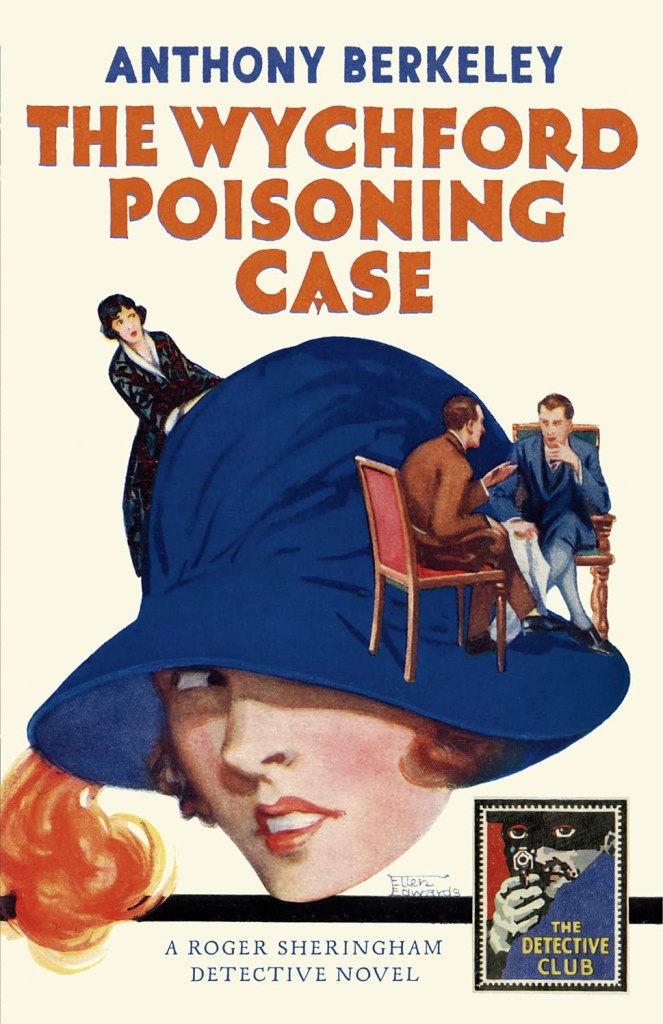


Having first turned up in perhaps the best debut of the Golden Age, Roger Sheringham’s second case pursued a similar line to inevitably lesser effect. Taking up the cause of one Mrs. Bentley, who is accused of poisoning her finicky, hypochondriac husband with arsenic, our gentleman sleuth is convinced that the accused lady is either “the most imbecile criminal who ever existed and simply went out of her way to manufacture the most damning evidence against herself…or else…she didn’t murder her husband at all.” But fine theorising is one thing, and actually proving the matter is quite another, especially when everyone else in the county seems to have made up their mind about The Wychford Poisoning Case (1926).
That Sheringham’s investigation — and so Berkley’s novel — doesn’t follow the traditional structure of such books is slightly unusual, but then one must remember that this sort of thing simply wasn’t done back then, so it’s hardly surprising if the japery which infects most of this hoons closer to the forthcoming Mr. Priestley’s Problem (1927) than any of the masterpieces this most efficient of farceurs was bout to unleash on an unsuspecting genre. And even at this stage Berkeley is clearly evincing more interest in the psychology of the crime and criminal — “a pretty little whetstone to sharpen one’s wits on…” — than in the physical clues which would betoken the work of so many of the writers chasing him.
Descending on Wychford with Alec Grierson once again in tow, Sheringham goes about the business of investigating the people involved in a manner that is both superbly humorous…
All these things she told him, and many, many more; but now and then, by accident, a fact did manage to leak out as well.
…and at times infuriatingly twee, as Berkeley wrestles with this newfangled genre and tries to work out how much it is a comedy of social manners (19 year-old Sheila Purefoy comes in for much disdain, in the manner of many a person despairing of the Younger Generation), how much a soapbox (“…in defiance of the dictates of a maternal government, pussyfootism and all the other futilities which order our lives for us in these days.”), and how much a study of character (the hint of Roger’s faintly tragic love life had escaped my memory). As it happens, the “sordid facts” which Sheringham so disdains aren’t really sufficient to support the narrative, which is solidly 20% too long, and as such the book can’t quite settle on a groove.
It doesn’t help that the problem is left feeling like so much intellectual pinball by Sheringham’s at times excessively overplayed personality — the man’s a caffeinated spaniel, at best — and the simple matter of the people at the heart of the concern (a woman’s life may be forfeit, lest we forget) being kept at arm’s length. Oodles of time is spent with Roger, Alec, and Sheila indulging in raillery and speculation, with, a few interviews aside, most of the investigation relayed through conversation. There’s no second murder, no spicing up of a trundling narrative (an early chapter is entitled ‘Mostly Irrelevant’ and…yup), it just sort of meanders along and everything turns out rosy.
It is, though, fun. This is the third time I’ve read this book, and Berkeley is always quick with an insinuation (“The conversation became personal. Very personal.”), a bizarre declaration (c.f. Roger objecting to infidelity on the grounds that it is “economically quite unsound”) or wry aside:
[Roger and Alec] were driven, for a perfectly exorbitant consideration, to the Man of Kent, a hotel which the driver of the elderly taxi was able to recommend with confidence as the best in the town; certainly it was the farthest from the station.
Occasionally you feel Berkeley courting controversy when he should be winnowing another masterpiece (“I’m always very sorry for Crippen…”) and the genre that we love feels very young as you read this, but the core precepts are there and the ingenuity and invention that the 1930s would refine to an artform are clearly in evidence. No, it’s not as essential as Berkeley’s preceding or succeeding books, but it’s wonderful to watch someone improve in real time, especially as we know he went on to do some of the very best work in the genre as a result. Learning in public can be unflattering, but with this lesson out of the way, wow, did Berkeley ever soar.
~
This is another book I’m fortunate enough to own in the Detective Club hardcover reprint edition from about 10 years ago. God, these are wonderful objects. Surely it’s time to try to relaunch that line, and be a little more selective with what it puts out, no? I’d buy the right titles in this format by the truckload.

