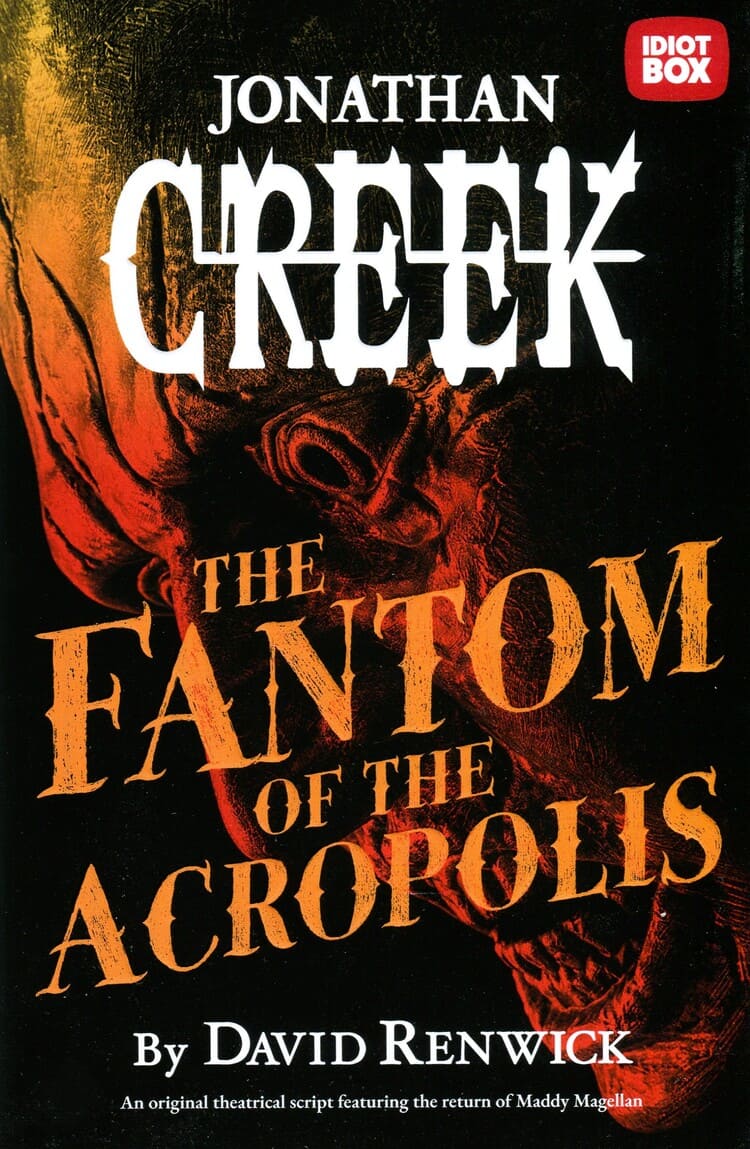
I’ll not deny that I’ve been less than resoundingly positive about latter-era Jonathan Creek (1997-2016). And yet the show undeniably holds a dear place in my heart, not just because it was so damn good at its peak, but also because, in being so, it held huge sway in my interest in impossible crimes. So when playscript The Fantom of the Acropolis (2026) was announced on Kickstarter last year, you’re darn tootin’ that I was excited to get my hands on it.
In the decade since we last had any Creek to sink our teeth into — a decade in which I have reimbibed a lot of 90s popular culture for various reasons — I have to say that I’ve very much come to appreciate even the less successful elements of the show. If anything, the main difficulty Creek faced for me was just how damn good it was out the gate: in an era when other shows were resolving locked room murders by having the murderer hide in the room and mingle with the people as they broke in, or locking the door from the outside and throwing the key on the floor as they broke in to give the impression it was in the room the whole time, David Renwick came up with some brilliantly new ideas, took the time to clue them properly, and then demonstrated their workings in a way that was technical, precise, rigorous, and entertaining.
Honestly, I think Creek sets it own bar so high, and had such a revelatory impression on me in doing so, that my own hopes and expectations for the impossible crime have always been up in the rafters. And this means that when my own reading of the subgenre hasn’t quite achieved those lofty expectations — the simplicity of ‘Jack in the Box’ (1997), the ingenuity of ‘Angel Hair’ (2003), the magnificent design of ‘The Seer of the Sands’ (2004) — I’ve been inclined to be disappointed because, early doors, the impossible crime for me was possibly the best ever demonstration of it on screen yet achieved in human history.
And obviously I felt it even more keenly when Creek itself didn’t reach those heights.
I think we would have all loved another four series of the show, but I commend Renwick’s desire to firstly retain control over it and secondly not skimp on the ingenuity of his tricks by resorting to tired tropes just to crank out another episode. You may not remember, but the fourth season of the show was released in two tranches with nearly a year between them, because the scripts for the final three episodes weren’t ready in time. I applaud that: Renwick had a vision of what he was trying to achieve, and was not willing to compromise it just to meet a deadline.

The later specials and the fifth series unarguably dropped in quality, but Renwick clearly had an intention to be as ingenious as he could. At the time, I did not enjoy the inverted nature of ‘The Letters of Septimus Noone’ (2014) — in which we saw how the impossible murder was done and understood why the characters not privy to its workings would think it impossible — but I understand now the desire to show that the show could do something different. Equally, the absurd coincidence of ‘The Sinner and the Sandman’ (2014) and the elaborate chain of events in ‘The Curse of the Bronze Lamp’ (2014) also speak now, with hindsight, of a creator refusing to compromise on the difficulty of the tasks he had set himself down the years. I can believe that, at times, the David Renwick wished for a killer hiding in a locked room and mingling with the witnesses who had broken the door in, just because it would make the job easier.
Even ‘Daemon’s Roost’ (2016) took some big swings, with the impossible levitating death showing a grand guignol design and commitment to the undeniable eeriness that ran through all the impossibilities like a stick of rock which is emblematic of someone once again straining at the limit of their creative power in order to not simply repeat what they have done elsewhere and, perhaps more importantly, what others have been recycling for decades. Yes, the show didn’t always deliver what those of us with unrealistically high expectations would have wanted, but Renwick could never be accused of taking shortcuts or of short-changing his audience where the imbrications of impossibility and the real world were folded by necessity into the design of the show overall (the vanishing corpse in ‘The Clue of the Savant’s Thumb’ (2013) is ridiculous, but it relies on an ingenious principle built on the purest essence of misdirection).
And it’s important to acknowledge this, because The Fantom of the Acropolis is the most derivative, shit-awful, tired, uninspired, unimaginative, predictable, nonsensical, and downright bloody awful waste of time to ever be put out under the Creek label.
The plot is simple: Adam Klaus is putting on a magic show at the Acropolis Theatre, and invites hot ticket Czech illusionist Jana Kablitsky over to perform as part of the show. Jana fears she is being stalked by someone, and before the show can go ahead she is attacked in her locked dressing room and non-fatally shot. The assailant vanishes from the locked room, the only exit being an open window which gives onto an alleyway lain with unmarked snow. Jonathan Creek is still working for Klaus — there’s no mention of his having become a hedge fund manager or whatever he was in the later series, and not a word about his marriage to Polly, which might tie into a theme of things we’ll explore later — and Maddy Magellan crops up to investigate the shooting, plus the murder of Jana’s twin sister.
In the play’s favour, Renwick still has an eye for a good line or two…
KLAUS:
Grand Guignol polls consistently strong, in the high sixties. Plus it attracts a young demographic.
CREEK:
So did the Hitler Youth, it doesn’t mean I have to like it.
…and things progress at a good lick. Renwick is aware of the limitations of the stage setting, and restricts the environs of the action in a way that doesn’t feel unduly forced. Despite a list of 37 characters at the front of the script, there isn’t an over-abundance of people, either, with most of the action devolving into natural-seeming conversations involving at most four people in a way that would be easy to stage and easy for the audience to follow (side note: if I’d paid £250 to name a character, I’d be a little put out…).
The problems, though, far outweigh these considerations.
For a start, there is a lot of repetition of jokes and motifs from the show which, given that these characters seem to exist in a universe where those actions were canon, is very odd. We begin with Maddy going through the same wake-up routine of recordings of her hitting saucepans, etc. from ‘Danse Macabre’ (1998) — not a big deal, who are we to say this isn’t how she wakes up every morning? But when we then continue through more explicit borrowing such as the streaker from ‘The Coonskin Cap’ (2003) interrupting the show and then being hired by Klaus to be a deliberate part of proceedings (the character even has the same name as in the series, and goes through the same routine of being a demanding prima donna), it feels like a sort of…’highlights’ is definitely wrong word, but there’s an inescapable sense of deja vu.
See, because there’s also a subplot lifted almost exactly from ‘Gorgon’s Wood’ (2004) in which a woman is pretending to be in a trance having been “hypnotised” by Klaus through her TV and her husband pushing her around in a wheelchair and demanding a huge payout. Beat for beat, this is almost exactly the same, until her fakery is revealed in a marginally different way. I mean, sure, if you’re going to copy then copy from the best, but at least make it clear whether this exists independent of the episodes which preceded it — which it can’t, given the characters and their relationships — or offer some reason why these familiar situations are being treated as if they’re new (maybe everyone got a head injury when a stage collapsed in 2019…).
Equally, then, the impossibility — note the stage direction that “[the action] needs to remain indistinct” — is Renwick borrowing heavily from the oldest trick in the book, and it’s not even well-disguised. For a show that was always very bold in what it showed — Lenny Spearfish genuinely believe he’d been shot twice in the chest and the bullets had bounced off him, a killer shooting their victim and then running away in the snow only to leave no footprints — this sudden coyness is alarming, and speaks of a creator who, after all those years straining to find something new, has finally snapped and just grabbed at the first trick they can think of. And, for all its flaws, Jonathan Creek has never done that before.
Equally, the presentation of the impossibilities has been meticulous until now, but here what we get is so hand-wavey and vague that it honestly doesn’t even seem like the same universe. To discuss this, some brief spoilers:
SPOILERS BEGIN
We’re told that Jana has been shot, but the bullet merely grazed her head and left a furrow in her skull. Then, later, it’s revealed that she has actually had this injury for years and she simply “open[ed] [the wound] up again” to give the impression of having been shot. But there’s a significant difference between a red-hot bullet coursing along your skull and you hacking at healed skin to make it bleed a bit, and any medical professional would have been able to tell in an instant that the crime did not happen as reported. Which would have been passed onto the police. And so…caused problems.
SPOILERS END
God, I could sit and pick this apart from hours yet, but to be honest even getting this off my chest has made me feel a little sad. The show wasn’t perfect, as we know, but it had more vim and life and invention and spirit and identity than this. I’ll not say this feels like an A.I. rendering of the show, because that accusation is already so ubiquitous as to have been rendered meaningless, but if you faxed someone the essential idea of Jonathan Creek and then asked them to come up with twenty new episodes, this would be the nineteenth written. Renwick has done some incredible work in the medium of television, and has a C.V. that many writers would kill for, comedy or otherwise; having now apparently retired from television, it’s to be hoped that he doesn’t jeopardise his reputation by making writing for the stage a regular thing on this evidence.
In the final analysis, I sincerely hope this play never gets produced; the retrospective damage it would do to the reputation of the show would be sad to see. I won’t go on, but suffice to say — bearing in mind that today is Hallowe’en — this feels very much more like a Trick than the Treat I had hoped for when it was announced.


I always liked Creek partly because it had a darker, funnier tone than a lot of “amateur sleuth” TV dramas, which can be very bland. Sometimes, though, the tone was… weird. Like an episode with Bill Bailey where there’s a “humorous” subplot about women being trafficked, using their work as magician’s assistants to get them in a box that’s then sealed. Or the disfigured sex worker in “Gorgon’s Wood”. Some of it felt oddly misogynistic in how glancingly it treated gender violence.
That’s no doubt a product of its time, however. When it was at its peak it was, as you say, amazing. Shame about this play. I kind of suspected that it would be dull. I feel as though it would have been either a novel or something produced for the screen if it was good. Releasing it as a printed script makes it seem as though a tired Renwick just threw his hands up.
LikeLike