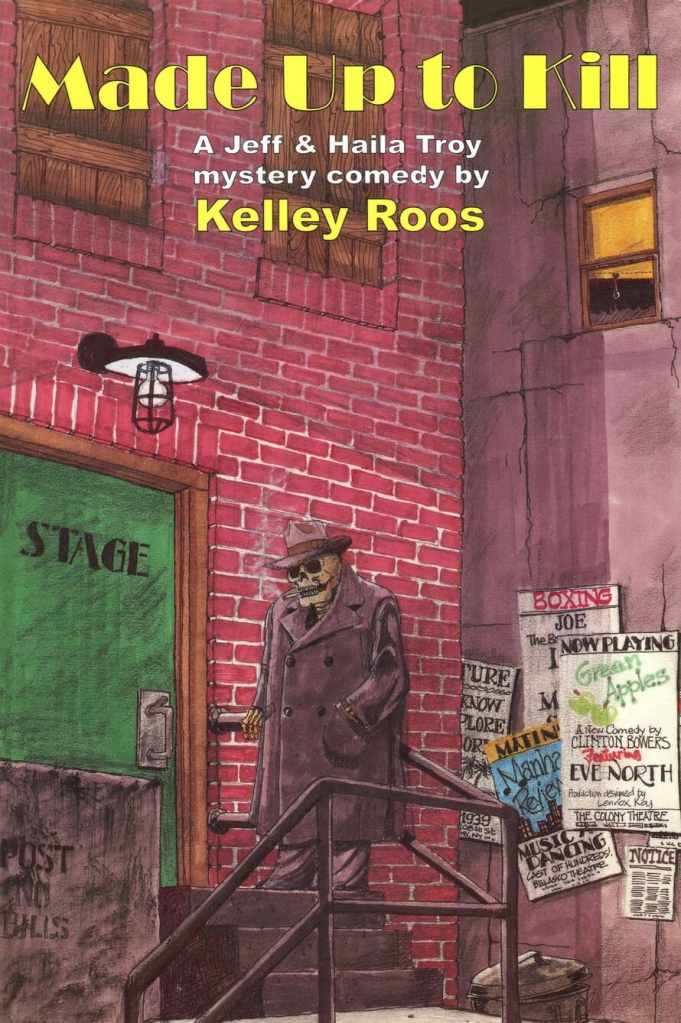


The first novel by husband-and-wife team Kelley Roos, Made Up to Kill (1940) was one of about 30 or 40 books I purchased from the now sadly-defunct Rue Morgue Press, who did such excellent work keeping Golden Age novels in print long before it was cool. And this debut sets the tone for (what I’ve read of) the series that would result very well: Jeff Troy and Haila Rogers — not yet married, that would come soon — stumble into a murder mystery by proximity and end up investigating the various Types who seem to exist within its boundaries. Narrator Haila is good for an eerie turn of phrase now and then, and happy-go-lucky Jeff will tend to bound around like a spaniel until almost accidentallying his way into the path of the murderer.
We have here much that makes the latter books good, just a little diluted due to callowness with the form. Hence it’s a third of the way into the thing that an actress in Green Apples, the off-Broadway play Haila is appearing in, is stabbed in the back during a performance (not on the stage, but discovered just off it) and the police descend and prove remarkably sanguine about advertising man Jeff acting as amateur sleuth alongside their investigation. Most of the time is spent pinballing from one interview to the next, and if it’s an enjoyable time it’s also somewhat light for how well-established the genre had become by this point.
Still, solid work is done, as always, in setting up the secondary characters who will form the array of suspects, all of them in this case associated with the play. From the rivalries that exist within the cast and regarding understudy Alice McDonald, to nearly-man male lead Philip Ashley who seems keen that no-one take any of his aspirin, to producer Clinton Bowers, enamoured of ageing actress Eve North, and snooty English playwright Greeley Morris.
“Is this your first visit to America?”
“Are there people who come here twice?”
First attempted murder and then the more successful kind will darken the Colony Theatre, and Roos proves adept here, as they would go on to be elsewhere, at stirring in an edge of darkness and unease to the frivolity that seems to predominate. See a stage had eyeing poisoning survivor Carol Blanton “and then [looking] quickly away again, as if he had been caught staring at a cripple”, or Haila exhaustedly leaving the scene of the murder after endless rounds of questioning feeling that “my whole life had been spent on the stage of the Colony Theatre and that those words were the only ones I had ever spoken”.
It settles into an easy pattern once the murder occurs, and various rounds of interviews give more life to the likes of Eve North’s maid Amelia, or the lugubrious detective Lugotti. The second half is less well-structured, it must be said, with what feels like a series of paired chapters — the first to set up a startling revelation, the second to go ‘Oh, no, it’s all fine’ — rinsed and repeated until we get to the showdown in the empty theatre with a killer who’s slightly less well-prepared-for than these talented authors would achieve elsewhere.
As the opening salvo of a career which would go on to span 40 years, this is perfectly acceptable — no lost classic, but a warm and appealing plot for those who find Craig Rice a bit too high-energy. It’s full of enjoyably witty moments and, crucially, is a book that would be improved upon by its authors almost immediately. It’s my understanding that the works of Kelley Roos are coming back into print, and that’s to be celebrated even if it’s not immediately clear how we in the UK are going to access them. With any luck you can find this easily and cheaply, and will be able to go on and enjoy much of their output in the years ahead.
~
Kelley Roos on The Invisible Event
Made Up to Kill (1940)
If the Shroud Fits (1941)
The Frightened Stiff (1942)
Sailor, Take Warning! (1944)
Ghost of a Chance (1947)

