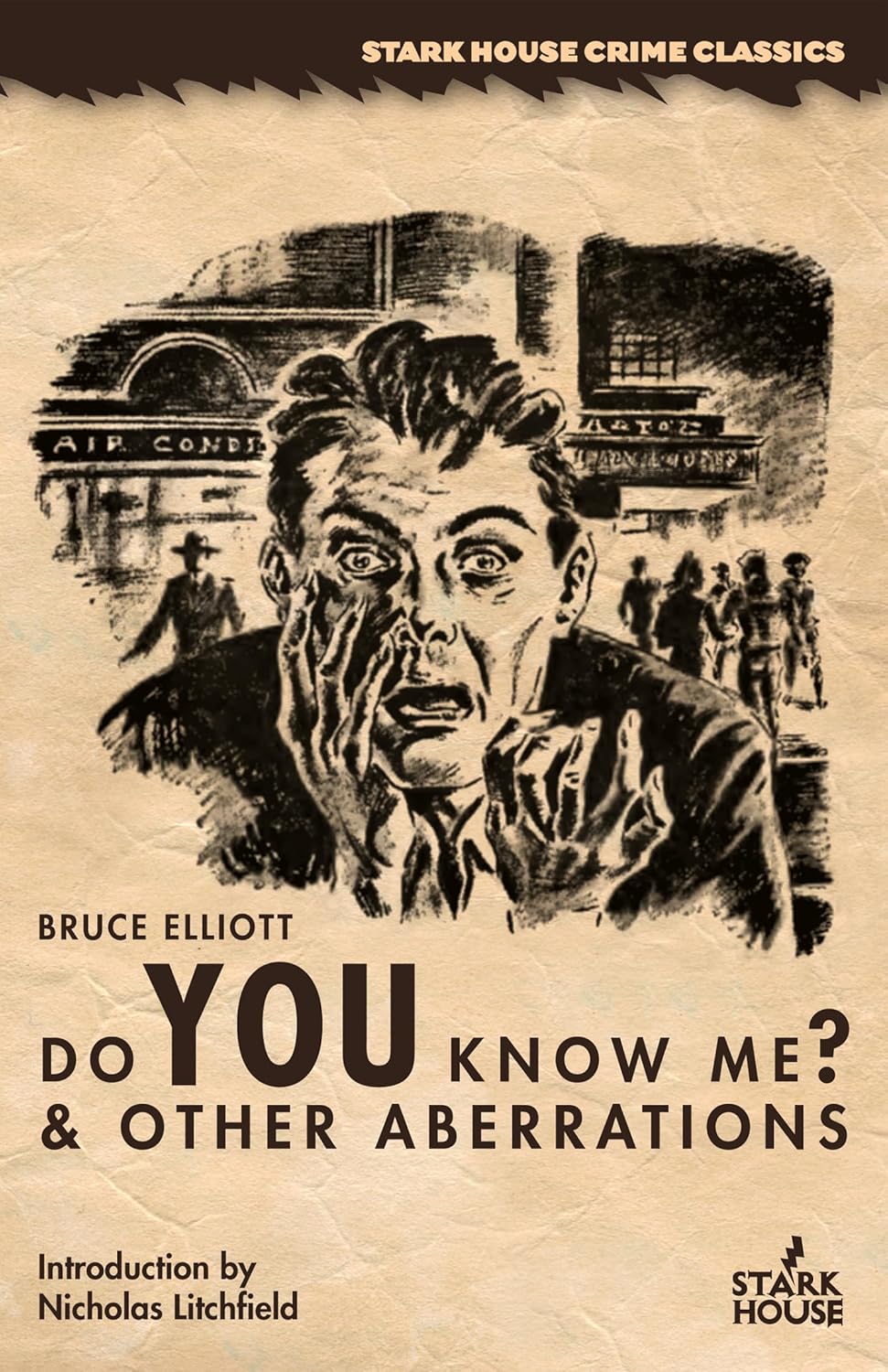
As a fan of the impossible crime novel You’ll Die Laughing (1945) by Bruce Elliott, I was delighted when I accidentally discovered that Stark House Press had put out a collection of Elliott’s short fiction, Do You Know Me? & Other Aberrations (2025). I was aware that You’ll Die Laughing is atypical of his output, but curiosity reigned nonetheless and here we are.
Nicholas Litchfield’s introduction paints a brief picture of Elliott that reminds me why I don’t generally like to know too much about my authors: their lives always seem to veer into the downbeat, and one wonders which is the cart and which is the horse when it comes to this informing their writing. So we’ll sweep past that slightly depressing opening and jump right into the madness…

Title story ‘Do You Know Me?’ (1953) concerns a possibly schizophrenic madman who sees everyone around him as mask-wearing blanks whose true face are hidden, and his seemingly endless quest to not only see someone else’s real face but to also find out his own identity.
He thought, God knows I’ve tried to get them to take off their masks. But somehow, when he cut the mask away, that which remained, the bloody pulp, was never what he expected to find.
It’s an unusual setup, and bizarrely builds through multiple perspectives to a single moment of violence that’s oddly blank itself in its irresolution. The characters brought in — a hopeful bride-to-be, an elderly Jewish woman, a man living behind various forms of deceit — are all interesting on their own, but it’s something of an embarras de richesses to have all these little insights in one story. Half the words and a third of the ambition would have made this hit harder.
A title like ‘Vengeance is Not Enough’ (1955) gives you an idea of what we’re expecting in this volume overall, and the story in itself is superb: opening in medias res with a man possibly being tortured and subjected to bizarre questions (“What day is it, Henry?”) before his fractured memories recall the tragedy that has brought him and us to this point.
That the whole thing seems so unlikely — he works in local politics, but why would someone try to assassinate him when “it was easier to kill a man at a committee meeting with a few well-chosen words”? While what happens here isn’t exactly clewing, there’s some good preparation of the ground, and it all pays off in a surprisingly logical way. The lazy thing would be to compare this to Cornell Woolrich, but Elliott gives it a mien all of its own.
‘The Darkened Room’ (1953) begins in the manner of many an anti-drug story from this era; with hopheads getting high in a crowded hotel room. Before long, and thankfully veering away from the sort of propaganda I feared this was going to be, we follow the career criminal Garrow into the same hotel where he strangles a man to death and then deliberately gets himself arrested attending the “tea party”.
From here, it’s a white-knuckle chase as a Woolrichian coincidence sees Garrow’s various crimes likely to be brought home to him, and the only option seems to be to run and create more chaos and harm along the way, with the odd moment of beauty thrown in for good measure.
So little time, Garrow thought almost despairingly. So little time.
The scenes here feel grubby and lived in — c.f. the arrested men and women giving false names to the police in a manner “as cut and dried as a well-rehearsed scene in a play” — and Garrow, while never close to sympathetic, is surprisingly easy company for all that there’s clearly nothing likeable about the man. The ending is one sentence too long, but this is pretty excellent stuff that one caveat aside.
When Tommy Winters wakes up, beaten, bloodied, and divested of his money and papers in a tin shack in “the worst hell hole he had ever seen in all the tiny islands that clot the Pacific like leprous sores”, he’s just in time to see the boat he was working on disappear into the distance. Thus opens ‘Carnage in Calossa’ (1953), a well-named tale for the complexity of the scheme Winters is now at the heart of, and an indication of how far a man will go when he has nothing left to lose.
I don’t normally go for this sort of slick-dame-tough-kingpin sort of story, so maybe it’s because I encounter them so infrequently that I enjoyed Elliott’s take on what should be a fairly hoary setup. Is this what people feel like when they read Dashiell Hammett? If Hammett could keep his stories as tight and focussed as Elliott does here, maybe I’d like Hammett more.
It’s not mere fondness for Elliott’s debut novel which keeps me reading this collection. Every so often, he’ll write a sentence so perfect that is goes straight to the core of me, like the opening two paragraphs of ‘Death Lives in Brooklyn’ (1953). Come to that, practically every sentence of ‘Death Lives in Brooklyn’ is perfect, such as the moment the broken down Farrell, having outlived his all-too-brief usefulness to a mob boss, finds himself escorted out to his death by two henchmen:
There was, Farrell realised, no blood lust in these men, no anger, no anything in particular. They happened to be men whose trade was murder and he was sure that they were good craftsmen or they would not have been so close to the top…
It’s an unusual accolade, but this is also only the second time — the first being The Godwulf Manuscript (1973) by Robert B. Parker — in which a strangulation has been described in a way that will live with me. Hot damn, this is genre fiction at its most electrifying.

Quite to my surprise — this is what happens when you don’t read the introduction fully — the second half of the book is devoted to Elliott’s SF stories. The first of these, ‘The Devil was Sick’ (1951), sees scientists or academics or something consulting The Machine in a bid to find some new research on a topic not yet covered by someone else, and stumbling into literature about gods and devils. It’s brief and entertaining enough, but it’s like a proto-Philip K. Dick story in that I don’t really know what it’s supposed to be about. There’s some religiosity in here, I guess, but it’s in such stark contrast to what came before that I was mainly just confused the whole way through.
Next up, ‘The Last Magician’ (1953), in which a futuristic society is treated to the sorts of magic tricks that would have been hoary in the 1950s and seems amazed. There’s a lovely commentary here on the nature of our seemingly endless need for distraction…
TV is a bottomless maw into which entertainment is shoveled only to vanish like one of [the magician’s] tricks.
…but it’s clear that Elliott has no idea what a Klein bottle is, which is a shame, because there’s germ of a good idea in here somewhere. This reads like Asimov, which is a compliment, except that Asimov definitely knew what a Klein bottle was and would have supplemented it with something more appropriate.
‘Wolves Don’t Cry’ (1954) reverses the werewolf myth by having a wolf turn into a man. It deals well with the themes of isolationism that crop up elsewhere in Elliott’s work, but glosses over a few of the more intriguing prospects that the possibilities here raise. Still, a good closing line means this will linger in the memory.
I don’t know what ‘”So Sweet as Magic…”‘ (1953) is about. It accounts for a quarter of the pages in this volume, and I lost interest waiting for it to settle on a key theme or idea. If there was a chance it was resolved rationally I might have stuck with it, but it’ll dissolve into hand-waving and half-measures and I don’t have the patience for that to be the end result of this many words and pages.
While as fantastical as the rest of this second half, ‘The Man Next Door’ (1954) is a superbly strong finish, with a distracted writer and his dissatisfied wife ignoring their son who may have just made a fabulous discovery. That the eponymous man has an interest in neither parent talking to the child adds to the tension, and the various strands resolving as they do is really rather pleasing. Brings to mind ‘The House Party’ (1954) by Stanley Ellin, which goes to show that 1954 was clearly a boon year for circular stories about burnt-out entertainers.
A top five? Well, it would be rude not to…
- ‘Death Lives in Brooklyn’ (1953)
- ‘The Man Next Door’ (1954)
- ‘Vengeance is Not Enough’ (1955)
- ‘The Darkened Room’ (1953)
- ‘Carnage in Calossa’ (1953)
It’s a shame that this Stark House Crime Classics book didn’t stick to Elliott’s crime writing, especially as there were more criminous stories that could have been included (the impossible crime tale ‘Death Paces the Widow’s Walk’ (1944) among them, which is entertaining if not spectacular). Still, the hardboiled writing on display is well-wrought, and if the second half is less interesting to me I can at least acknowledge a handful of good ideas within it.
Elliott writes well about fear and isolation, and is mostly content to push those ideas without milking them too hard for what meagre suspense may also be drawn from his slimly-parsed setups. Had I read this collection first, I can’t say I would have rushed out to read his novels, but having read You’ll Die Laughing first I’m pleased I’ve had a chance to see another string or three added to his bow. My preference would have been for this to contain solely crime tales, and it’s weird that a book labelled as a Crime Classic devotes so many of its pages to SF, but that’s clearly a decision Stark House were happy with even if it dilutes the overall impact and appeal of this slim volume.
Difficult to know who to recommend this to, but fans of Hammett, Woolrich, James M. Cain, Jim Thompson, and David Goodis will find much in the first five stories to admire. ‘Death Lives in Brooklyn’, in particular, is a hard-edged little masterpiece that deserves to be far better known.


I might read this just for “Death Lives in Brooklyn”. The SF stuff sounds like vintage RA Lafferty, a deeply idiosyncratic, Christian SF writer whose work is comparable to shaggy dog tales. I looked up Elliott after you mentioned the depressing intro and saw that he was killed by a taxi cab in his late fifties. Shame; no age.
LikeLike
If you can find ‘Death Lives in Brooklyn’ it’s worth tracking down — laying out for the whole book pure on its account might be a little excessive, however 🙂
And, yes, it seems Elliott led an increasingly drunken, unhappy, and compromised life towards the end. Hell of a thing, and more common with writers than I like to know.
LikeLiked by 1 person
That also seemed to be the case with Craig Rice. Still, lots of them ended not that way. x
LikeLike
True; I guess Agatha and FWC and others were fairly bland in their extra-curricular pursuits. Gives us some hope.
LikeLiked by 1 person