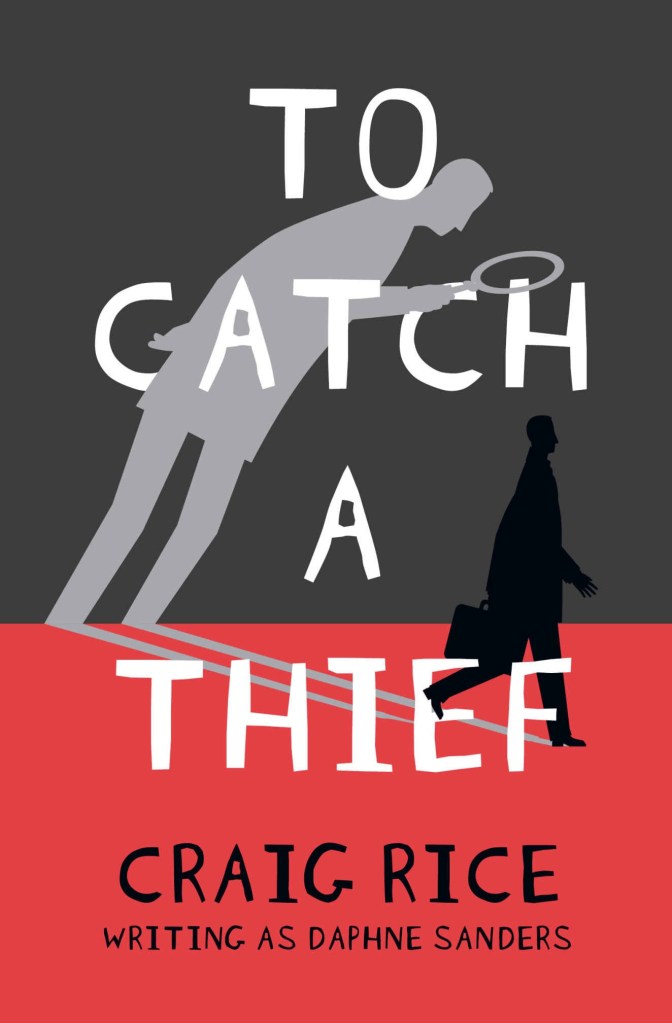


All I really knew about To Catch a Thief (1943), published by Craig Rice under the nom de plume Daphne Sanders, was that it represented something of a change from the work she’d done to that point in her career. And having read most of the work she’d done to that point in her career I can reaffirm that position. Not only is the focus of this rather more stern than we’ve seen elsewhere, it’s also less-tightly constructed and decidedly more in the Pulp-y vein than anything I’ve seen from this wonderfully talented writer, and in that regard it came as something as a disappointment. It scores some good points along the way, but overall the Rice non-completist can dodge this one.
Several years ago, seven financiers combined to manipulate the stock markets in such a way that they made a fortune and a bunch of other people were financially ruined — I’m not sweeping over this, Rice only really goes into that broad detail. Now, each of those financiers is suffering a loss of their own, as valuable jewels, paintings, heirlooms, and other niknaks are being stolen from them, each time having received a warning that such-and-such an item will be taken. These warnings are all written in the same hand, and all signed N…and so the financiers have roped in the help of private detective Donovan to get to the bottom of these thefts.
Parallel to this, we follow the action from N’s point of view, as he disguises himself, inveigles his way into the houses and lives of these crooked men, and absconds with the loot. And, well, that’s sort of the whole book: six longish chapters of N doing things, the financiers getting uptight, and Donovan being exhorted to do something about it. Rice’s books were never really that concerned with a message, generally revelling in well-plotted and ingenious schemes — we’ll give you a pass, Telefair (1942) — but this is simplicity itself, and reads like an exercise that Rice gave herself to write a book in a single weekend, without the need for a second draft.
And yet, we wouldn’t be here if Rice didn’t exert some fascination over me, with flashes of her exquisite phrasing…
Renzo Hymers said, “Yes,” and made it sound like a pebble falling on an icepack.
…and a couple of defiantly hilarious moments that do well to release the building tension (“It’s so ghastly hard to get good chauffeurs.”). A few thoughts stray towards considerations of the wealthy and the driven nature of their avaricious pursuit of money and more money, and if we’re not exactly encouraged to feel sorry for them there’s also a sense of wishing to be aware of the bars of the gilded cage in which they live (c.f. Poppy Hymers, first seen as “one of the richest girls in the world, and the most unhappy.”, or Wilfred Hume’s “one misfortune [being] the wealth and position to which he had been born. He had nothing to try for, nothing to achieve.”).
The book feels, given Rice’s ability to spin you in circles and have you pointing up and looking down at the same time, all too simplistic. The framing has not only been done elsewhere (Six Were to Die (1932) by James Ronald is, in my estimation, better; as is They Can’t Hang Me (1938) from the same source, now I think of it), the plot is so hilariously reliant on serendipity (the finding of the gun, the — heaven preserve us — marmalade) that if you told me this was Rice wedging her tongue firmly into her cheek to poke fun at the convenience of tough-guy Pulp stories I’d happily believe you.
I have to say, too, that the formatting of this Mysterious Press ebook is pretty shoddy. Consecutive paragraphs take place in entirely different places and with different characters and yet without a blank line between them to indicate a change of scene, and the plethora of errors throughout — there’s a nine-point list in chapter 3, and the points numbered 6 and 8 are just prose that supposed to come between the points in the list, not actually points on the list themselves…
6. Down at the very end of the page, added as though it were an afterthought, was one more question.
7. What happened to John Casalis?
8. He read the page through twice, then added one more question. After a moment’s thought he underlined it.
…make it feel like this has been rushed out as a fringe title only of vague interest to the most ardent of Rice completists, and losers like me don’t warrant someone looking through the book before being charged for it.
It’s interesting to see another side to Rice’s writing, but this is a very minor effort in the career of a woman who would do some of the best puzzle plotting and create some of the cleanest and clearest characters in the American school and so should be experienced at her best. As with the aforementioned Telefair, I like that she had the chance to stretch her wings a little, but even that stretching has been given more thought elsewhere. If you want to see a more successful experiment from this wonderful writer, my advice would be to read The Man Who Slept All Day (1942); that, at least, had more than a weekend spent on it.
~
See also
John @ Pretty Sinister: I was genuinely impressed with To Catch a Thief. It shows a thoroughly new side to Craig Rice’s writing and gives us an insight into her darker more serious worldview, a philosophy I think perhaps reflects her true nature rather than the frothy worldview we get in her comic crime novels. This is definitely a book worth reading and seeking out.
~
Craig Rice on The Invisible Event
Featuring Helene Brand, Jake Justus, and John J. Malone:
Eight Faces at Three, a.k.a. Death at Three (1939)
The Corpse Steps Out (1940)
The Wrong Murder (1940)
The Right Murder (1941)
Trial by Fury (1941)
The Big Midget Murders (1942)
Having Wonderful Crime (1943)
Featuring Melville Fairr [a.p.a. by Michael Venning]:
The Man Who Slept All Day (1942)
Featuring Bingo Riggs and Handsome Kusak:
The Sunday Pigeon Murders (1942)
Standalone:
Yesterday’s Murder, a.k.a. Telefair (1942)
To Catch a Thief (1943)
Home Sweet Homicide (1944)

