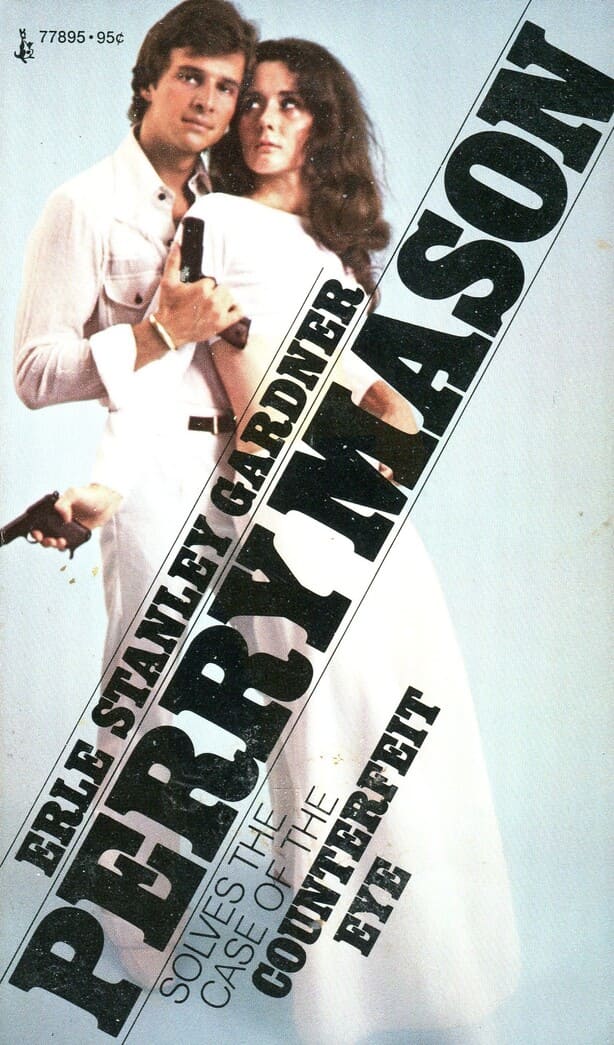
Firstly, no: I have no idea what the cover of this 1973 pocket edition of The Case of the Counterfeit Eye (1934) by Erle Stanley Gardner is about. This sixth novel to feature the sharp-brained lawyer Perry Mason does involve a shooting, but never anything close to the scene depicted on the front. Mind you, the photograph isn’t even in focus, so maybe we shouldn’t dwell on it too much.
“You mean to say,” [Mason] asked, “that the person who stole your bloodshot eye took it from this case and put the counterfeit eye in the pocket from which the original had been taken?”
“That’s right.”
“What possible object would anyone have in doing that?”
“That’s what I want to know. That’s what I’m here to find out.”
This is the situation that confronts us at the start of the book, the one-eyed Peter Brunold having lost one of his high-quality glass eyes and found it replaced with a cheap replica. He seems to have a very specific fear, too — that a murder will be committed and the eye left at the scene to incriminate him — and he wants Mason’s help to prevent that coming about.
No sooner has this been established than a second client enters: Bertha McLane with her brother, Harry, who has stolen some money from the wealthy Hartley Basset. Bertha wants to make good on Harry’s debt, but wants Mason to approach Basset with the offer of gradual repayments, and for once Mason is unwilling to act as requested — reading Bertha the riot act about her wastrel brother who will always disappoint her, and insisting that she should instead allow Basset to press charges that will see Harry jailed and, hopefully, straightened out.
“You are the type who makes fair-weather friends,” Mason told him. “A man who hasn’t any more character than you have doesn’t make friends who stick by him.”
Nevertheless, Mason finds himself involved and arranges to meet with Hartley Basset, only for Basset to end up murdered…a bloodshot glass eye gripped in his hand.

In an already slightly complicated milieu — Basset’s wife might once have had a dalliance with a certain P. Brunold and consider him the love of her life — it’s hilarious how Gardner adds simple complications, including second and third guns in the office where Basset was shot. Oh, and Perry’s fingerprints are on one of the guns, too, which might be an oversight or might be an attempt by Mrs. Basset to frame him for her husband’s murder. Honestly, if you’re a fan of Gardner, this bristles with so many of the ideas that make him so compelling.
It is, though, slightly disconcerting that he has a character called Bertha herein, given what would start five years later. Of course, that’s about 40 books in Gardner Time, so I guess he had forgotten all about this by then.
It’s a swift and efficient ride throughout, with the “blunderingly ubiquitous” Sergeant Holcomb out to prove something, anything against Mason and convinced that our noble attorney is hiding something (for once, he really isn’t…sensation!). This feels like the point where the blueprint for the future Mason books largely comes together — sure, the scene in which Mason and Paul Drake disguise themselves to go and interview a witness kept under observation by the police feels a little broad, but nobody’s perfect. There are some clever shenanigans, a neat reversal or two, and, in the closing stages, a very clever piece of legerdemain which we’re witness to without ever understanding until it becomes beautifully obvious.
In short, classic Mason.
While the plot itself is the usual brisk time, the book is a little more significant for being the debut appearance of District Attorney Hamilton Burger, who would go on to spar with Mason untold times in the years ahead. Interestingly, Gardner paints Burger and Mason in largely similar terms, both physically…
…broad-shouldered, thick-necked, with the powerful muscles of virile maturity…
…and morally. Burger is not, and I don’t think in the books was he ever intended to be, out to ‘get’ Mason in any way, and, if anything, the first meeting between them foreshadows the respect that would be shown in what many have argued is this relationship in reverse: that between Doug Selby and Alphonse Baker Carr.
“I think an attorney has a right to work any legitimate trick in order to bring out the truth,” Burger went on. “I notice that your tricks aren’t for the purpose of confusing a witness, but for the purpose of blasting preconceived notions out of his head, so that he can tell the truth.”
Mason bowed and said, “I’ll thank you when you’ve entirely finished. Experience has taught me that words of praise like this are generally preliminary to a slap.”
“No slaps this time,” Burger went on. “I just want you to understand my attitude.”
Burger is not the enemy, he’s just on the other side. And his horror at the prospect of the indictment of an innocent man makes him much more interesting than I ever remember the character being on TV (I have, though, very hazy memories of the TV series).
The courtroom finale here is a good one, providing the answers in a way that often wasn’t the case in the Mason books, laying it out clearly for the reader so that various complications introduced by Mason’s brilliant legal brain make a lot more sense, and give an impression of a very canny operator in a way that, to my way of reading these books, didn’t always come across. Sometimes I think it can seem that Perry does random things and happens to come out well by coincidence, but keep this book in mind when it seems like that, because Gardner always had something deliberate up his sleeve; you can just miss it sometimes amidst the fireworks.
While not one of the all-time classics in this series, The Case of the Counterfeit Eye shows us the way — the character relationships are here, the structure that sees ingenious reversals and sailing close to the wind are now well-established, and we are in no doubt about Mason’s acumen, his respect for the law, and his canny-eyed lookout for any loophole he can squeeze through. For my money, the best work was done in the series in the ten years after this, but the work taken to get us here should not go unrespected.
~
See also
Brad @ Ah Sweet Mystery: For most of Eye, Gardner keeps the pace up brilliantly, until we land in court three quarters of the way through. Then, as Mason and Burger square off, the pace begins to sputter a bit. Mason clearly knows his way around an objection, but it’s almost as if we’ve landed in Ngaio Marsh territory as the D.A. parades one expert witness after another in order to establish the corpus delecti and the motive. We learn more about fake eyeballs than you probably ever thought you’d know, and the information certainly helps Mason solve the case. But only one of the suspects appears on the stand, and this is where I missed the heightened drama of the TV series, as guest stars paraded into court, accused by Mason in one fakeout after another until the climactic interview.
~
Perry Mason on The Invisible Event
Novels:
1. The Case of the Velvet Claws (1933)
6. The Case of the Counterfeit Eye (1934)
11. The Case of the Lame Canary (1937)
12. The Case of the Substitute Face (1938)
13. The Case of the Shoplifter’s Shoe (1938)
15. The Case of the Rolling Bones (1939)
16. The Case of the Baited Hook (1940)
28. The Case of the Borrowed Brunette (1946)
Novellas and Short Story Collections:


I always thought the premise for this one was over the top, not among my favorites, which came in the early 1950s I think. Burger became less nuanced as the series went on, well, most of the ongoing characters became repetitive. Gardner focused on the plot and the clues and hiding them, the people were only mechanisms to carry it forward.
And the cover art for this series of reprints generally had nothing at all to do with the content of the books.
LikeLike
As hooks go, it’s a little tricky to get one’s head around, I agree, and it takes a while for the focus to gel. I think Gardner learned a lot from this, with the likes of Caretaker’s Cat, Lame Canary, Substitute Face, and Baited Hook all benefitting from a tighter, sharper, quicker focus.
I’ll certainly agree that the series got rather less interested in character as it progressed. 80-some books with a small recurring cast is no small ask, and it’s fairly incredible that he remained as constant as he did. These days, surprise brothers and unknown children would positively bristle after book #10, so we can at least be thankful for what we got that was sustained.
And don’t get me started on reprint covers 🙂
LikeLike
This was my first “full” Perry Mason. I remember finding the mystery plot a little disappointing–but when I skimmed the ending recently it held up a little better than I thought–but the main appeal was the legal gambit Mason pulls at the end, which is brilliant.
This is also, I believe, the first book where Mason lays out how he handles guilty clients (argues extenuating circumstances, tells them to plead, or drops them). I also think he explains why he does what he does (because the full force of the State is against the defendant, and they’re going to do everything they can to convict so Mason will fight back with every legal trick he can), but maybe that’s another book.
LikeLike
I’m about six weeks ahead with my reviews, so my memory of this is a little vague, but I think that Mason’s justification of his approach is indeed in another book — I’ve definitely read it, and my impression is that it’s more distant than this book in my experience.
Overall, I think this is a little weaker than the books surrounding it, but the formula is now in place and there’s some wonderful work done going forward. I think I might try to read the other books before this before skipping ahead to the later ones, but it’s very much down to the order I restumble across them.
LikeLike