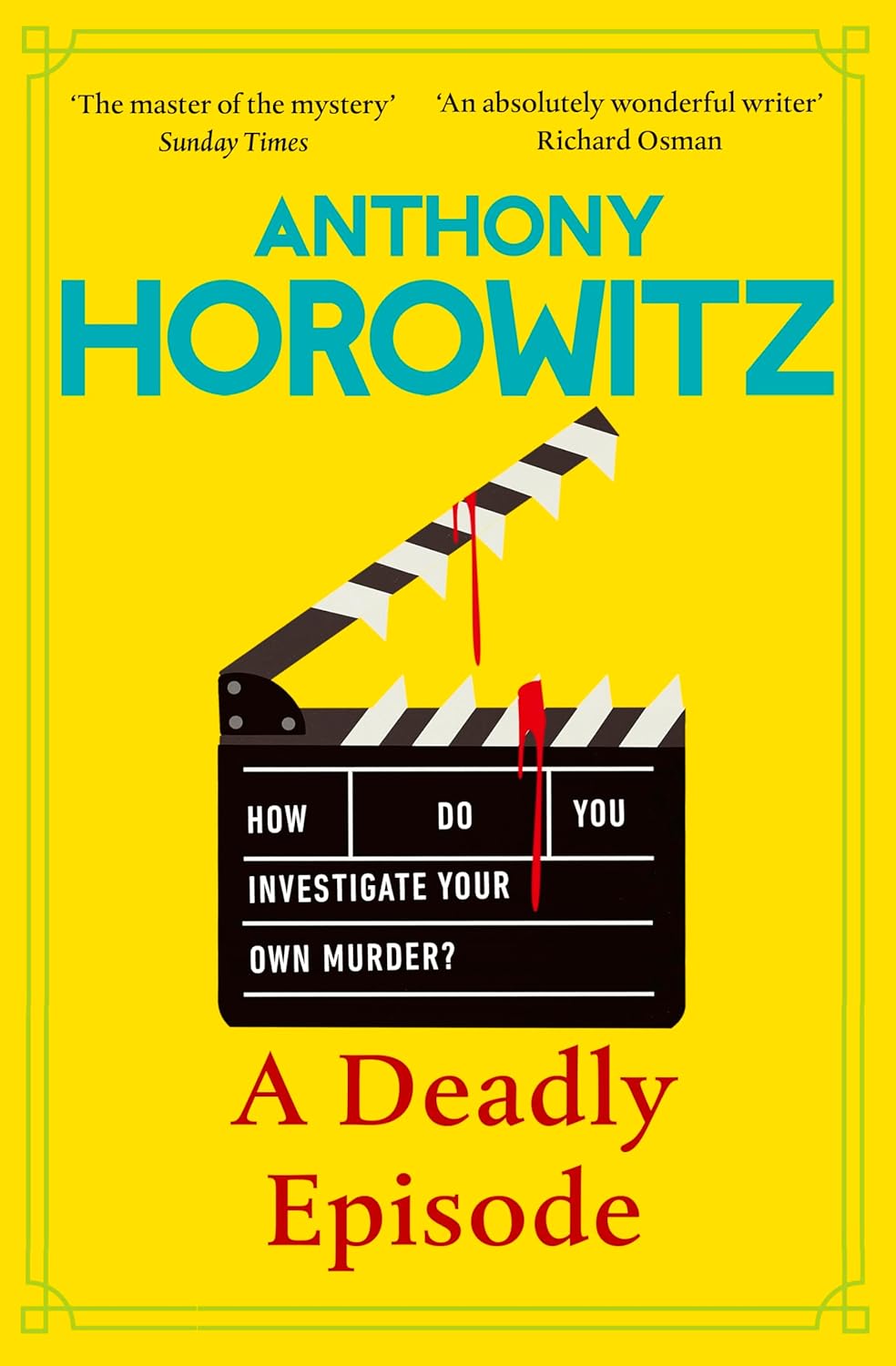

The metafictional world inhabited by Anthony Horowitz in this series, where he plays Watson to the mysterious, ingenious ex-DI Daniel Hawthorne, kicks up a notch in sixth title A Deadly Episode (2026). A film is being made of the first book, The Word is Murder (2017), and early on Horowitz reflects on its being set in Hastings when the events on the book took place 60 miles away in Deal: “I thought it was questionable to take a real tragedy and real pain and to fictionalise it by changing the location”. It’s a sly joke — if ‘joke’ is the word, which I suspect it isn’t — and it speaks to the confidence Horowitz is finding as this series progresses.
When one of the actors appearing in the film is murdered, Hawthorne and Horowitz again find themselves with a front row seat, and begin investigating in earnest.
“Most writers have to sit on their own, twiddling their thumbs and making it all up, but you get it handed to you on a plate.”
The book is a rollicking success for a multitude of reasons, not least the confidence Horowitz has now found in his fictional pairing with Hawthorne, reflecting on how “the view from five steps behind him was one I never enjoyed” and playing structural games — c.f. Hawthorne insisting that something only appear in the book if it has relevance to the case…and so obviously shifting your focus to those events on account of their appearance in the book. Hawthorne seems more rounded than previously, too: his first scene in which he demonstrates how “real” he is provides much delight, but as the investigation inevitably takes in more of his past we start to get a little shading on a man seen largely in outline. I still maintain that this isn’t going to pay off as darkly as Horowitz has hinted, but the steady parcelling out of information has achieved a heft of its own on account of its careful handling to date.
We also confront some questions about their association, many of which has remained unexamined to date. Do they actually like each other? Is Horowitz interested in Hawthorne’s past beyond more than just self-interest? And what if Hawthorne isn’t the unerring sleuth of lore?
It was unthinkable that Hawthorne could ever have made a mistake and I wouldn’t have dreamed of suggesting it myself. I had many reasons to be wary of him but I had never had any reason to question his brilliance. How could I have written about him if I had thought otherwise? For that matter, why would anyone bother to read a mystery novel if they had any doubts about the man who was leading them to a solution? It’s a simple rule. Detectives have to be infallible. If not, readers will never trust them again.
I worried that Horowitz had hit a bit of a duff in introducing fully eleven new characters at once just past the halfway stage, but the man’s a consummate professional and draws those relationships clearly and quickly, pulling you in to this new focus. And yet, for all that he knows he’s doing an excellent job, he’s not drowning in hubris: I enjoyed that the film is somewhat low-rent and poorly conceived (“I suppose it might have been a mercy killing. If the killer had read the script…”), and the numerous knock-backs Anthony (the character) receives throughout are all part of the fun, not least the way he is treated by people who really don’t want him digging, making him more convinced that there’s something to find (“I know I have an overactive imagination. It’s what’s kept me in business all these years.”).
And, on top of all this superbery, the book also stands as an exquisitely-clued mystery in the grand tradition, with even the couple that might be a little borderline explained away beautifully in the closing scenes. There’s so much going on that I was very proud of myself for catching what I was certain was a key one — (rot13) ab ubgry yrgf lbh purpx bhg ng unys-cnfg guerr va gur nsgreabba, fheryl? — which would have been very clever of me if it had any relevance to the plot. Instead I overlooked some screamers, and was thoroughly taken by surprise by the two-tiered solution. Excellent work, sir; my hat is off to you.
If you’ve not read any of these books yet, A Deadly Episode is not the point to join, but if you’ve been a fan all along this is the mid-series lift you were hoping for: a richly-plotted, slickly-written, highly-readable, and expertly-weighted example of the detective novelist’s art which shows there is plenty of life in the concept yet. All Horowitz has to do is write another six like this and he’ll have produced perhaps the great modern crime series. And that should be easy, right? With Hawthorne handing him cases this rich on a plate, all Horowitz needs to do is ask for more…
~
The Horowitz & Hawthorne mysteries:
1. The Word is Murder (2017)
2. The Sentence is Death (2018)
3. A Line to Kill (2021)
4. The Twist of a Knife (2022)
5. Close to Death (2024)
6. A Deadly Episode (2026)


I admit, when I saw you were reviewing this, I was afraid that it was going to be a three or even two-star review. Glad to see that my fears were unfounded!
LikeLike
I’d only give it a low rating if it was a bad book — and Horowitz absolutely delivered here. The only thing wrong with it is that he now needs to write another 5 this good 🙂
LikeLike
I wasn’t aware there was a new title out. Horowitz is so cheeky in how inserts himself into his own novel.
LikeLike
He’s clearly having a lot of fun with these, and that’s great/ It’s especially wonderful because he’s also writing mysteries that are well-clued and so allow the reader to play along — arguably the only sort of mystery worth writing 🙂
LikeLiked by 1 person
I’m sad to be the arse here, but I found this novel really disappointing. After the rather delightfully quirky and experimental “Close to Death”, this one felt like a real trudge through the (now overly) familiar Hawthorne formula right down to the “murder from the past” being introduced almost exactly at the midway point. Now, I don’t mind a bit of formulaic writing, but here it felt like even Horowitz was a bit bored with it all. The central murder case was never particularly gripping, I twigged the secret of the (ROT13) cubar zrffntrf the second it was mentioned, and I never developed any sort of interest in the multitude of suspects. It doesn’t help that we only meet some of the suspects once, and most of them completely vanish from the book at the halfway point. The film shoot setting is also totally wasted, and similarly disappears once the second murder is introduced.
The best portion of the novel is the Foss stuff, and I’m baffled as to why Horowitz didn’t just make that the main plot of the novel. I’d be much more interested in seeing Hawthorne navigate a classic manor house mystery. The visit to Reeth is overdue and quite atmospherically rendered, but I’m already quite bored with the mystery box that is Hawthrone’s past. After five books of hints and nudges, I really hoped we’d get some answers by now. Instead, after all that suspense-building, we get more nothingburgers. Another vague threat, another hint, another mystery. I’m not sure I can do six more books of that. It’s like watching “Lost” all over again. I’m realizing that one of the best things about GAD authors is that they never bothered with their detective’s private lives. After all, that’s not why anyone reads a murder mystery, right?
Now, I don’t want to give the impression that I think “A Deadly Episode” is a bad book. It’s quite OK, but that’s kinda the problem. I’ve commented here before how much I love Horowitz’s work, and I know he can write novels which are so much more interesting, complex, and inventive. Even the language in this felt flat and overly-simplified. Horowitz has never been a particularly stylish writer, but the way he writes here makes the book feel like one of those ESL simplified novels.
More interestingly, however, this novel made me wonder have the rules of fair play been changed by the prevalence of internet searches. Now, Horowitz himself mentions in the novel that there’s one important clue which he didn’t explain, but he did describe. Strictly speaking, this is a violation of the rules (or at least a borderline case), but I’d argue that since a reader can just Google the answer in 30 seconds and get the full clue, the rendition of that clue in the book is fair. For example, in the 1930s, if a writer had hinged the whole plot on an obscure medical fact, they’d be rightly called out for cheating. Nowadays, when we can just Google that medical fact at any point in the book, it’s no longer unfair (even if it is a bit devious). Something similar has already happened in a Horowitz book, (ROT13) “N Yvar gb Xvyy”. He introduced a character claiming to be one thing, and then at the end of the book, that character is revealed as a liar. This revelation was not obviously clued, but at one point, Horowitz provides us with that character’s biography. While reading the book, I Googled the biography and found out it was copied word-for-word from a real person. That way, I got the same clue Hawthorne later used to expose that person even though the clue is not laid out fully in the text itself. Food for thought for one of your blogs perhaps, but I’d argue that the Knox Commandments are being rewritten by the existence of Google as we speak, more so than they ever were by modern forensics.
Sorry for the overlong rant, but I don’t know anyone else who’d even partially understand any of this.
LikeLiked by 1 person
For what it’s worth, I, agree with just about everything you say. I was really looking forward to some sharp satire about adapting one’s work, especially since Horowitz (the real one) tends to partner with his wife for that as much as possible. What we got was pretty much just a setting, and a pretty superfluous one at that. And then we moved to a completely different case – not a bad idea, especially if it gets us closer to some reveal of this interminable Hawthorne backstory. Yet I remember thinking that the introduction of a whole household of interesting suspects was boiled down to part of one chapter, and I tend to agree that this was potentially a more interesting mystery. What I did love? There was more Horowitz and less Hawthorne, and I did enjoy the motive for the movie crime, especially since it was paraded in front of us. And even at his less-than-best, Horowitz is more interesting and fun to read than most modern mystery writers. Maybe that’s why I hold him to an even higher standard.
LikeLike
I’m pleasantly surprised to see we agree so thoroughly. Your review of the book read rather more positive and I had assumed you enjoyed it much more than I did. You’re spot on about hoping for more satire on adaptation, especially since Horowitz is such a wonderful and respected adapter. I hold that he’s the only screenwriter who’s actually improved an Agatha Christie story with his take on “The Yellow Iris”.
I also see what you’re saying about “more Horowitz, less Hawthorne”. Even though I like Hawthorne more than most readers seem to, I do enjoy this balance more, and it seems like the books are heading in that direction since “Twist of a Knife” which first separated the two for long stretches of time.
I hold Horowitz is very high esteem, as well, and have for decades now. I was first a fan of his TV writing before reading a good chunk of his YA novels. I’m certainly not implying I intend to give up on him or that he’s a bad writer, I just wish he’d shake up this formula a bit and give it some of that Susan Ryland formula-busting oompf! The Horowitz/Hawthorne books have so much promise, and are at times so brilliant, that it’s a real shame none of them have quite reached “Magpie Murders” levels of brilliance. I’m still waiting for my 5/5 Hawthorne, and I’m getting quite impatient.
LikeLiked by 1 person
Does this mean there’s another fan of Crime Traveller out there?!? I thought I was the only one!
LikeLike
Absolutely! An incredibly unfairly maligned show, I’d say. Superb premise. Sure, the execution was at times shaky, but not many shows hit it perfectly right out of the gate. If they’d done a second series, however, I would have preferred a little more mystery, and just a tad less romp. I guess Horowitz was still in a more YA-oriented mindset at that time as the humour of the show very much reminds me of “The Diamond Brothers”. But, yeah, one of the best mixtures of sci-fi and mystery I can think of. That’s partly why I enjoyed “The Time Traveler’s Hourglass” so much, I think. Because it’s like someone finally perfected the “Crime Traveller” premise.
“Murder in Mind” was just superb too. I love a good anthology series. I was a bit less keen of “Injustice”, even though, in hindsight, Charlie Creed Miles is excellent as Hawthorne. I hope he gets a nicer ending in the book series!
LikeLike
Oh, this is a happy day. I’m tempted to track both down and rewatch them now.
LikeLike
And Murder in Mind, obvs.
LikeLike
I’m sorry this didn’t work for you — and don’t apologise for the length of your comment, it’s important to get these things off one’s chest among people who will understand 🙂
For what it’s worth, your criticisms of this aren’t miles off how I felt about A Line to Kill, so it just goes to show how much the reader brings to the experience of a book.
LikeLike
“A Line to Kill” is the only Anthony Horowitz novel I outright didn’t like, and I’ve read many of them including most of “Alex Rider” and lots of “The Diamond Brothers”.
LikeLike