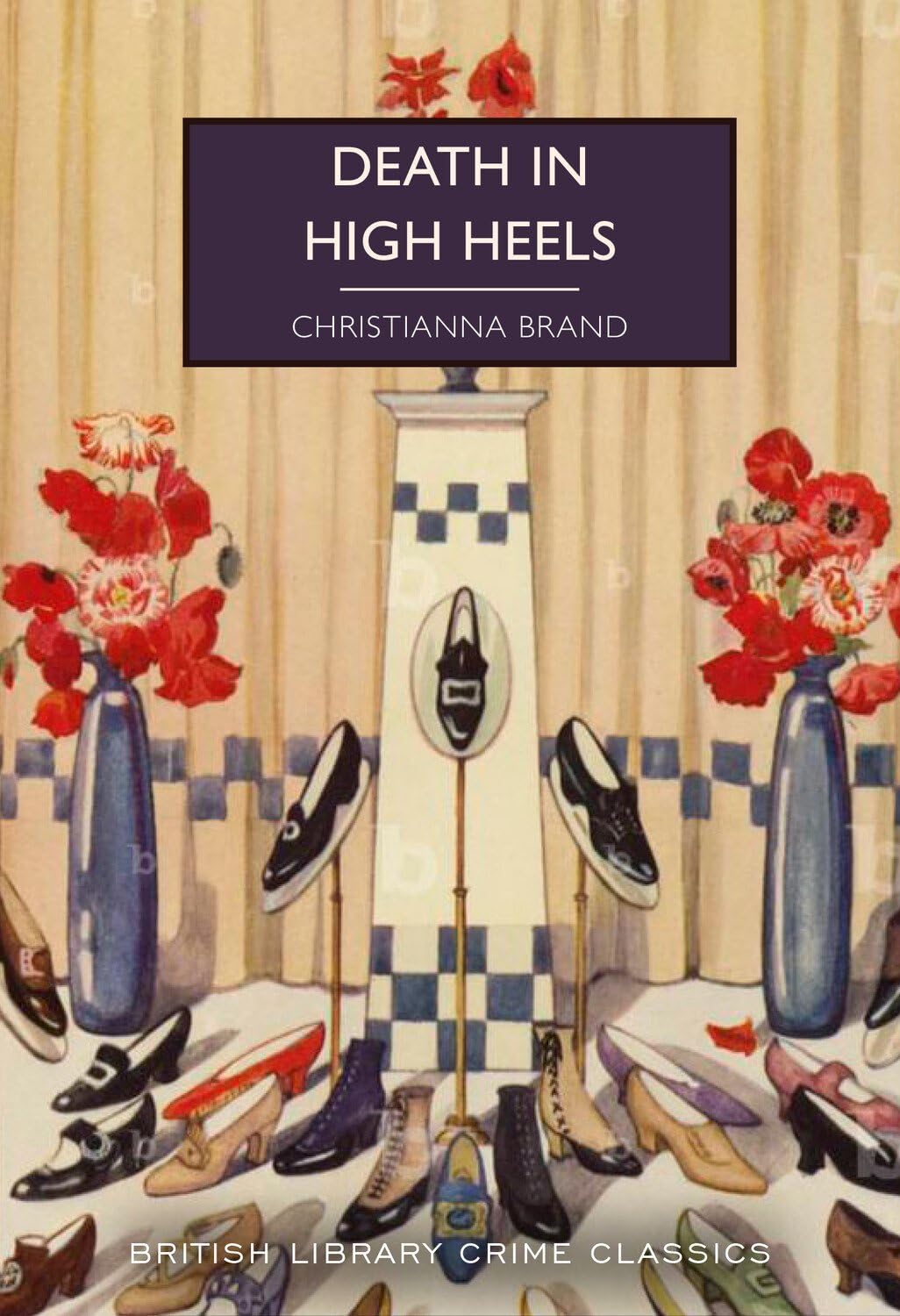


Having recently looked at the debut from one legend in the annals of mystery fiction, let’s turn our attention to another: Death in High Heels (1941), the first novel from Christianna Brand, recently republished in the excellent British Library Crime Classics Range, so that, incredibly, fully seven of her novels are now readily available. And, once again, we find a genre great on apprentice form, with this story of murder in a fashionable dressmakers running too long and rather lacking in incident. Brand would have to learn her trade somewhere, however, and there are encouraging signs here of the force she would become.
For one thing, there are some expectedly magnificent moments of character, communicated through the arch tones of an omniscient and disinterested narrator in the way that Brand could virtually copyright. Be it the “motherly landlady [who] opened the door and her mouth at the same time” when Inspector Charlesworth comes calling, or the aside that “Irene had been born and bred in a cathedral city and…had a deep distrust for artistic temperament,” Brand’s catty edge is on full show at times, and it’s to the book’s benefit. Alongside this, she also makes you believe in the people who fill out the story — a light touch gives them all some depth, like Rachel Gay coping with an absentee husband or the boss’s right-hand woman trying to jolly the sales girls along and inspiring only “nervy revulsion”.
Full credit, too, to Brand for writing a homosexual character as if it’s no big deal. Admittedly, dress designer Mr. Cecil isn’t treated necessarily kindly — he’s known throughout as “Cissie”, dismissed at one point as being only “half a man”, and subject to all sorts of innuendo (“Be careful ‘e don’t misunderstand you.”) — but the unashamedly making him gay, and detailing all the difficulty he’s had with his various boyfriends down the years and attitudes faced in the present, arguably does more for representation than Hinchliffe and Murgatroyd did nearly a decade later. Elsewhere we’re on more familiar ground, with a cast of familiar sorts all given Brand’s customary twist so that at times you really to ache for them. I could have done without all the names — Irene is also Rene, Rachel is Ray, Victoria is Toria, one of them is also Mrs. Best, there’s a female character referred to as Gregory throughout, plus there’s an Aileen as well as and Irene, lawks-a-mercy — but they’re a spry bunch and fun to be around, if a little BYT and Roaring Twenties at times.
Away from our suspects, Inspector Charlesworth is a bit of a dull egg, losing his head over one of the attractive, married shopgirls and humorously taking against her husband on principle, though I did enjoy the moment he inquires after a colleague’s wife as a way of “mak[ing] amends” and gets an unexpected answer. Really, though, the chief problem here is that the plot really needs a second murder to justify the lengths this is pulled out to (and, no, that final line of chapter seven is not a death, though you’ll damn well think it is for several pages…), and it all feels very thin as a result, even if the circling of the curious vultures of the public as they descend upon the shop following the tragedy is superbly communicated.
Additionally, for all that you’re told how there’s no way that the fatal poisoning could have taken place, I have to admit that I have no idea how it was achieved, since the conclusion explains it in such a muddled way that I can believe that Brand herself is alone in understanding how someone not being seen or being in a room twice or something means that they and they alone must be guilty. It needs a floorplan, for one, and it needs to be a simpler piece of misdirection for another…but, well, she would improve upon this (eventually — her second book Heads You Lose (1941) is also problematic in this regard) even if she does retain the habit of rather more pages than are strictly necessary.
Death in High Heels is, then, a flawed but promising start to what would become an illustrious career, and, while it’s difficult to advise you to seize it avidly, if you’ve read any of the other books of Brand’s that the BL has wonderfully brought back it’s understandable that you’ll be curious to try this one. Approach with reservations, but know that there’s just about enough here to reward patient admiration of one of the greats.
 The Invisible Event