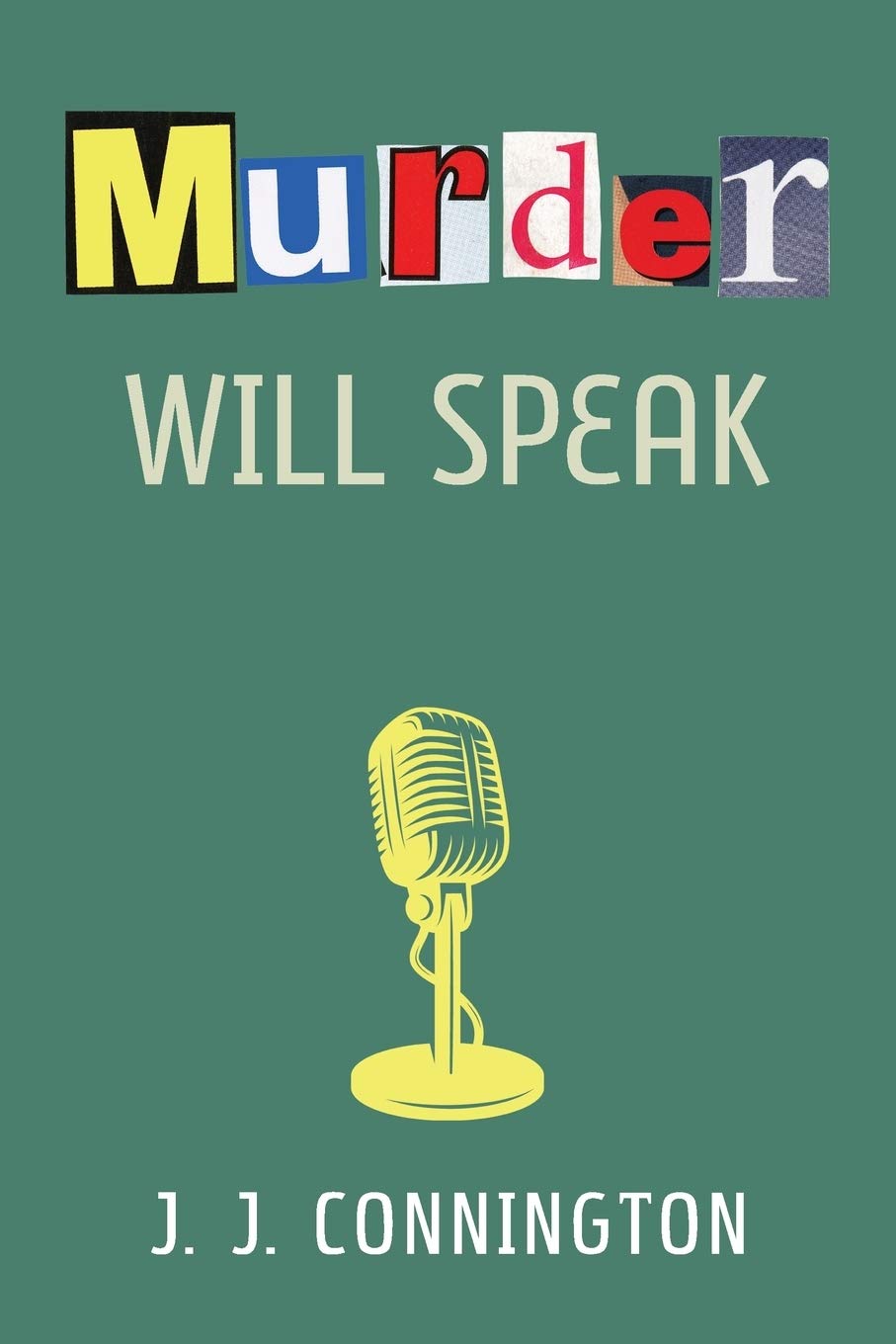


I’m pretty sure that I’d rather, in the 24 novels of crime and detection Alfred Walter Stewart wrote as J.J. Connington, he took a few risks and so remained curious, but that doesn’t mean I’m always going to like what he wrote. And so to Murder Will Speak, a.k.a. For Murder Will Speak (1938), the thirteenth novel to feature Chief Constable Sir Clinton Driffield, and one that takes a slightly sideways steps in its telling which, while not always successful, at least fails in some interesting ways. Connington’s other experiments — The Eye in the Museum (1929), Gold Brick Island (1933), The Brandon Case (1934) — were certainly harder to read than this, and with a few pages chopped out this might have been more successful.
For all that works about this — we start with poison pen letters already a blight in a small community, sent seemingly at random and often filled with more embroidery than accusation — it still takes an age to get going, as if Connington himself is uncertain what the focus will be. Indeed, the way we open, with Oswald Hyson taking over the stockbrokers’ office he has been the junior member of following its chief suffering a heart attack, it almost seems that we’re going to be in for a Freeman Wills Croftsian inverted mystery: the married Hyson regretting his romantic entanglement with typist Olive Lyndoch and clearly facing up to financial defalcations — indeed, the only real difference is that Crofts’ inverted villains are usually sympathetic where Hyson is a self-interested bastard of the first order.
Just as this seems to get going, the poison pen letters are brought in, and a genuinely very interesting time is had with Post office man Duncannon explaining why a special investigatory branch of a P.O. is dealing with what initially seems to be a police matter. Then Hyson drops Olive and she becomes jealous and sends an anonymous letter of her own, then the old man of Hyson’s firm dies, and then a possible murder is discovered when someone whose connection with everyone else remains vague now travels up to his isolated cabin in Scotland and finds his wife drowned in a local body of water. Then another murder-or-suicide is discovered and we still haven’t gotten any further with the anonymous letters and, oh, I dunno, it’s all a bit of a stew really.
Oh, and there’s Dr. Malwood, whose specialism is glands, hanging about like a bad smell, and it’s…weird:
“Take a perfectly decent human being, knock one of his or her glands out of order, and you may get what the law considers a criminal. Or, at any rate, you may loose forces that the poor creature can’t control. Is that right?”
“Something of the sort,” Malwood agreed.
There’s a looseness to all the associations here that is new in Connington — Dr. Malwood had treated the dead woman for possibly nymphomania using, er, X-rays — and does the book few favours. And every time there’s some clever idea, such as the way a police officer ensures that a letter was posted at a certain time, there’s some bewildering oddness to loosen the structure further and leave one shaking their head (“[H]is sphincters have all gone slack, of course.”). We’re constantly seeing things from the outside: I think we’re only present at the discovery of one body, and Driffield, Duncannon, and Squire Wendover discuss the letters much as a scientist would examine a common beetle through a lens. It never quite engaged me as Connington does when he’s on form, and despite being more densely-plotted than The Brandon Case it comes close to that book’s level of tedium at times.
Interesting social trappings glitter through: “The classes are getting very much mixed up, since the war,” we’re told at one point, and the prevalence of car ownership and gas ovens in every home means that “suicide’s easier than winking, nowadays”. Connington is also surprisingly sympathetic towards Olive Lyndoch, who, having used her looks to gain the affluent Hyson, must now face being ousted by a younger model, and all the spoiling of her plans that will ensue. Also, electric kettles take a long time to boil. Why were they invented then? That’s honestly more intriguing than most of the criminal activity herein.
And, to really kill the endeavour off, the criminal scheme is far from Connington’s strongest, with a murderer’s alibi that Crofts would see through before it’s even presented and a lumpen psychological dismissal of the equally obvious culprit in the letter business that makes me wonder what Connington had against that section of society. All told then, not very good at all; he’d already published a good book in 1938, so maybe he should have taken just the rest of the year off.
~
See also
Martin Edwards: As so often with Connington, the technical complications and focus on fair play mean that it’s not terribly difficult to figure out who is sending the poisoned pen letters, or who is responsible (directly or indirectly) for Hyson’s death. But I found the story engaging and readable, even though I was rather taken aback by one of the plot strands (which to quote a review on the GAdetection site involves “a woman whose nymphomania has been corrected through a glandular adjustment”.). All a bit odd, and reflecting Connington’s attitudes, which were not exactly modern or progressive. As a result, the book ranks as something of a curiosity – but to my mind, an under-rated one.
~
J.J. Connington on The Invisible Event
Standalones:
Featuring Sir Clinton Driffield:
Murder in the Maze (1927)
Tragedy at Ravensthorpe (1927)
The Case with Nine Solutions (1928)
Mystery at Lynden Sands (1928)
Nemesis at Raynham Parva, a.k.a. Grim Vengeance (1929)
The Boathouse Riddle (1931)
The Sweepstake Murders (1931)
The Castleford Conundrum (1932)
The Brandon Case, a.k.a. The Ha-Ha Case (1934)
In Whose Dim Shadow, a.k.a. The Tau Cross Mystery (1935)
A Minor Operation (1937)
Truth Comes Limping (1938)
Jack-in-the-Box (1944)
Featuring Superintendent Ross:
Featuring Mark Brandon:
The Four Defences (1940)
 The Invisible Event