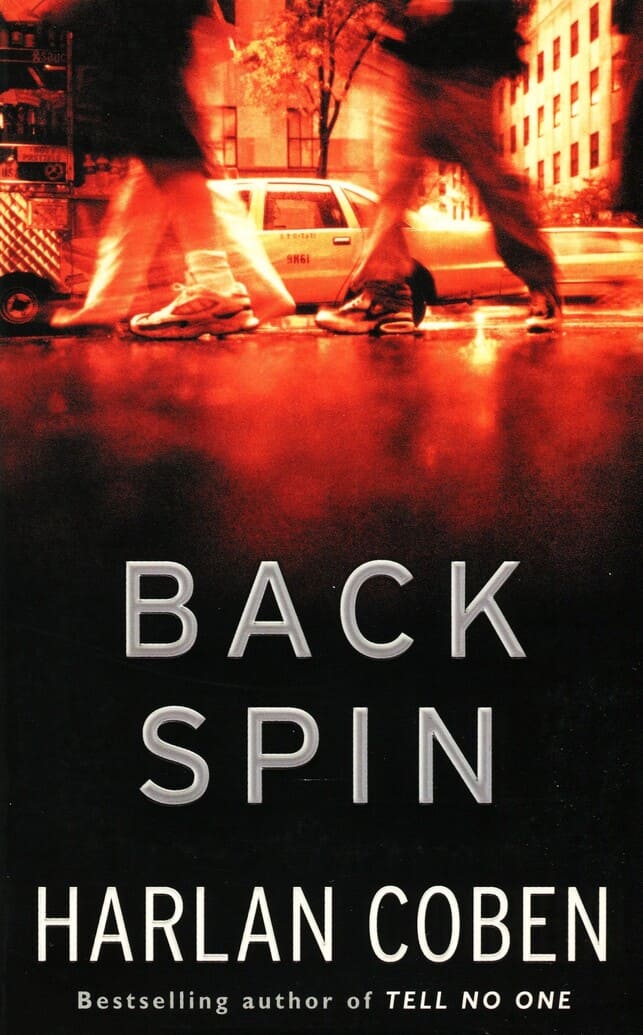
A potentially final visit to the work of Harlan Coben, who I got into in a big way in the early 2000s but who now, as my own tastes have moved on, occupies more a position of nostalgia than any sort of feeling of needing to continue to read him.
Prepare to pretend that golf is a real sport in…
Back Spin (1997) by Harlan Coben
How I encountered this book
I’ve talked before about how I came to Coben’s work as an avid reader of a lot of American crime writers who seemed to gain traction in the laste 1990s and early 2000s. Of those authors, it’s fascinating to see how the popularity of some of them has only grown over the decades. Lee Child — who, yes, is English — had two movies made of his Jack Reacher books, but they pale in significance to the demand for the currently-popular streaming show Reacher (2022-present) made from the same material. Michael Connelly, who wrote a short-lived crime series for American TV, has seen his Harry Bosch novels similarly translated into a long-running streaming series — two, in fact, since the character Renée Ballard also got her own show.
It’s fair to say, though, that Harlan Coben has probably done the best out of everyone in this regard. I got into Coben when his 10th book Tell No One (2001) started generating buzz among online fans, at a time when his first two novels, Play Dead (1990) and Miracle Cure (1991), weren’t even in print. He has, at the time of writing, now put out 39 novels — although The Magical Fantastical Fridge (2016) might easily be overlooked as sounding, er, rather unlike his other, thriller-based efforts — including a novel co-written with Elle Woods herself, Reese Witherspoon. On top of this, he signed a long-term deal with Netflix to develop projects for their streaming services, and has reached a point of popularity that his own name is often attached as the brand of any new series (e.g. Harlan Coben’s Fool Me Once (2024)).
And, in fairness, you can understand why. There’s a Coben promise of complex dynamics, sudden reversals, and shocking finales that runs through his work like the text in a stick of rock. Sure, this can mean that sometimes his plots descend into a farce of sorts, but a mainstream audience is rarely going to worry about that too much, and the money stays in Coben’s bank account no matter how outlandish some of his ideas are. So while I’m not quite as signed up to his world as I used to be, I was intrigued to give him one last swing and revisit Back Spin (1997), his sixth book which, even at this early stage in his career, both followed and established the pattern that he’s impressively maintained for three-and-a-half decades now.
What’s it about?
Attending the US Open golf tournament at Merion Gold Club in Philadelphia, sports agent Myron Bolitar is approached by a relative of Linda Coldren, the world’s top female golfer. Linda’s 16 year-old son Chad has been kidnapped, and the Coldrens have been warned against contacting the police. To complicate matters, Linda’s husband Jack is a career golfer whose claim to fame is having choked in the final straight when leading the US Open 23 years ago at the same course…and this year sees him on a hot streak, with an almost-unassailable lead in the competition with two days remaining.
To further complicate matters, the Coldrens are the cousins of Myron’s best friend, the psychotic and violent Windsor ‘Win’ Horne Lockwood III, and, given a terrible event in his past which sees him refuse to be involved with his wealthy kin, Win refuses to either speak to the Coldrens or involve himself in the case in any way. Who’s behind the kidnapping? Has it been done purely to distract Jack Coldren from winning the Open? And can Myron resolve matters without his trusted partner at his side?
Any seeds of detection?
There’s always a fair amount going on in a Coben novel, and it’s to his credit that a majority of that is focussed on the intelligent way to approach the crime or baffling occurrence central to the plot. Yes, we veer into plenty of personal issues, too, but a large chunk of the 15 or so Cobens I’ve read retains a focus on an often very normal person trying their best to investigate and make sense of whatever side-swipe of a situation their creator has placed them in.
As such, this takes on a sort of modern Humdrum aspect as Myron tries to work to what could have happened. It seems, for one, that Chad can’t have been kidnapped to throw his father off, since no-one had seen the boy for three days before the apparent kidnappers called…and yet it’s not unknown for the Coldrens to not see their son for days at a time, so maybe that’s a premature conclusion. Equally, little details must be made to fit into a sensible pattern: when a call is received and Chad heard to utter a bloodcurdling scream down the phone, the worst seems likely; but when the call is traced to a local mall, the fact must be faced that no-one is going to harm a teenager in distress in public just to make his cry out in that manner.
Coben also partakes in some fairly classical misdirection. “There were two possibilities,” we’re told following a certain development, and these two are then spelled out…completely guiding the reader away from a third possibility that, as it happens, turns out to be the truth (and, no it didn’t occur to me just because I’d read this before — it’s been 20-some years, how good do you think my memory is?). And, in this regard, there’s a superb piece of foreshadowing or clewing or something dropped fairly early on that points directly to the solution…I’m not sure quite what to call it if only because the reader isn’t provided with the key piece of additional information until Myron uses it to explain things. Even when Myron learns it, in the final line of chapter 39, it’s still withheld from the reader, and from a classical detection perspective that frustrates me somewhat.
There are also a few instances where the desire to introduce clever elements like this don’t quite work. And while Coben is to be commended for toying with an element of fair-playism in an era and subgenre that wasn’t interested in it — all the better to hold it back of that smash conclusion — it’s another reason why I think I don’t need to keep reading him any more. The interpretation put on a newspaper article that doesn’t hold in the way Coben wants it to is a key example of this, but, like I say, it wasn’t the focus on this era and isn’t the raison d’être of this book, and so you can’t really blame him for not doing this more openly or within the success criteria of the classics of the form. But he’s aware of the principle because he actually does manage it at a key point with a conversation that’s given a new spin in the closing stages, and I love that he played the game the fairly (better still, it rests on a false impression from earlier, so I was distracted by that).
Elsewhere, we’re on slightly ropier ground. “Sherlock Holmes warned that you should never theorize without all the facts because then you twist facts to suit theories rather than theories to suit facts,” we’re told at one point, following some frankly wild wheel-spinning — some of which, it has to be said, is a little reductive and insulting (“[She] was probably a bit of a kinkster…”), and some of which just leaps straight in the air and happens to land, with zero reasoning, on the right answer from stark nowhere (rot13: gur vqragvgl bs Punq’f ovegu zbgure, sbe vafgnapr, pbzrf bhg bs n cbvag fb sne erzbirq sebz nalguvat gung cerprqr vg gung V ubarfgyl jbaqre vs Pbora xarj ur jnf tbvat gb qb vg orsber vg unccrarq).
Can you go home?
One of the things that really stands out here is that while in a way we’ve becomes more tolerant and careful in how we talk about other cultures, such as Myron receiving good-natured grief about his decidedly non-Jewish name given his heritage…
“By the way, Myron, what kind of name is Bolitar for a member of the tribe?”
“It’s a long story,” Myron said.
“Good, I wasn’t interested anyway.”
…there’s also a real unkindness and inequality about the way other people are treated that doesn’t feel exactly deliberate as more a reflection of the sort of attitudes that were taken as mainstream at the time:
She had a dye job from the planet Bad Bottle and basically looked like the type of woman who might go for a tattoo-infested skinhead — or to say the same thing in a slightly different way, she looked like a regular on the Jerry Springer show.
It also feels rather accidental that all the people who suffer at the hands of the consequences of their illegal actions are poor, non-white, and/or not signed up to a comfortable middle class existence, while all the WASPs face no consequences at all and everyone just seems fine with that. Every era, it seems, has its own prejudices to air for those who come afterwards. Who’d’ve thought?
It’s also one of Coben’s major strengths and largest weaknesses that his characters really don’t register. On the plus side, this feeds into those smash endings because the stay-at-home mom with four kids and a crushing mortgage can turn out in the penultimate chapter to be the forger-cum-assassin-cum-getaway driver everyone’s been looking for and you, the reader, are shocked — shocked!! Mission accomplished. Conversely, it means that most of the tension goes out of things because anyone can do anything to make the plot move and it’s fine: Win’s refusal to help has zero bearing on the story, because at a point where Myron might need Win’s help he basically goes ‘What would Win do?’ and just…goes and does it. Imagine if Gideon Fell had to break into a house — you know he simply cannot do it, and it sets up a fascinating principle that encourages an inventive and entertaining workaround. Here, meh, everyone is whoever they need to be at the drop of a hat and it feels a little too easy. The decisions or the actions they take have no weight, and so the shocks don’t shock because, sure, why not?
On the plus side, I did enjoy what I’m taking as a Perry Mason reference:
“I may search for legal loopholes, but I always play by the rules.”
“You sound like a criminal defense attorney,” Win said.
All told, though, while I won’t deny that Coben’s brand is now so consistent that he deserves the success that comes from giving people what they want, I think I’ve moved past what he offers. In a few years I might pick up one of his books again because I know it will provide a slick, unmemorable time, but for now I’m grateful for him playing a part that started me on the road to classic detection and I’m happy for us to part ways as friends.
~
Going Home on The Invisible Event:
Fade Away (1996) by Harlan Coben
Back Spin (1997) by Harlan Coben
Blood Work (1998) by Michael Connelly
Angels Flight (1999) by Michael Connelly
Dark Hollow (2000) by John Connolly
The Monkey’s Raincoat (1987) by Robert Crais
Airframe (1996) by Michael Crichton
Dead Meat (1993) by Philip Kerr
A Drink Before the War (1994) by Dennis Lehane
Black and Blue (1997) by Ian Rankin
 The Invisible Event