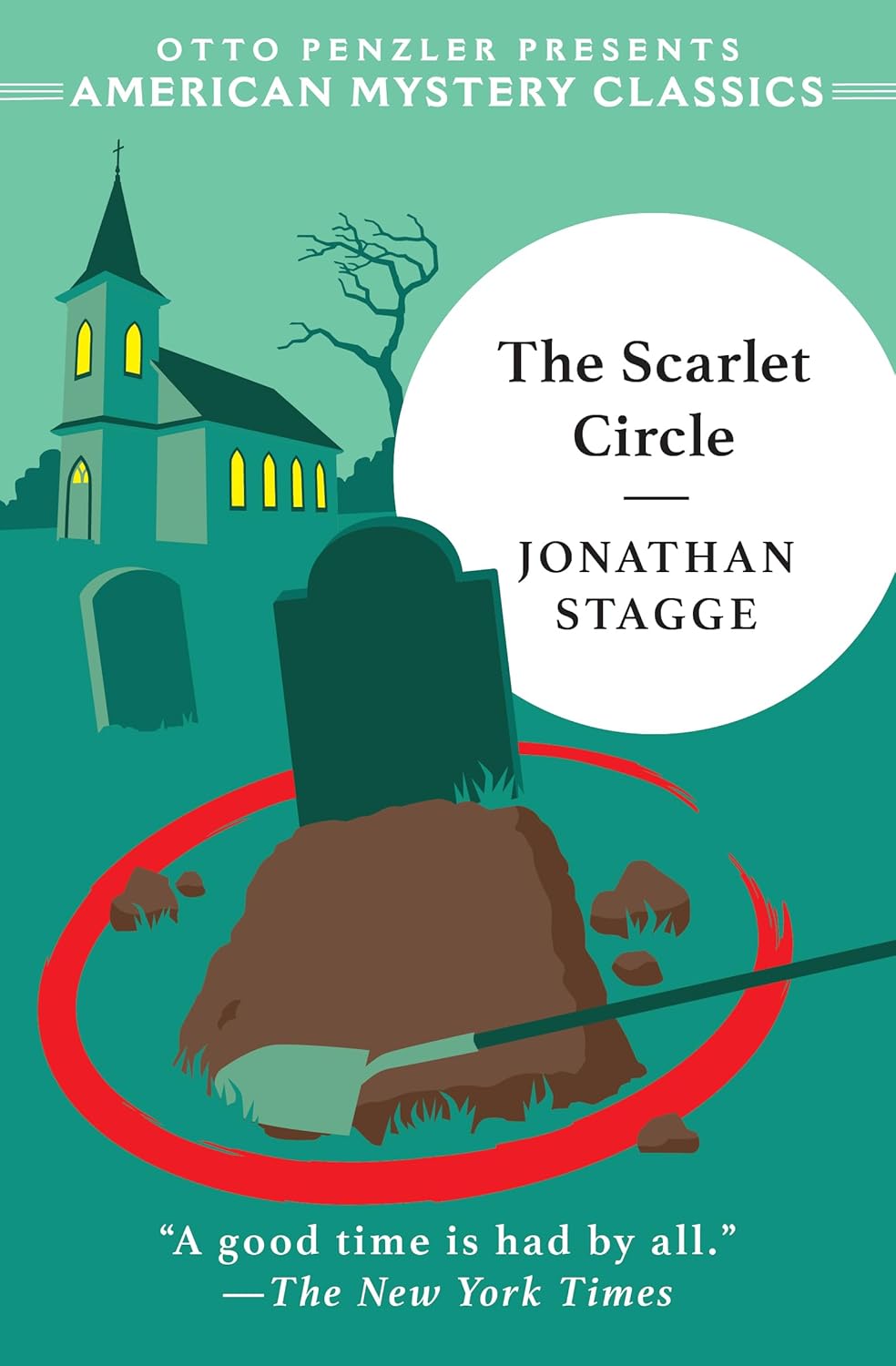


For reasons beyond finding Puzzle for Fools (1936) merely okay, I’ve never quite been able to summon much enthusiasm for investigating the work of Jonathan Stagge/Patrick Quentin/Q. Patrick/etc. Maybe it’s all the pseudonyms, maybe it’s the fact that the names seem to hide an army of collaborators, maybe it’s their general unavailability…maybe it’s a combination of all of that. But The Scarlet Circle (1943) came recommended by someone (apologies, I get a lot of book recommendations) and, being newly minted in the American Mystery Classics range, there was no reason not to check it out. And, having read it, I’m still unenthusiastic about these guys, just now with more evidence.
On a fishing holiday in a New England town, “one of those spots against which the elements seemed to have a perpetual grudge”, Dr. Hugh Westlake and his young daughter Dawn are drawn first into the mysterious appearance of a Chinese lantern by a grave someone is busy disinterring, and then the death of a local woman, found strangled on the beach with a circle drawn in red lipstick around a mole on her cheek. Then a second woman is discovered murdered, a circle similarly drawn around a mole on her leg…and alongside each dead body was found yet another Chinese lantern.
That lantern…threw me into the mood for horror.
To the book’s credit, the setting feels windswept and interesting, with the various denizens of the town and the inn where Westlake is staying well-drawn and neatly imbricated in each other’s lives. The artist Virgil Fanshawe is using buxom Nellie Wood as a model for his scenes from Dante’s Inferno while his beautiful, timorous wife looks on, suspecting that more exists between them. And in this mistrust the Fanshawes neglect their five-year-old son Bobby, who is looked after by Daisy and lifeguard Buck Valentine, also modelling for Fanshawe and perhaps involved with Nellie. The way resentment laps against the edges of these relationships feels natural, though the constant references to and considerations regarding childcare do get in the way somewhat.
Westlake’s dealings with the locals — Dr. Gilchrist who brings him into proceedings, and local policeman Barnes, who “as a source of local information had to be firmly blue-penciled” — are nicely-realised, even if, as background characters, these and others feel more like names spouting dialogue than actual people. They seem to be there mainly to spout possible complications to the seemingly reasonless crimes, and to push their caps back on their heads and look flustered as oddnesses add up and no answer seems in sight, c.f. Gilchrist speculating on the possible psychological makeup of our killer — obviously wrong, but there as an addendum of sorts to the plot to give it heft.
In the debit column, then, we have that the book doesn’t really seem to get going until about three-quarters of the way through, with a visit to Chekov’s Penetentiary following much trudge, trudge, trudging through lots of interviews and lots of speculations (“No-one could call you boring,” Westlake is told in the final summary, and, hmmmm). Indeed, were this less well-written…
His neat face was disorganized by shock; his hands, below the immaculate white shirt cuffs, scurried back and forth like flustered mice.
…I’m not sure I would have persevered with it as I did, because the mystery is singularly uncompelling, and for all Otto Penzler touting its “impeccable use of clues and fair play ending” in his introduction, this might be the most scantily-clued book I’ve read since two weeks ago. There are maybe one-and-a-half clues in the whole thing, one of which is so egregiously lumpy in its dropping, and existing only to easily point the finger at the guilty party, that I’d probably find it hard to tolerate even if it wasn’t the killer themself who introduced it. And when you realise why so much attention has been given over to the kids and their playing throughout…yeuch. It’s one thing adding a human angle to proceedings, and quite another to drop in moppets purely to be the deus ex machina that saves the day in the final confrontation.
Under whatever name Stagge/Patrick/etc. published anything else, I remain somewhat lukewarm about reading further, especially with this vaunted in the introduction as the best of the Westlake series — I mean (rot13) gur guveq ivpgvz unq ab bgure zbyrf ba ure obql? Abar ng nyy? Abar?!? — and apparently worthy of reprinting ahead of seemingly so much else put out by this collective. It would be harsh indeed to dismiss an author after a mere two books, but at present I can see me trying a lot of other people before dipping a toe in these waters again.


I have this on my nightstand. You’ve depressed me.
LikeLike
Oh, man, wait ’til you meet me!
I reckon you’ll love the moodiness of this, it’s delightfully garish at times. I’m more broadly a plot guy, and plot this lacks for my tastes.
LikeLike
Now come on, keeping track of who was behind the 3 pseudonyms isn’t so hard (Richard Wilson Webb wrote or co-wrote them all in the 30s and 40, with Hugh Wheeler as his constant co-author from 1936; in the 50s and 60s, Wheeler was the sole author. Was that so hard? 😁) The Duluth books, or stand alones like THE MAN WITH TWO WIVES are the ones to focus on I would have thought (I really enjoyed the spooky Stagge books in my youth – not read one in over a decade though).
LikeLike
Pretty sure one of the co-writers was female at some point, right?
LikeLiked by 1 person
Martha Mott Kelley (2 books) and Mary Louise Answell (1) collaborated on the 3 of the early Q Patrick books before Wheeler joined Webb. Did that from memory, kiddo. Not that convoluted. 😁
LikeLike
Well, gosh, aren’t you impressive 🙂
LikeLike
I am but I think we may be straying a bit from the point … but no, you’re right, I am pretty marvellous 🤣
LikeLike
You’ve not had much luck lately! This seems on about a level with The Sanfield Scandal in terms of quality. It’s never promising when a review says “hmmmmmm”…
LikeLike
Thankfully I’ve read a few books since this one, and the general experience has been better.
It’s never enjoyable reading a book about which you’re going to say “Hmmmm”, but hopefully I keep in mind the things that even the books I don’t enjoy do well. And it’s only my opinion — others are available 🙂
LikeLike
The Scarlet Circle was recommended to me as an antidote to the awful Death’s Old Sweet Song and liked it more than you did, despite the familiar looking solution and the authors inability to create child characters.
You have already read Puzzle for Fools. So if you want to read something really good from the Q Collective, I recommend tackling Death and the Maiden (by “Q. Patrick”) next followed by crossover novel Black Widow. It pits Lt. Trant from the excellent from Death and the Maiden against Peter Duluth from the Puzzle series.
LikeLike
Duly noted, many thanks.
LikeLike
Sorry to hear this one wasn’t for you, probably my fault as I really enjoyed it, which naturally means it would drive you batty. I think I have had more success with this writing collective than you have. The stories are written in a number of styles, so it might be that some will suit you more than others. I recently read Suspicious Circumstances which is more of a comedy thriller than a detective story. I enjoyed it, but the crime element would probably be too minimal for you.
LikeLike
Ha, yes, completely your fault 😄
it stands to reason there would be a variety of styles, given the various combinations of author the pseudonyms covered, so maybe you’re right and it’s a case of finding one particular seam of their work that is on my wavelength. Certainly the moodiness of this was very effective…I just needed a plot to match…!
LikeLike
I always appreciate Patrick Quentin just for being written by two guys who are known to have been gay, so that where Agatha Christie would have Hastings comment on how beautiful auburn-haired women are, Quentin is telling what a great body the lifeguard has.
LikeLiked by 1 person
Haha, you make an excellent point.
LikeLike
The Webb/Wheelers I’d recommend: The Grindle Nightmare (grim, though); Puzzle for Players (theatre); and Death and the Maiden (nicely constructed).
And Sweeney Todd.
LikeLike
Thanks, Nico, I’ll keep an eye out for these.
LikeLike
Pingback: The Scarlet Circle (1943) by Jonathan Stagge – In Search of the Classic Mystery Novel