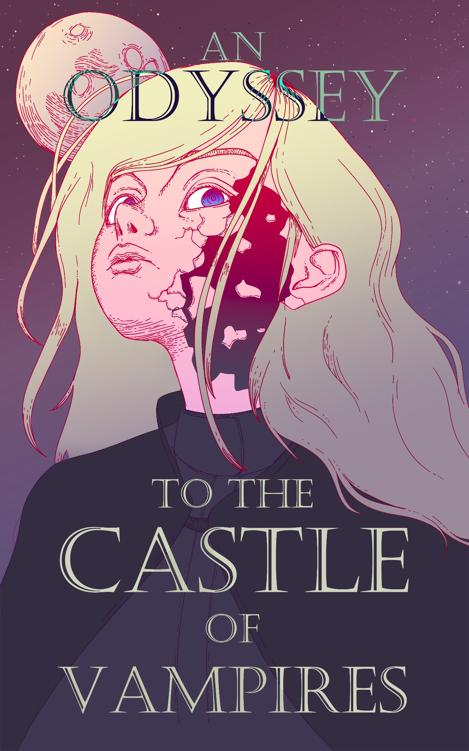
It’s been a while since I read any of the often boundary-straddling works of DWaM, and with a couple of self-published books by other authors proving hard going, common sense finally prevailed and I turned to An Odyssey to the Castle of Vampires (2023) — an epic which has been patiently waiting its turn for nearly three years now.
And, wow, is ‘epic’ the word. While DWaM has shown some fabulous creativity in his earlier works, bringing to the impossible crime a genuine desire to stretch the nature, object, and at times credibility of this subgenre to the very limit, I don’t think anything can really prepare you for just how much of a whirligig this book is. It’s a decade- and genre-spanning work of astonishing scope and ambition that takes the rule-book of what you’ve come to expect from crossover mysteries and somehow manages to simultaneously stick to every tenet and expectation while simultaneously ripping them up for fun.
How best to describe the plot?
The isolated township of Dagon Hill is a close-knit community based in a form of religious observation that feels at once familiar and spectacularly alien. I can’t really describe what this belief system is, since you only really get impressions from the descriptions in the text, but those impressions contain much of the formalism of observed religious motifs as well and an uncomfortable parallel or two with organisations formed on, shall we say, less caring grounds. When the town’s pastor is kidnapped, amidst possible tracts from gospels concerning figures known as the First King and the Last King, it will be the beginning of a series of inexplicable events whose reverberations will be felt down the ages.

That’s a dissatisfying attempt to give a loose idea of what the book is about, and even though it’s accurate I’m not sure how true it is. In many ways, the book has at its core this same confounding conundrum over and over: what it’s about, how the plot progresses, what it ends up being about…it’s all rather shadowy and loose and vague, and even as someone who enjoys the relaxed formalism of the crossover mystery I have to admit that I found this a little frustrating at times. There’s a superbly light touch with history, and some wonderful commentary on the nature of religious sects and cultist mindsets, but for all this confident handling of multiple ideas and concepts I’m not really sure what the book is about, if I’m honest.
It’s not even really about a castle of vampires, oddly enough, although the various inexplicable occurrences — bodies found in the mud with only their footprints nearby (and sometimes not even that nearby…), murderers vanishing from locked and watched rooms, sometimes whole people disappearing with no possible means from a room someone was just in — are inevitably designed to bring the eldritch horror of the undead to mind. And this, of course, introduces the meta element that rubs against the narrative, peeping into view from time to time to remind you how ridiculous the whole thing is:
“And while these murders were elaborate and complicated, they were not something a mystery fanatic would’ve ever designed. A true mystery novel fan would know that the last thing you would ever want to do in real life is execute a mystery novel plot.”
We’re reminded throughout that “[m]ystery readers would never accept the idea of servants being culprits”, or, in the midst of all these baffling events, there’s of course a character called Carr, and naturally a commentary on the nature of rigidity — or perhaps rigour — in plotting and clewing:
“Mysteries where more than one solution is possible – particularly where no clues overwhelm the other possibilities – are of no interest to me.”
Clearly, DWaM has had a lot of fun writing this, and if you can get on its wavelength — its infuriatingly-variable wavelength, it must be said — there’s much fun for the reader, too. Impossible situations bustle out of the plot in a way that boggles the mind at times, a positive cornucopia of inventively-staged and superbly-timed events which add much enticement to the at-times slow-moving plot. I loved the early no footprints posers, aided by some very clean and clear diagrams, and there’s a vanishing of a man from an observed study that’s equally magnificent for how damn impossible it seems. Honestly, though, there are — and I can’t believe I’m about to say this — almost too many impossibilities: if this makes the next edition of Skupin, it’ll easily have a couple of pages to itself, and while it’s amazing to see it’s also a little exhausting.
See, because solutions positively bristle, too, with explanations given and then overturned and then overturned and then overturned…again and again, you’re not sure if you’ve reached the terminal solution or if more possibilities exist. And while the sense of creative straining-at-the-leash is phenomenal, it’s slightly enervating having to keep track of everything without knowing whether that component can finally be allowed to drop from consideration. I’m not sure they all work — to take one example (rot13), n zna jvgu gncr bire uvf zbhgu pna fgvyy fpernz irel ybhqyl — but criticism is sort of moot, so busy and uncertain are you kept. As a piece of imaginative fiction nevertheless shackled to the expectations of the impossible crime subgenre it’s a hell of an achievement, and for the sheer mettle involved in writing this I take off my hat to DWaM and bow deeply many, many times, but, man, I never thought it was possible to have waaaaay too much of a good thing before reading this.
In truth, the overwhelming number of impossibilities and potential solutions might be easier to bear if the book were a little shorter, something which really comes to mind when characters have a tendency to talk in elliptical manner that got vaguely annoying once I noticed it:
“How’d it go?”
“Better than I expected, worse than I would’ve liked,” she said.
“Meaning?”
“I don’t know.” She sighed, waving a hand in the air. “I don’t even know what I just said.”
Theresa shut the door of the study, gave a light nod to the pair and shuffled out of the library.
“I’m sorry.” Isaac scratched the back of his head. “I should’ve warned you. He can sometimes be like that.”
“Like what?”
“Like… I don’t know,” he chuckled to himself. “Like however he was in there, I suppose.”
To counter this, there is some wonderful prose herein (“it is truly marvellous, the human habit of calling upon God in places where he so obviously does not dwell.”), but I wonder if, in the huge amount of time this would have taken to write, DWaM lost a little perspective on the magnitude of everything and so kept it all. A line about halfway through talks of “an underlying throughline between everything [that] existed somewhere”, and it feels like the philosophy of the book in a nutshell. And when everything is connected, it can hurt to excise any of it, almost as if the work itself will cry out in pain and miss whatever you’ve put so much time into crafting, no matter how small.
An Odyssey to the Castle of Vampires is an incredible piece of work, and honestly unlike perhaps anything else I’ve ever read. This is both a major strength and something of a weakness, however: the creative sturm und drang here is astonishing to witness, and it’s weirdly thrilling to flip the pages as the plot careens across four lanes of traffic to deliver a surprise or development that completely upends what you thought had been going to happen, but that comes with the price of forbearance. If you have the patience to stick with it, there’s a chance you might discover your very favourite book of all time — but go in expecting to work at enjoying it, and for it to not ever quite settle into whatever form you think it’s taking, an experience which might not recommend it to some.
I honestly don’t know quite how to feel about this one. It’s a real privilege to see someone pushing so damn hard on the boundaries of fiction, and I look back at my own effort in the genre now and see it as a depressingly hidebound and spectacularly unimaginative lump of coal by comparison. I’m envious of the mind that was able to construct so much of this, even as I find myself pulling away from its experimental form and nature: sometimes the hides need bounding, I can’t help but feel. Either way, a little DWaM in my life every so often is likely to be a good thing, so — especially as I’m pretty sure I read a couple of self-published works in the last few months that were AI-enhanced, and would much rather be talking about authors who actually write all of their own work — expect me to finally get back to reading him on a more regular basis, at the very least.
~
Past and future reviews of self-published impossible crime fiction can be found here.
 The Invisible Event
Thanks for the review. Have been curious about DWaM’s works, and this title might be my first read. Also interested in “Gospel of V”.
“Honestly, though, there are — and I can’t believe I’m about to say this — almost too many impossibilities.” Curious whether you will enjoy Danro Kamosaki’s “Golden Age of Locked Room” novel series. The first book has six unique impossible crimes, the sequel has seven, and the third has eight. This series is my guilty pleasure, since it is solely made for locked room fans (especially the mechanical ones). It probably has little to offer in other aspects, which made it difficult to general audience. But as a locked room novels, it is full of original tricks and I marvel at the creativity of the author coming up with those tricks.
LikeLike
Six or seven impossibilities feels perfectly tolerable — I think some of what wore me out here is the incredibly inventive solutions and re-solutions over and over, so that you’re never sure if a question is answered.
Where can I find the Danro Kamosaki works? Would love to encounter some more original setups and solutions.
LikeLike
Unfortunately no official translation yet (hoping someone would pick it up), but there are fan translations for all three books from Mitsuda Madoy available online.
LikeLiked by 1 person
If what you want is incredibly inventive solutions Kamosaki is definitely for you. On the negative side, Kamosaki’s writing and characterisation is perhaps not as strong as one would hope and his works can only be found in English via fan translation. See https://mitsudamadoy.neocities.org/.
LikeLike
I very much appreciate this, thank-you. I shall attempt to give these a read in the future, and there may even be some feedback here. Watch this space!
LikeLike
Oh, this is a really nice surprise! Thanks for reading! I’m really happy you liked it, especially since I’m aware it’s not gonna be to everyone’s tastes, but I really do feel like I gave it my all and one of the few works I probably wouldn’t change anything about (except maybe an editorial pass…)
A huge inspiration for this was primarily Japanese fiction and seeing the limits of the genre (the 3 occult books, 4-volume werewolf castle, etc.) so if I was able to bring some of that craziness over I think my work is more or less done.
LikeLike
It’s one hell of an achievement, man, and I’m both appalled and hugely impressed by it 🙂 That sense of insanity carries through from what I’ve read of Japanese fiction in translation, so you’ve well and truly achieved your aim as far as I’m concerned.
Looking forward to digging into more of your work in future; apologies for the big delay, nothing personal 🙂
LikeLike
This a crazy book to jump back into the DWaMosphere with. I’d recommend The Four Fiends of Niflheim, which is kind of similar to this one but a lot more manageable. It also has one of my favorite solutions to an impossibility ever.
Gospel of V and Hear the Devil Sing are great as well
LikeLike
Thanks for the recommendations; I’ll certainly take on a few more, so anything to inform that decision is greatly appreciated.
And, yes, this really is crazy. I’m not sure quite what could have prepared me for it…!
LikeLike
I second the recommendation for Gospel of V, published as by H.M. Faust, which is better than great. Only reason why held off on reading more is because I was given to understand his other work was also going to get a proper ebook/paperback release, but nothing appeared following the release of Gospel of V in 2023.
Danro Kamosaki gets another second. The House of Snow and the Six Tricks is a good introduction to the series and not as overwhelming, because the plot is limited to only six impossibilities. I recommend taking your time with The Solitary Island in the Distant Sea and the Seven Tricks and The Locked Village and the Eight Tricks. They give you a lot to digest, but, if you love locked room mysteries, this series is banquet. Some locked room-tricks are so good, they deserved their own short story or novel. That visual image of the impossible beheading from the third novel will haunt me to the grave.
LikeLike
Unfortunately the plans for other books being in print are more or less on hold (ready when it’s ready kind of deal); the original plan was really only for Odyssey to be in print but it’s kind of held up due to some other stuff. So if you’re interested in more you may need to settle for the free version of the ebooks, I’m afraid!
LikeLiked by 1 person