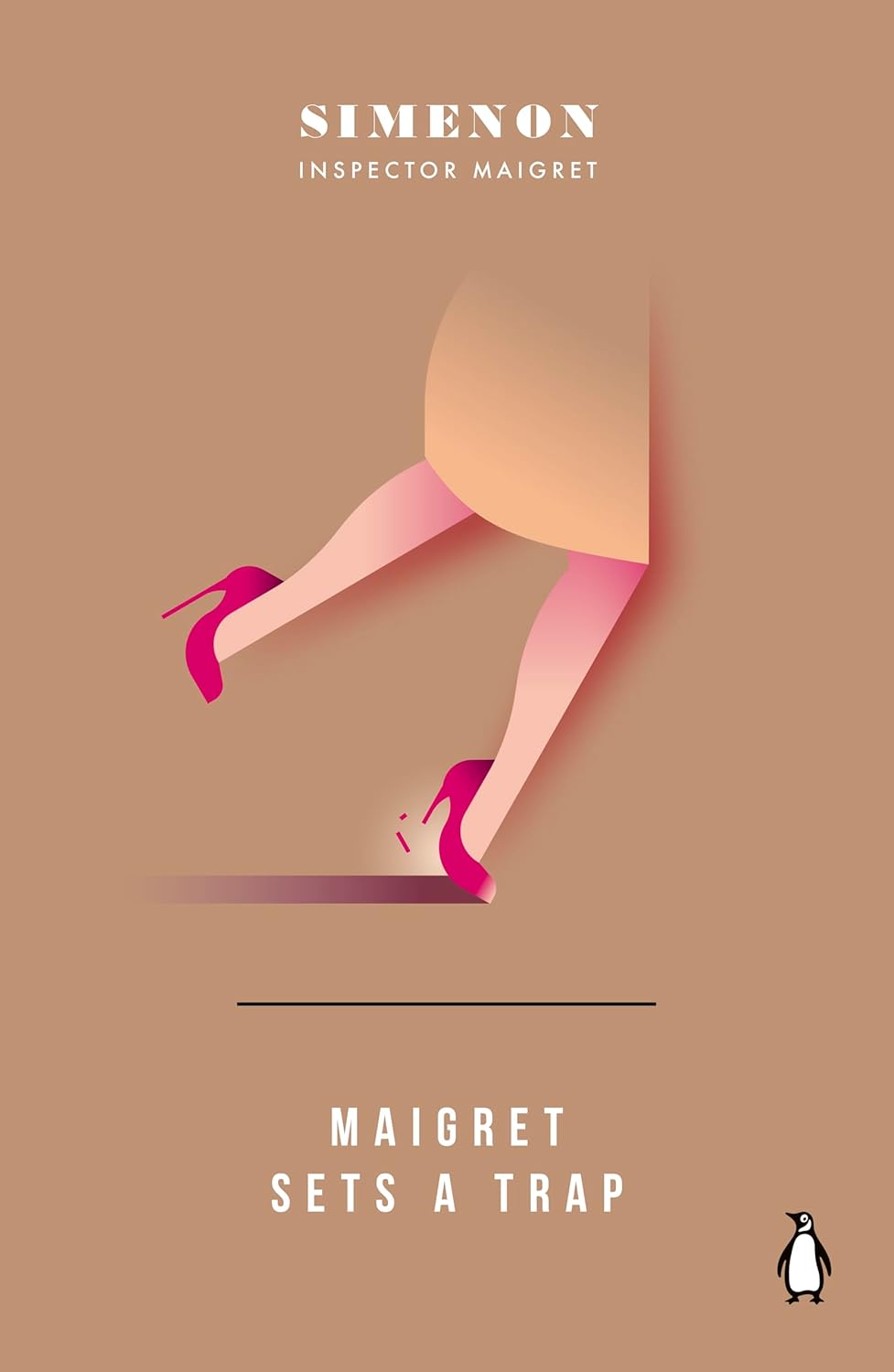


Despite enjoying a few standalone titles by Belgian minimalist Georges Simenon — thanks in no small part to the Orion Crime Masterworks series — I was left rather ambivalent by my first encounter with Inspector Jules Maigret in The Late Monsieur Gallet (1931). A recent comment on that post, however, directed me to a few titles which might be to my liking, and so here we are with Maigret Sets a Trap (1955), the forty-eighth of seventy-five books featuring the character. A serial killer has already murdered five women in the same Paris arrondissement, and while much of what follows feels very familiar, you also have to wonder if it was Simenon who established a pattern that others would so intently adhere to in the decades ahead.
We begin with something already afoot, Simenon sparsely yet easily painting Maigret as famous in his methods where the watching Press are concerned — “When [he] sent for a trayful of beers, it indicated that he thought they would be there for some time.” — and awake to the seriousness of what he is undertaking (“Five women had died, and there was no reason to think it would stop there.”). That the eventual reveal leans into the emerging psychology that was finding its way more and more into crime novels in this era is unsurprising, and the threads of psychology picked up throughout feel familiar now but as if they are asking genuinely startling questions in 1955:
“At what moment did the impulse seize him? Do you see what I mean? At what moment does he stop acting like you or me, and start acting like a killer? Does it strike him at some point during the day, and does he then wait for nightfall to prepare his plan of action? Or on the contrary, does the impulse come over him the instant an opportunity offers itself? At the very moment when, walking down an empty street, he sees a possible victim?”
Reflections on how responsible the killer may be for his actions rub against the growing discomfiture of the populace at large (“Everyone is watching the neighbours with suspicion. We’ve received hundreds of letters informing us about the strange behaviour of perfectly normal people.”). And while the psychological toll on Maigret isn’t exploited in the way that you feel a modern crime novel would wring him out and flap him around a bit, there’s a sense of a man under pressure feeling himself separate from the world around him — lying to his wife, which he hates — and being always aware of his status as a public figure, with associated pressure more implied that explored.
And so, in this region of the capital with its “hundred dark corners where an attack could take place almost without risk”, Maigret sets his trap and must deal with the fallout. Again, one feels that a modern author — or one who relied more on shilling shocker techniques — would delve into this more deeply, but there’s a power of sorts in Simenon’s minimalism, and the translation by Siân Reynolds both keeps the developments taut and finds some unlikely poetry at times:
The police would still be scouring the Montmartre area, street by street, house by house, until the dawn lit up the dustbins pulled out on to the edge of the pavements.
Very little herein with surprise or even really fully engage the modern reader, who has seen it all a million times, but, as I said above, this is both a period of genre fiction in transition, with the forensic science evinced nearly five decades earlier by Dr. John Thorndyke still holding sway (“After all, three years earlier, had they not identified one criminal thanks to traces of sawdust on a handkerchief, and another through a spot of printer’s ink?”) yet modern concerns like an awareness of the importance of keeping the Press on-side very much in Maigret’s thoughts. Plus, again as above, it’s to be wondered if the developments which seem to hoary now were ever quite deployed in this way before. It seems unlikely that Simenon would write so trammelled a book, with the concentration of his efforts deserving perhaps more consideration for innovation than we now realise.
Little moments speak loudly, such as our embattled Chief Inspector being likened to a concert pianist as he prepares to confront a suspect, and while the final recourse to psychology of two women involved in the case doesn’t quite ring true for me — innovation will always stumble at some point, the ground being unmapped — this might just have the most perfect final sentence of any book I’ve read in the past decade of this blog, with a sentiment that reverberates back into what you’ve just experienced and paints elements of it in a new light.
This has been, then, an interesting delve into Simenon’s oeuvre, which hints at a power in the concentration of his writing which was conspicuous by its absence in my earlier sample from this series. It would overstate the situation to say that I’m now a convert and will dive hungrily into his other works, but there’s definitely something about this which makes future visits to the Maigretverse a far more likely and appealing prospect. I won’t be reading all seventy-five of them, but the occasional toe in these Parisian waters might be just the sort of revitalising experience the GAD doctor ordered. Expect developments.
 The Invisible Event
Really glad this Simenon rang your bell, Jim. Bienvenue!
LikeLike
It’s a great translation, which really helps. And that final line is magnificent. Here’s to more Georges in the months and years ahead…
LikeLike
I thought you might be reading Simenon in French.
LikeLike
If I could read French to that standard, I’d be ripping through Boileau and Halter first, believe me…
LikeLiked by 1 person
The series get better and better. I’m reading them in order
LikeLike
Stands to reason, I guess. Most authors improve after their first few books, right? I’m really pleased you’re having such a good time with these, how many have you read?
LikeLike
I am wondering if my mistake with Simenon is trying to do Maigret in order… Strongly considering trying to start in the middle now!
LikeLike
It’s fair to assume that, with so many books in the canon, Simenon would have been a bit up and down in quality, so I imagine starting anywhere is bound to unveil something a reader likes. I was fortunate enough to be guided to this one (and a few others), and I’m glad I was!
LikeLiked by 1 person
That makes a lot of sense. I think given I am unlikely to do them all, just dipping in to do some would be a good strategy.
LikeLike
I’m a big fan so I think there are excellent reads from across all 40 years. But MAIGRET SETS A TRAP, or MY FRIEND MAIGRET, are two I often recommend as a good jumping on point. But sure, the initial 19 books were pretty much all written by Simenon before he turned 30 and are very varied. By the 1950s one could argue the style and approach was more homogeneous. But they all have greatness…
LikeLiked by 1 person
I’d never read Maigret before and had been tempted several times. Then late last year I found someone on eBay selling 65 “like new” editions for £65. They were the most recent translations for Penguin. So I took the plunge (as I’ll never see that many, virtually new, at that price again). I considered reading in order but I’ve been dipping in and out and have read half a dozen so far. I can’t say they’ve been Earth-shattering but they have been enjoyable and, as you say, venturing back into Maigretland every now and then has been good.
LikeLike
Wow, that’s an amazing deal! Like you, I doubt that Simenon never wrote anything earth-shattering, but for quiet and at times impactful little stories of dogged policing which don’t overplay the social or emotional aspects too much I can easily believe that there’s some small, quiet enjoyment to be had in these slightly psychological tales.
I’ll definitely get to more of them in due course; are there any you’ve read so far that you’d recommend?
LikeLiked by 1 person
I got lucky out of someone else’s sadness. The seller was going through his late father’s things and just wanted them gone, I think. Having done that myself, I know that sometimes you just don’t want to faff around trying to get the best price. He was happy they were going to a good home. I’ve only read half a dozen so far but I did enjoy The Cellars at the Majestic, The Hanged Man of St Pholien and The Yellow Dog.
LikeLike
Thanks for the recommendations, will keep them in mind as I periodically return to this series.
LikeLiked by 1 person
There’s a 1992 TV series adaption of Maigret with Michael Gambon that’s absolute perfection in my book. This story was the first episode of it.
LikeLike
Thank-you, yes, I’m old enough to dimly remembering seeing it on ITV as a kid, and it was Gambon I largely pictured in the role while reading this. Maybe I should check it out, you raise an interesting prospect…
LikeLike
I’m thrilled you enjoyed it, and glad you found my comment helpful! I certainly hope it continues to be a steady guide as you navigate the “Parisian waters” (though I think I recommended quite a few books set outside Paris, didn’t I?). One thing I often think about is how hard it is to get into some of these ultra-prolific authors. As you well know, first impressions are extremely important when trying out new writers, but they’re always rather tricky. You certainly don’t want to start on a bad book, but you also don’t want to read something which is excellent but highly unusual and unique in the author’s oeuvre (for example, “Heir Apparent” would certainly set the wrong expectations for a prospective Henry Wade completist). I wish someone would do a series of guides for new readers of old masters (like the old “five to try” posts) to address this very issue.
You’re quite right to focus on Simenon’s minimalism, and that very quality is why he’s one of my all-time favourite writers. His atmosphere is also second-to-none, as far as I’m concerned, as he is able to create a thick sense of dread and foreboding without any use of purple prose or extended stream-of-consciousness interludes (I’m looking at you, Charlotte Armstrong!). His work may look a bit thin on first reading, but the thing I found with him is that the more you read his work, the stronger you feel it. Very few novels actually actively develop the character of Maigret, but once you’ve read a dozen or so Simenon novels, you can feel his character more acutely and precisely than any literary detective I can think of. Now, that I’m very well versed in all things Maigret, very small touches (like Maigret catching snowflakes in “Maigret’s Little Joke” or his dourness in “Maigret and the Young Girl”) feel like momentous shifts in the canon. Simenon reveals Maigret’s character bit by bit across all of the books, and it’s a delight getting to know him.
Reading the entire canon feels a bit like a fool’s errands (especially since it’s of rather varied quality in the early years), but I get the Simenon itch every few months, and I’ve imperceptibly found myself quite close to completing it. Simenon is, of course, one of the most influential crime writers of all time. You can feel him and his approach to the mystery genre in almost every French film (especially those by my perennial favourite Claude Chabrol). His fingerprints are all over European detective fiction from the 20th century and even the Japanese shakaiha school (Seicho Matsumoto is pretty much the Japanese Simenon) in the same way that Nordic Noir is now the prime influence in the genre.
As for the Maigret films, I reviewed almost all of them over on IMDb a while ago (https://www.imdb.com/list/ls539910073/). “Maigret Sets a Trap” with Jean Gabin is not only one of the best Maigret films, but also one of the finest detective films ever made. Still, my favourite Maigret is Harry Baur in 1933’s “A Man’s Head”. Baur is for Maigret what Suchet is for Poirot, as far as I’m concerned. He’s exactly right!
LikeLike