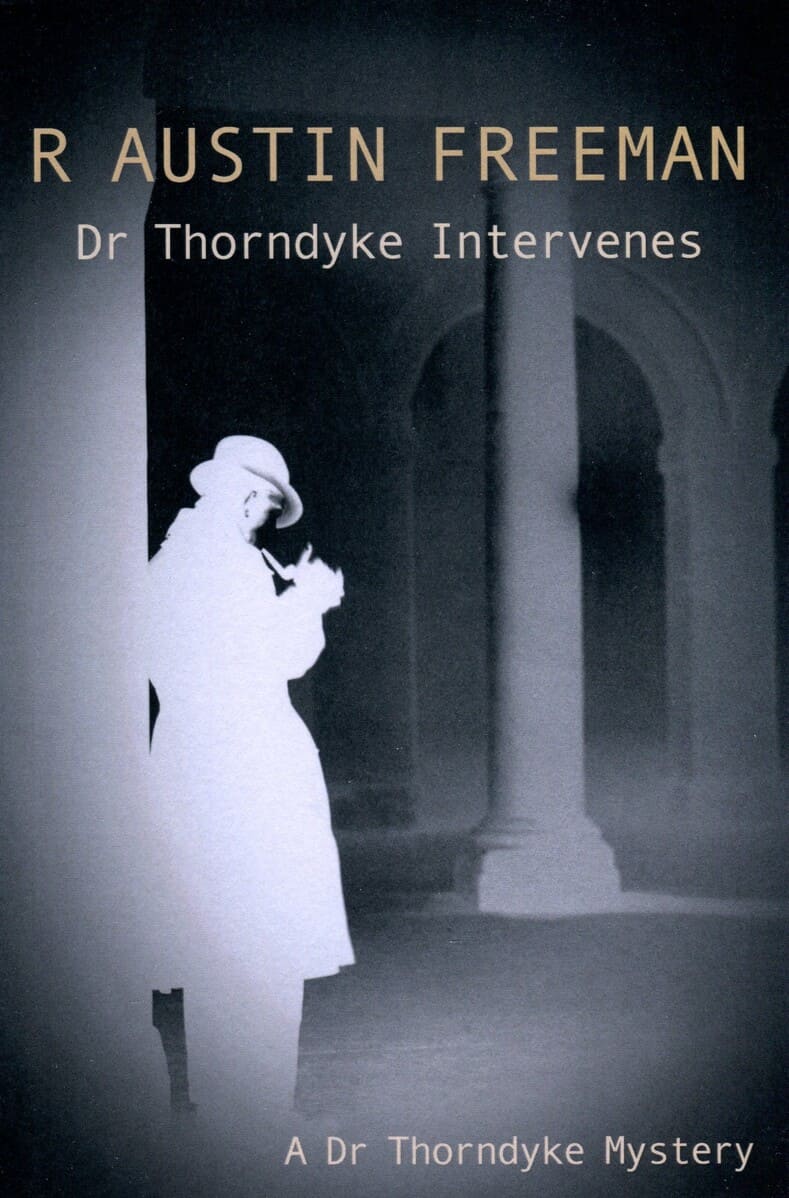


The next couple of years will see me read the final few titles by a bunch of authors I’ve come to very much enjoy: I have five novels by Freeman Wills Crofts remaining, five by J.J. Connington, and now, having read Dr. Thorndyke Intervenes (1933), six by R. Austin Freeman. So my enjoyment of these books — and their later books are still proving enjoyable, though I appreciate that may not continue, with John Dickson Carr‘s work already stumbling into that slough of despond — is tinged with melancholy. It’s been such fun, and I don’t want it to end; and I especially don’t want it to end on a damp squib of turgid prose and bumbling plot mechanics.
Once more tinkering with structure, this fourteenth novel-length case for esteemed medical jurist Dr. John Thorndyke sees two threads weave around each other all the way to the close. The first concerns the discovery of a severed head in a case in the left luggage office of Fenchurch Street station, and the second concerns American gentleman Christopher J. Tippet coming to London in the slim hope that some old family papers give him a claim to an Earldom. When Mr. Tippet makes the acquaintance of a Mr. Buffham, who is clearly in the affair for all he can get out of it, and Buffham puts Tippet in touch with his “legal friend” Mr. Gimbler, things begin to move.
Thorndyke is approached for his involvement in the case, and there are already complications aplenty. The current Earl of Winsborough hasn’t been seen for at least three years, believed dead somewhere in Africa, and Tippet’s claim rests largely on the belief that a former inhabitant of the rôle — and antecedent of Tippet’s — was leading a double life, faked his death, and packed his coffin with pieces of lead. It should just be a small matter of opening the casket to find out, but since Tippet has no standing to do so unless they know he’s the rightful Earl, and they don’t know he’s the right Earl unless…well, you can see the legal circles one gets drawn into.
The sudden entry, like a whiff of fresh air, into this fog of surmise and rumour, of a promise of real, undeniable evidence, made the testimony of the remaining witnesses appear like mere trifling
This might be the most playful Freeman has ever been in the long form and, while he doesn’t exactly pile on complications in the tradition of the finest puzzlers, it’s lovely to be swept up in the fun of it all. Sure, he still writes in a slightly old-fashioned style, but then he hits you with a lovely character note (“A retreating tendency on the part of the bait is apt to produce a pursuing tendency on the part of the fish.”) or starts adding complications (our bodyless head needs, after all, a headless body…) that can’t help but quirk even the stiffest lip.
Thorndyke remains the detached observer throughout it all, of course, at times giving others around him a sense of ghoulishness (“You were speaking just now of this man ‘having a human head on his hands’ as if it were a worn-out umbrella or an old pair of boots.”) but remaining clear-sighted about what has evidential value and what is mere profitless, potentially distracting, speculation. He still fascinates as a repository of knowledge that feels somehow obtainable yet superhuman — the colour of dust, carpentry innovations of the 1850s, the obscure chemical principle on which the muddle of the corpseless head revolves — and the man’s ability to foresee difficulties, and to explain away how he foresaw them, makes his brand of genius far more compelling than many attempts at the same.
Thorndyke is aided in all things by his artificer Nathaniel Polton, easily my favourite minor character of the Golden age…
Polton…carried a small suitcase with a secretive and burglarious air, persisted in walking on tiptoe, and generally surrounded himself with the atmosphere of a veritable Guy Fawkes.
…and we have narrator Christopher Jervis on hand to see everything, miss its implications, and occasionally provide a lovely description of some otherwise mundane action (“For now, as we peered down the well-like shaft at our friend — already grown small in the distance — faintly illuminated by the glimmer of the candle, we were able to realize the horrible depth to which this strange memorial of a forgotten race sank into the earth.”). There are also a few lovely weird touches of zero consequence, like a man not being sure what his middle initial stands for or someone being accused of “moguing” (clear in context, but still…).
The resolution of Tippet’s story is rather wonderful, too, and rounds out the character side of this very well. Such an enterprise could easily get bogged down in legal and plot mechanics, but Freeman retains an eye on his people, ensuring that the human cost of all this manoeuvring is front and centre. It’s wonderful to see the efforts he’s gone to in varying his approaches over the last several books, and very pleasing to report them as the successes they are. It bodes well for what little of his work in this corpus remains, but, of course, the important thing is really the joy had with each book, not the potential disappointment of any future failures. And in that regard, this is once again a great success.
~
R. Austin Freeman on The Invisible Event:
The Red Thumb Mark (1907)
John Thorndyke’s Cases, a.k.a. Dr. Thorndyke’s Cases [ss] (1909)
The Eye of Osiris, a.k.a. The Vanishing Man (1911)
The Mystery of 31 New Inn (1912)
The Singing Bone, a.k.a. The Adventures of Dr. Thorndyke [ss] (1912)
A Silent Witness (1914)
The Great Portrait Mystery [ss] (1918)
Helen Vardon’s Confession (1922)
The Cat’s Eye (1923)
Dr. Thorndyke’s Casebook, a.k.a. The Blue Scarab [ss] (1923)
The Mystery of Angelina Frood (1924)
The Shadow of the Wolf (1925)
The Puzzle Lock [ss] (1925)
The D’Arblay Mystery (1926)
The Magic Casket [ss] (1927)
A Certain Dr. Thorndyke (1927)
As a Thief in the Night (1928)
Mr. Pottermack’s Oversight (1930)
Pontifex, Son and Thorndyke (1931)
When Rogues Fall Out, a.k.a. Dr. Thorndyke’s Discovery (1932)
Dr. Thorndyke Intervenes (1933)
 The Invisible Event
At this point, I reckon you’ve got one more excellent novel to come, plus another which is hugely enjoyable for giving you the backstory of the best minor character of the Golden Age.
LikeLike
Well, that’s awesome news — thank-you for letting me know 🙂
LikeLike
This one was adapted for radio for BBCs Saturday Night Theatre under the title ‘The Corpse In The Case’ and broadcast on 9/6/62. It was adapted by Mollie Hardwick and starred Cyril Luckham as Thorndyke. Unfortunately at the moment it’s considered missing from the archives, though Mr Pottermack’s Oversight, which she adapted the following year does still exist and is on YouTube.
LikeLike
I presume they simplified the plot for the radio adaptation, because this would be a long and complicated time otherwise. I guess we’ll never know….but here’s hoping it turns up in an obscure archive at some point.
LikeLike
Well the runtime was 90 minutes so I’m not sure. The adaptation of Pottermack is fairly accurate to the book, with some obvious changes like removing the Prologue and starting with Thorndyke studying the photographs of the footprints.
LikeLike
Hmmm, a photograph clue on the radio? Yeah, that’s a tough ask. You make me want to check this out more and more.
LikeLike