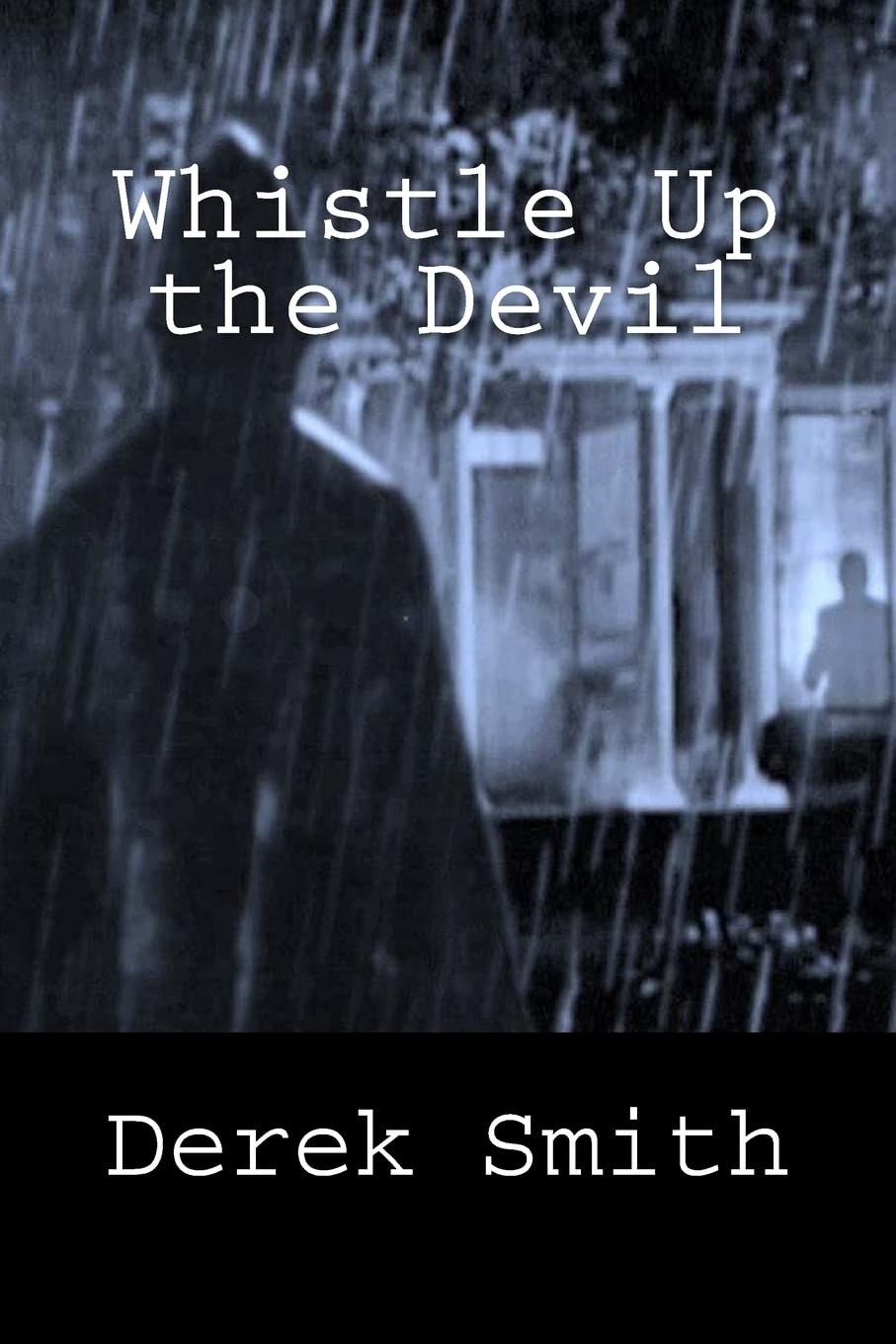

It is moderately funny to me that I searched for years for Whistle Up the Devil (1953) by Derek Smith, only to finally run a copy to earth for sensible money — with a dustjacket and everything — in 2014. Then, about two months later, Locked Room International republished it along with all Smith’s crime and detective fiction, and I went from zero copies to two in no time at all. In 2018 I called it one of my fifteen favourite impossible crime novels, and one of those has already dropped off the perch, so revisiting this in January 2026 was fraught with peril. But, well, if anything, a second read has given me even more to enjoy about it, and it thankfully remains available now for you to get it for sensible money…so go, quickly!
Exhorted by his friend Chief Inspector Steve Castle, amateur sleuth Algy Lawrence goes down to the family pile of the Querrins in the hope of forestalling elder sibling Roger from seeing through a potentially fatal ceremony: locking himself in a room and seeing if the ghost of a murderous ancestor turns up to relay an apparently ancient family secret. When Roger is stabbed in the back in the locked room despite Algy and younger Querrin brother Peter watching one entrance and local policeman Sergeant Hardinge watching the other, it really does seem as if they are faced with a killer “oozing like smoke through the solid walls”.
Individual responses to books do, of course, vary, but it’s not exactly unheard of for a book to acquire a reputation through unavailability and then turn out, for this reader, to be something of a dud (Exhibit A). So not only was it a delight to find this so enjoyable on first read, it’s great to go back to it over a decade later and see even more here to admire: some superbly unsettling scene setting (“[I]t had been in just these words that the tale had been told a few weeks before, at the dawn of the terror.”), rich genre awareness (The Big Bow Mystery (1892) by Israel Zangwill, Inspector Joseph French, DCI Edward Beale, and others all get a mention), and a pleasingly light touch…
The sergeant muttered something that sounded more like a profanity than a prayer.
…in copious evidence.
Most impressive is how adept Smith proves, in his first novel, at weaving in a genuine touch of Agatha Christie into his clues. I’ll obviously not spoil how, but there are several moments which, when you know the guilty party, read very differently to how they would first time around, and the boldness of this is simply delightful. It’s true that Lawrence himself is a sylph of a character, with the likes of Uncle Russ and Hardinge coming through much more strongly — I’d read another several books about either of them — but when steel shows in Smith’s writing it rings true and fits into the classical mould we’re hoping for:
“I don’t hang murderers to flatter my ego. Whatever a killer’s done, it makes me sick to trap him… I don’t want to sound pompous, damn it, but I think I serve the cause of justice. And I believe, with all my heart, that the person who killed Roger Querrin deserves to be sent to trial.”
Inside a tiny cast, Smith does a job on par with Christianna Brand of hiding his killer and stirring in two excellent impossible murders which are resolved clearly, cleanly, and with zero hand-waving. To see a debut novelist apply himself so confidently to the Grandest Game in the World makes the heart ache that only one other Algy Lawrence novel was ever written, and while we can nitpick — the romance is weird, the final scene unnecessary — the simple fact is that few people ever took on this subgenre with the confidence of the best and made it work. Yes, okay, there’s a blazing clue — (rot13) gur gurezbf synfx — never mentioned that could easily have been mixed in, but everything else is there, it rattles along at a fair lick, and I loved every moment of this second visit.
That’s all I have to say, really: this book is spry, fun, flawed, and beautifully creative, and if you’re a fan of impossible crimes and have somehow not yet read it then I suggest that 2026 be the year you correct that. I’ll reread Smith’s second and final novel Come to Paddington Fair (c. 1954) in due course, but for now this has been wonderful and made me very happy in these gloomy Winter days.
 The Invisible Event
In his introduction, Adey writes that Derek Smith “recalled with great fondness Philip Levene’s locked room radio play, “Murder Beyond”. Does a recording of that still exist somewhere I wonder?”
Well, it actually does! The BBC released it on CD and streaming in the past few months as part of the “Murder Is My Subject & Other Thrillers” collection. It’s also available on YouTube for those of us with more seafaring proclivities.
Having just listened to it, I don’t think it’s any kind of a lost masterpiece (the characters are thoroughly interchangeable and the central trick depends a bit too much on the ol’ “and nobody noticed” handwave for my liking), but the atmosphere is wonderful, the pacing is fast, the problem familiar yet interesting, and the detective rather likable in a low-key way. Well worth a listen, especially since it’s only 50 minutes long!
LikeLike
There are not that many locked room radio plays to begin with. So I’ll take a fairly decent and fun one. Thanks for the tip-off!
LikeLike
Sounds like a lot of fun, thanks for bringing it to wider attention.
LikeLike
The 2nd impossibility in this one for me has one of the strongest and most brazen solutions in the . I’d say it’s on par with Death of Jezebel.
LikeLike
*in the GAD repertoire
LikeLike
Yes, it was really pleasing to reread this and see just how brazenly Smith is going about things here. It’s a phenomenal performance, and I bitterly regret that he wrote so little in the genre.
LikeLike
Your reread prompted me to grab this from the big pile and I just finished it.
I read classic detective fiction first and foremost for the puzzle and this one reminds me of the fine workings of an expensive Swiss watch. Smith really impresses with the intricate plotting of the impossibilities. So many times times solutions to impossible crimes underwhelm or fail to convince, but the two in WutD really deliver. I can see how rereading this would be a pleasure to witness the culprit actions as they happen.
Plus the references along the way to Clayton Rawson, John Dickson Carr, Rupert Penny, etc. put a smile on my face whilst reading.
Some impossible crime fiction I admire but fail to enjoy. With this one, I come away with both. Thanks for prompting me finally to read this.
LikeLike
The most incredible thing here is that you hadn’t read this before — you’ve got such great coverage of so many obscure books, I’m honestly surprised that you’ve only just gotten to WUtD. But I am, of course, delighted that you enjoyed it so much.
LikeLike
I requested this from the library via ILL after seeing such a strong recommendation and it came surprisingly quickly. It was VERY not for me, and I’m starting to realize that as much as I appreciate impossible crime, I find it impossible to visualize floor plans and so am incapable of really appreciating many of them, so the things that people seemed to really enjoy here are not my thing. I’m going to just link to my review with the rest of my critiques so they don’t pollute the positivity on the page lol. (All I’ll say is… to say the romance was weird is an understatement.)
On the other hand, I DID read a nice number of other recommended books from your blog and really enjoyed them! The Man Who Slept All Day and The Hours Before Dawn were particular highlights; Cat and Mouse was… weird and annoying but enjoyable? Very Christianna Brand lol. And The Man Who Died Seven Times was a really interesting concept very well done, though also very much with its weirdnesses. (I haven’t read your reviews of these yet but figured I didn’t want to automatically spam your blog- if I read your reviews and feel like there’s something I want to respond to I will over there.)
LikeLike
Well, nothing is for everyone, and WUtD is very much the sort of book that people who are nerdy over impossible crimes will find more compelling — some of the clewing here is magnificent, and that’s rare indeed in the era its written. The slightly stodgy characters and weird relationships are hardly new for the puzzle mystery, but someone less into the puzzle will, I completely agree, be more frustrated by those elements,
Still, I’m delighted those other books mostly worked out for you. There’s so much breadth in this genre, it’s great fun to see how more playful approaches can appeal to people in different ways.
LikeLike