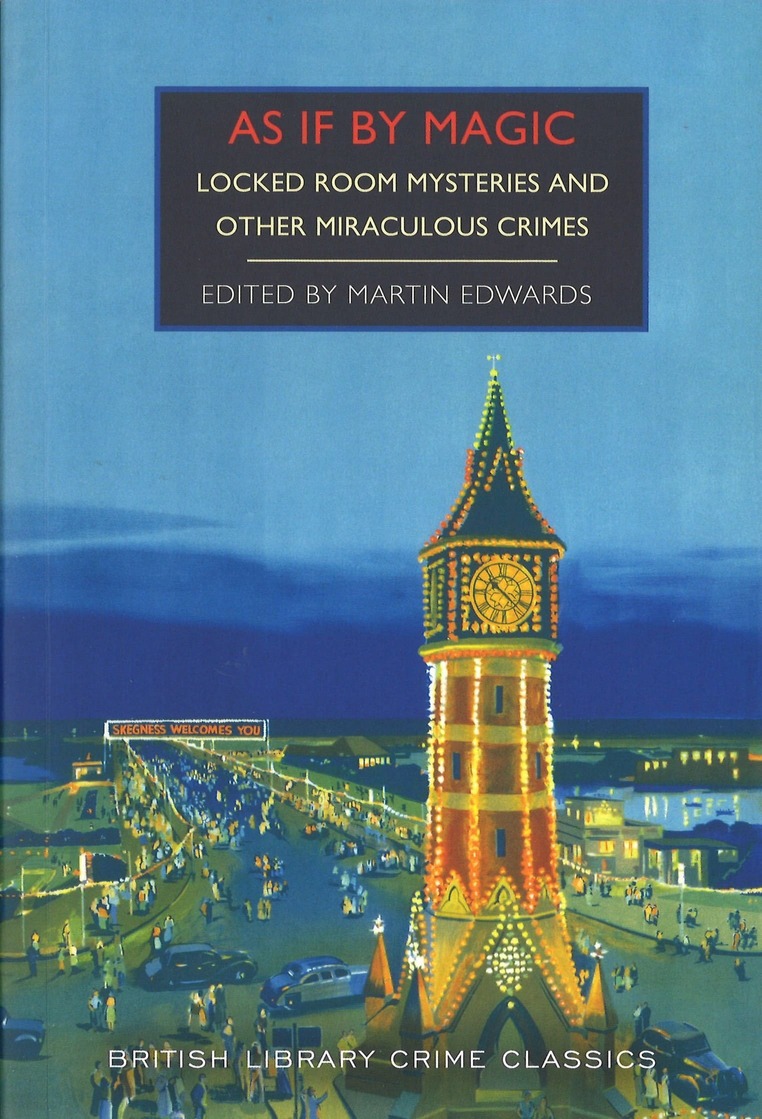
A second anthology of impossible crimes from the British Library Crime Classics range, As If by Magic [ss] (2025) is another genre-spanning collection from editor and Detection Club President Martin Edwards that does much to highlight the depth and breadth of classic crime and detective fiction.
Pleasingly, Edwards takes time in his introduction to confront to current mislabelling of closed circle mysteries as ‘locked room’ stories, and while he’s right to acknowledge it might only matter to the purist it’s at least nice to see this addressed in so popular a medium. He’s kind also enough to say some complimentary things about a few blogs, The Invisible Event included, and on these two points alone I think we can safely declare it his best introduction to date.
As to the stories, well, let’s get baffled…

I’ll be honest, I’ve never been sure if ‘The Wrong Problem’ (1936) by John Dickson Carr counted as an impossible crime. The initial conundrum of a man stabbed in a watched house could be got around by, y’know, approaching from the unobserved side, after all. I always forget the second stabbing, in an empty room, which is more obviously impossible — witness testimony aside — but disappointingly mechanical. But the mood here (“Those days after the funeral were too warm; and suspicion acted like woollen underwear under the heat.”) is so completely Chestertonian, as Douglas G. Greene observed, that it’s hard not to enjoy on its own terms.
Edwards typically manages to include some of the antecedents of the Golden Age in these collections, which has played no small part in my growing interest in that era of crime story, and ‘The Warder of the Door’ (1897) by L. T. Meade & Robert Eustace continues this excellent practice. Concerning a family curse that seems to trap the first-born of the Clinton family in an after-death vigil guarding a “coffin with hath not human shape”.
It’s a nice idea, and does well not to descend into Victorian melodrama too deeply, our narrator keeping his wits about him for the most part (“There might be a hidden spring, or tilted hinges…”). Fun to think of some old-timey bastard in the Clinton bloodline doing all this just to mess with future generations, too. All told, a far better tale than its provenance might have you anticipate.
I’m not sure I considered ‘The Ordinary Hairpins’ by (1916) E. C. Bentley an impossible crime story even when the equally genre-savvy Otto Penzler included it in the Black Lizard Book of Locked Room Mysteries [ss] (2014). The notion of disappearing without a trace borders on the impossible, but that disappearance being achieved by falling overboard on a boat…well, that happens all the time. I imagine.
Still, there’s some intelligent reasoning displayed by artist detective Philip Trent in the final stages, and fun to be had in the misinterpretations of events (“…from Canada, you will remember.”). I like it as a story, and it’s made me affirm that I will try oce again to get through Trent’s Last Case (1913), but it’s not in the subgenre by my reckoning.
Several years ago, I spent a very happy afternoon in the British Library reading Giglamps [ss] (1924) by Will Scott, and thought I had written the collection up for this blog. Not so. And therefore ‘The Vanishing House’ (1924) coming to public awareness is both great, because it’s a lovely story, and vexing, because I thought I’d done it first. Not only is Scott’s prose charming…
Balanced on his nose — their presence here no doubt incapacitating their lawful owner in the search for them — were a pair of pince-nez.
…the easy assumption by which a vanishing body — or, indeed, a vanishing house, take your pick — is beautifully slight. Add in our tramp sleuth’s humorous tongue (“In the hands of a country cop a mere suspicion is to a conviction what Carlisle is to Scotland. Y’understand me? Too near to be nice.”) and it’s to be hoped that this isn’t the last we see of Scott or Giglamps in this series.
An impossible shooting confronts us in ‘The Border-Line Case’ (1936) by Margery Allingham, and if the workings aren’t exactly going to set anyone’s life on fire, the human frailty of how the crime warrants inclusion in this subgenre has something beautifully relatable about it.
I can fault ‘The Shot That Waited’, a.k.a. ‘The Duel of Shadows’ (1934) by Vincent Cornier only in that the first time I read it, in the Mike Ashley-edited The Mammoth Book of Perfect Crimes and Impossible Mysteries [ss] (2006), Ashley’s introduction gave away the eventual reveal. It’s true that Cornier’s prose feels a little elliptical at times and I don’t love (rot13) gur svercynpr abg orvat zragvbarq hagvy gur fbyhgvba, but this improves on the Ashley anthology by providing a lovely diagram, and this level of ingenuity is rather hard to beat.
With a title like ‘The Gold of Tso-Fu’ (1926) you can feel Ronald Knox shying away in pre-emptive horror, but Anthony Wynne‘s story is mostly about a man claiming to have committed a murder when the victim was alone in a watched room and our murderer presumptive was several miles away.
This is…well, it’s not good, is it? And yet, there’s something about it that stands in contrast to the previous stories in how lacking in subtlety and ingenuity it is which seems to speak to the range of possibilities of the impossible crime (a subgenre, it must be said, to which I have given waaaay more thought than, y’know, any normal person). It’s a shame to see the potential of Wynne as a wrangler of impossibilities (Adey and Skupin have a combined 24 entries about him) decline so much, but I guess we need reminding of the prospects within the genre, and that includes hoary examples such as this.
Contrastingly, ‘The Two Flaws’ (1934) by Hal Pink is simply told in unadorned language and, with its pulp roots on show, is rather charming in its simplicity. A man stabbed in the heart, the only key to the locked door on the table next to him…this recalls The Clue of the New Pin (1923) by Edgar Wallace, and arguably bests that tale by its method being comprehensible come the end. Stands as the impossible crime in a microcosm: entertaining, and with a few good ideas along the way.
I’ve read ‘Murder Game’, a.k.a. ‘The Gemminy Crickets Case’ (1968) by Christianna Brand twice before, but how can you not want to spend time in this company? A conversation between two men concerning the murder of a lawyer found in his locked, bolted office strangled, bound to a chair, stabbed in the back, in front of a burning desk, this has many delightful contortions — Brand couldn’t tell you the time without a wonderful elaboration or five, I’m sure — yet remains clear and tightly-focussed throughout.
The final answer, too, shows how much life there is in the stock solutions when the effort is taken, as the best in this subgenre always have, to do a little more with the setup. Go from the problem straight to the solution and it’s no more than the Hal Pink story which preceded it; add in a strangled policeman across town, mysterious phone messages babbling about “the long arms…”, and four false solutions and we’re in heaven. And the final revelation is too damn satisfying for words.
I read ‘Too Many Motives’ (1930) back before James Ronald was cool, and I enjoyed his pulp sensibilities enough to revisit this. It’s not an impossible crime — the situation rather mirrors one of Arthur Conan Doyle’s Sherlock Holmes stories, or one of the facets of The Rynox Mystery (1930) by Philip MacDonald — but this story of a man who invites to dinner four other men who all loathe him, only for their host to end up shot with no gun in sight is quickly told and difficult not to enjoy, not least for the intelligent guesswork Dr. Daniel Britling engages in to bring it all to a satisfying conclusion.
Of supplementary interest — to me, at least — is that the text here clearly differs from the version I originally read, since it lacks several of the quotes included in my previous review. I checked, and this text matches the one in the Moonstone Press collection of the Dr. Britling stories, so clearly the story must have been published in more than one place, and earned itself a minor rewrite. Intriguing.
My experience of the work of Ernest Dudley has, to date, not filled me with much excitement, and so I approached ‘The Case of the Man Who Was Too Clever’ (1943) with caution. And, well, this story of a dead woman in a locked bathroom once again fails to exhibit the intelligence and rigour even the fourth-best of the Golden Age could offer (FFS, there’s — rot13 — na haybpxrq jvaqbj jr’er abg gbyq nobhg).
Dudley really does for me encapsulate someone writing about intelligent detection without even the vaguest notion of what it is. His Dr. Morelle might honestly be the most condescending, pompous, and unpleasant protagonist of the entire era, as complete a misunderstanding of the Golden Age as it’s possible to achieve.
‘The Broadcast Body’ (1936) by Grenville Robbins is fun — our narrator’s Uncle John believes he can broadcast his physical form in the same way a television camera transmits sound and images, and vanishes in the process — and uninspired. The workings are pretty hoary, but the explanation behind it all is at least conveyed with a little more vim and interest than might otherwise be achieved. Well-written and enjoyable, I intend to revisit Robbins’s ‘The Broadcast Murder’ (1928) after seeing him do so well here with so little clay.
Michael Gilbert is a well-established feature of these collections, and ‘The Coulman Handicap’ (1958) does a good job of wrangling an impossible disappearance into the shape of a more grounded police story. Gilbert tantalisingly dangles the core principle in front of you, and while this lacks for rigour, as this era of crime story had already shifted away from the pure puzzle, it’s a nicely-dressed problem that is to be lauded for managing to smuggle some of the genre’s more playful heyday under the wire.
‘The Last Meeting of the Butlers Club’ (1980) by Geoffrey Bush is a long way from the Golden Age, and not even a locked room mystery, but never before has something that does not fulfil the requirements of its inclusion felt so damn right in a collection. It is by turns charming, hilarious, wonderfully sinister, and — by its own magnificent logic — absolutely an impossible crime story.
It is perhaps unsurprising that Bush was a friend of Edmund Crispin, because this has about it the sharp tang of Crispin’s best short stories and you can tell the two men shared a sense of humour. We’d be appalled if this was written during the Golden Age, of course (all those infallible sleuths…!), but its era suits it perfectly and Edwards is to be roundly applauded for including it.
I read ‘As If by Magic’, a.k.a. ‘The Hiding Place’ (1954) by Julian Symons several years ago, and this short newspaper story had the same effect on me this time around as back then: it’s not really an impossible crime, but difficult to object to given the little space it uses well to do what it does.
The only excuse for not finishing the collection with the Bush story above is if you’ve got something even more superb instead, and ‘The House in Goblin Wood’ (1947) by Carter Dickson is certainly that, right? Except…I dunno, this is about the fifth time I’ve read this tale of an impossible vanishing and the sheen has come off for me. Yes, the atmosphere is great and the way that playful things aren’t playful when you know what’s going on is masterful…
…but, dammit, there’s simply not enough time to do the thing that gets done: it would take aaaaages, and gets allowed here simply because it’s such a magnificent idea that you don’t stop to consider the temporal impossibility never addressed. It’s still several heads and shoulders above the Ernest Dudley and Anthony Wynne stories, but my advice would be to read this no more than once per decade.
And so, a top 5:
- ‘The Last Meeting of the Butlers Club’ (1980) by Geoffrey Bush
- ‘The Warder of the Door’ (1897) by L. T. Meade & Robert Eustace
- ‘Murder Game’, a.k.a. ‘The Gemminy Crickets Case’ (1968) by Christianna Brand
- ‘The House in Goblin Wood’ (1947) by Carter Dickson
- ‘The Vanishing House’ (1924) by Will Scott
This collection contains, perhaps, slightly fewer uncommon tales than the impossible crime nerd in me would demand, but as a primer for a general audience it does a great job of showcasing the sweep and possibilities of the subgenre. The good stories here really do show off how to do this well, and the less successful ones highlight the difficulties in laying the extra level of preparation that make this the Grandest Game in the World.
The key with any such collection is range, and that’s here in spades. I wanted to read everything in here despite having encountered at least half of the stories before because it only seemed fair to give the entire collection consideration not just my own cherry-picked parts. And, as a collection overall, I think it’s more successful than the first set of impossible crimes the BL put out, Miraculous Mysteries [ss] (2017), which is a very pleasing state of affairs.
Might we get a third volume in another 8 years? And how incredible that the BLCC range has been so successful that we can almost take for granted that it might still be putting out volumes eight years from now? A starting selection of famous names could include ‘The Blue Sequin’ (1908) by R. Austin Freeman, ‘The Blast of the Book’ (1933) by G.K. Chesterton, ‘The Dream’ (1938) by Agatha Christie — how has that not been used yet…? — and then you could add ‘The Round Room Horror’ (1911) by A. Demain Grange, ‘Footprints in the Snow’ (1946) by Douglas Kennedy, and ‘A Nineteenth Century Debacle’ (1979) by George Locke. Ooo, and how about reprinting ‘Behind Locked Doors’ from Photo Crimes (1937) by Mileson Horton and Thomas Pembroke? That was a story told through captions on 15 photos which then revealed the answer in another photograph with explanation. That would be something a little different…and a great title for the collection, to boot.
Well, if anyone wants to make this happen, you know where to find me.
~
British Library Crime Classics anthologies on the Invisible Event, edited by Martin Edwards
Capital Crimes: London Mysteries (2015)
Silent Nights: Christmas Mysteries (2015)
Crimson Snow: Winter Mysteries (2016)
Continental Crimes (2017)
Foreign Bodies (2017)
The Long Arm of the Law (2017)
Settling Scores: Sporting Mysteries (2020)
Murder by the Book: Mysteries for Bibliophiles (2021)
Final Acts: Theatrical Mysteries (2022)
Crimes of Cymru: Classic Mystery Tales of Wales (2023)
Who Killed Father Christmas? and Other Seasonal Mysteries (2023)
As If by Magic: Locked Room Mysteries and Other Miraculous Crimes (2025)
 The Invisible Event
Wish there were a similar collection for Japanese or Chinese impossible crime stories. There have been publications of Japanese impossible crime short story collections in English (e.g. Ayukawa Tetsuya), but those are by single author. Though the copyrights may be trickier for multiple authors.
LikeLike
Yes, I completely agree, it would be wonderful. So far the closest we’ve come is the British Library’s Foreign Bodies collection (which aren’t all impossible), The Realm of the Impossible (which covers a range of nationalities), and Ellery Queen’s Japanese Golden Dozen (which may not contain any impossible crimes, I’ve not read it). Hopefully someone out there is working on something following the loss of Locked Room International. We can but wait and see…
LikeLike
I, too, hope we get to see more of Will Scott and Giglamps, but prefer to get a reprint of the collection rather than getting the stories piecemeal through various anthologies.
“Might we get a third volume in another 8 years?“
Hopefully, we get a third volume long before 2034 rolls around! John Dickson Carr’s rarely reprinted “The Diamond Pentacle” is still waiting to be anthologized and I’m still very curious about Arlton Eadie’s “The Clue from Mars.” It would be a lot easier for BLCC and Martin Edwards to create a varied anthology of quality stories if they included Americans, because they produced more short impossible crime fiction than the British. I would take a BLCC anthology of exclusively American short stories (titled Bloody Colonials).
LikeLike
Ha, Bloody Colonials — good one.
Another collection of non-Anglophone stories would be wonderful, too, but I appreciate that the cost of producing such a volume increases significantly due to paying translators.
Oh, well, I guess we’ll just have to console ourselves with more Eastern fiction coming into English than ever before, and plenty of knowledgeable people working their socks off behind the scenes to keep we nerds — and the normal people who represent a far larger proportion of the customer base — in these high-quality reprints.
But, seriously, if anyone wants to make another impossible crime anthology a thing, get in touch…
LikeLike