
I don’t make a reading round-up post an annual occurrence on The Invisible Event, but particularly wanted to do one today if only because I read 164 books in 2025, which is the most in a single year in the existing archives.
The broad numbers, then, are as follows:
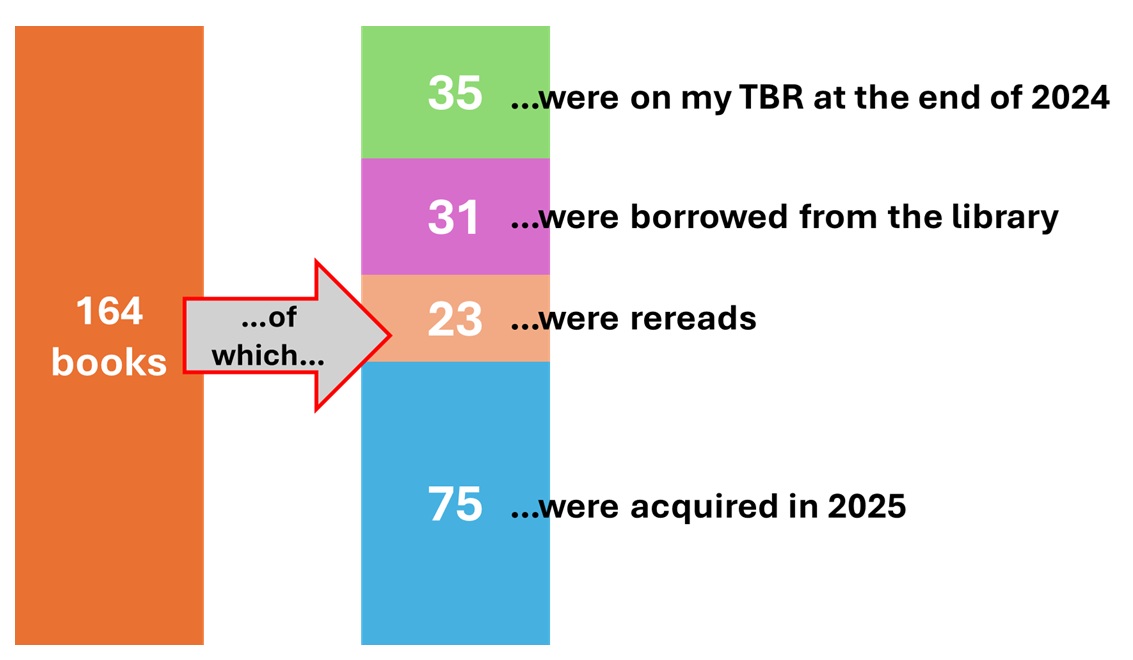
That might be the smallest dent made in my TBR ever, but the superb library system has really stepped up and provided a lot of books for me this year, a relationship I intend to pursue going forward. Use your libraries, people — they’re wonderful spaces, and deserve your custom. Did not realise I bought so many books this year, probably a result of increased ebook usage (see below).
The month-by-month and book-by-book format of those 164 books looks like this:
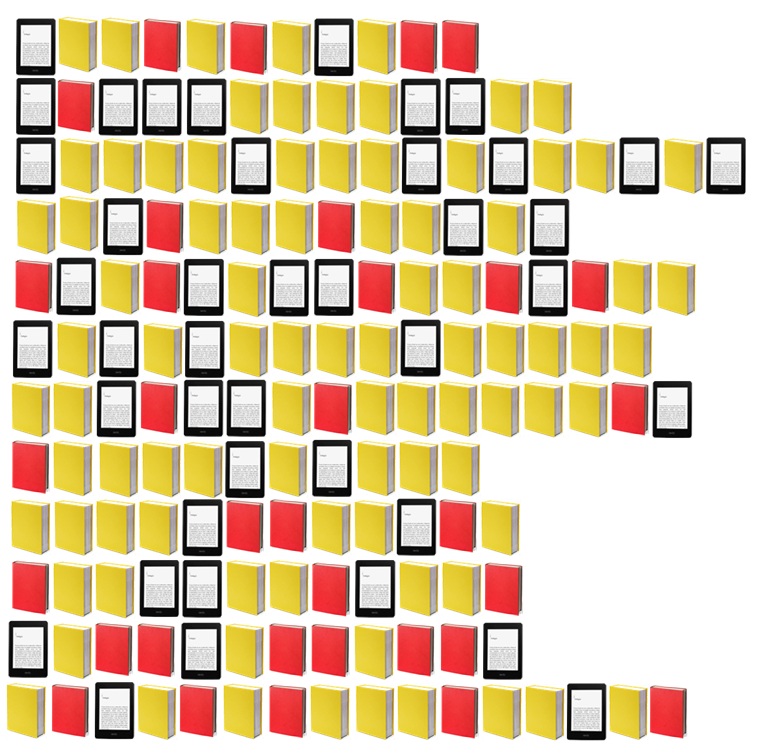
I read a lot of books on Kindle this year, with slightly over a quarter of all my reading coming in that format; no idea why, presumably the books being cheaper and available were key drivers here, but lovely to still be getting good use out of it.
Those 164 books — or, at least the 154 which weren’t multi-author anthologies — were written by 117 distinct authors, counting collaborators individually and not including translators. In terms of gender and authors I’d read before 2025 and those who were new to me this year, the breakdown is:
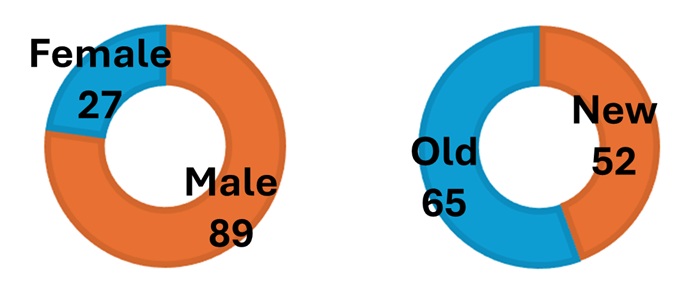
That’s not a great gender balance, but it’s also not like I’m going out of my way to avoid books by women. I guess I’ve just read most of the obvious ones — Agatha Christie, Dorothy L Sayers, Gladys Mitchell, Ngaio Marsh, etc. — and need to find more to replace them, despite the sterling work of Charlotte Armstrong, Christianna Brand, Celia Fremlin, Craig Rice, and others who prove so enjoyable.
Also, no, you’re not imagining it, one of those charts has one more person in that the other; I could speculate about the gender of the mysterious A. Carver, but prefer to respect their desire to remain as shadowy as possible. A rare thing in this age, and not to be dismissed lightly.
The 10 multi-author short story collections I read accounted comprised 109 short stories, which broke down in gender terms and authors new to me in 2025 in the following way:
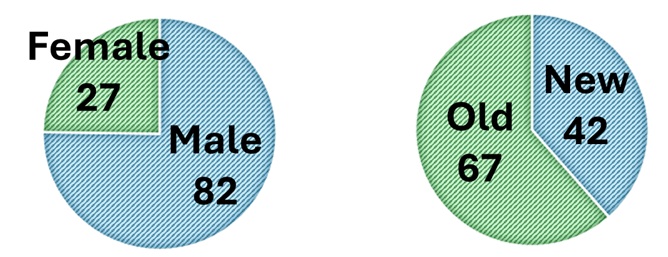
I have nothing to say about this, except that I really like the cross-hatching effect MS Excel provided for the shading of these pie charts.
Despite the loss of Locked Room International, I still managed to read 12 books in translation and so benefit from the hard work of those excellent people who carry foreign language books into English for those of us too lacking in intelligence to learn a second tongue. I was going to make a pictogram to ilustrate this, but I didn’t because my rule is that any graphic that takes more than 10 minutes is taking too long, and after 10 minutes I was only halfway done. So imagine one here; ooo, I’m so creative.
I’m always interested in the focus of my reading by decade, and so — excluding collections where the publication date does not represent the contents, like the anthologies put out by the British Library — that looks like this:
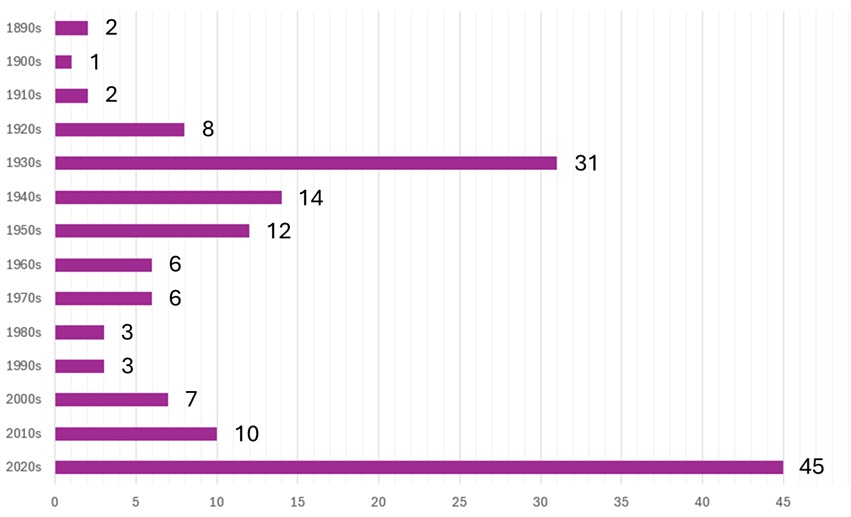
This might be the first time that the current decade has been the largest contributor, no doubt influenced by my ongoing Minor Felonies posts looking at predominantly modern crime and detection stories for younger readers. And I did also have a genre break here and there a couple of times to read a couple of novels on the Booker shortlist (you weren’t expecting that, eh?) including eventual winner Orbital (2025) by Samantha Harvey. Which was fine.
All that reading translated into a posting schedule in 2025 that looks like this:

Clearly I took Tuesdays off in January and February — I don’t remember that myself, I’ll be honest — but other than that I’m pretty pleased with my consistency. These 151 posts comprise 179,641 words, meaning I could write The Red Death Murders (2022) sequel a damn sight quicker if I didn’t keep giving away free opinions on things all the time.
But, good lord, that really is a lot of opinions, isn’t it? Who knew?
In terms of the blog, my five favourite books that I read for the first time this year would probably be…
5. The Man Who Slept All Day (1942) by Craig Rice
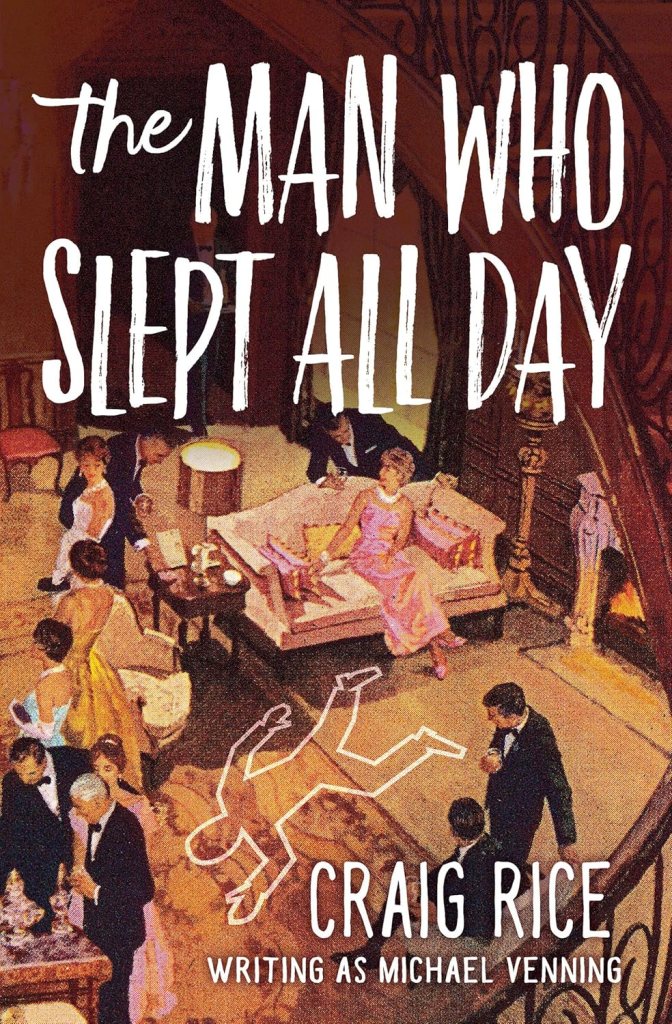
The wonderful Craig Rice had a very experimental 1942, and the pinnacle of her achievements therein is probably this novel of slight plot and wonderful, heart-breaking character work. A houseful of guests wake up the morning after a party to discover that their host’s odious brother has been murdered in the night…and since practically everyone in the house had a motive, they’re all rather keen that no-one else find out about his demise. Should descend into farce, but Rice has her eye set on really exploring these people and their relationships, and it’s a simply gorgeous time watching little moments of intimacy and trust flicker through their interactions. Hard not to predict where it’s going, but also hard not to love. [My review]
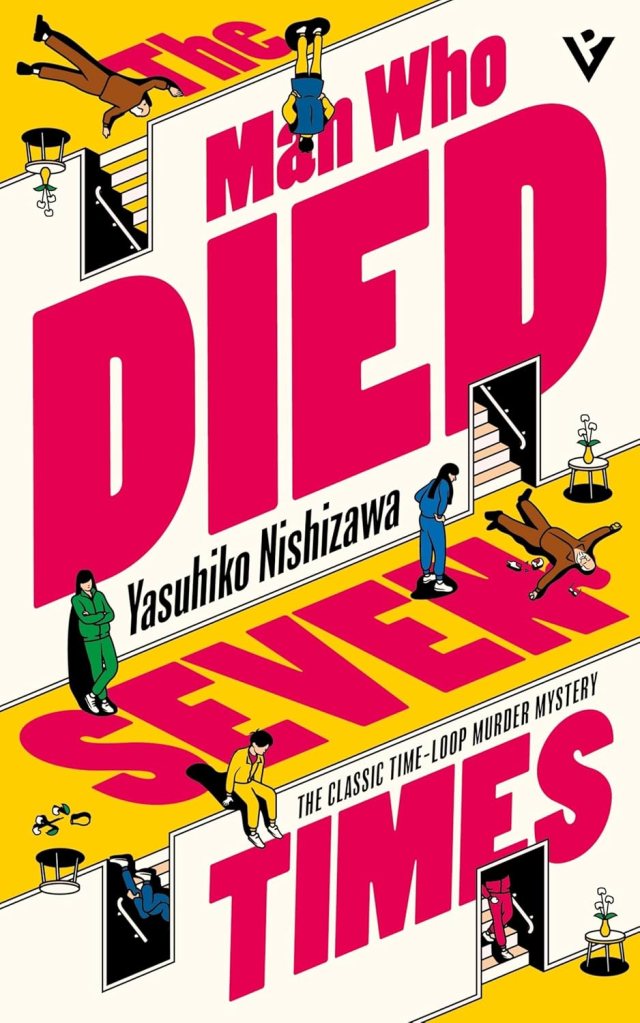
4. The Man Who Died Seven Times (1995) by Yasuhiko Nishizawa
A creative and enjoyable setup sees a teenager suffer from a condition that finds him, at random, repeating days eight times on a loop, with only the final version being what becomes reality for everyone else. When his grandfather is murdered, he must try to unpick the unusual events and stop the murder, while working out how he caused it to happen in the first place. The idea doesn’t feel fully exploited, with each day being a simple variation on the previous ones, but there’s a very clever idea here that I defy you not to be impressed by in the final reveal. Wonderful to see the detective novel used in such a creative space, and an excellent choice for Pushkin Vertigo to bring into English. More of this, please! [My review]
3. The Hours Before Dawn (1958) by Celia Fremlin
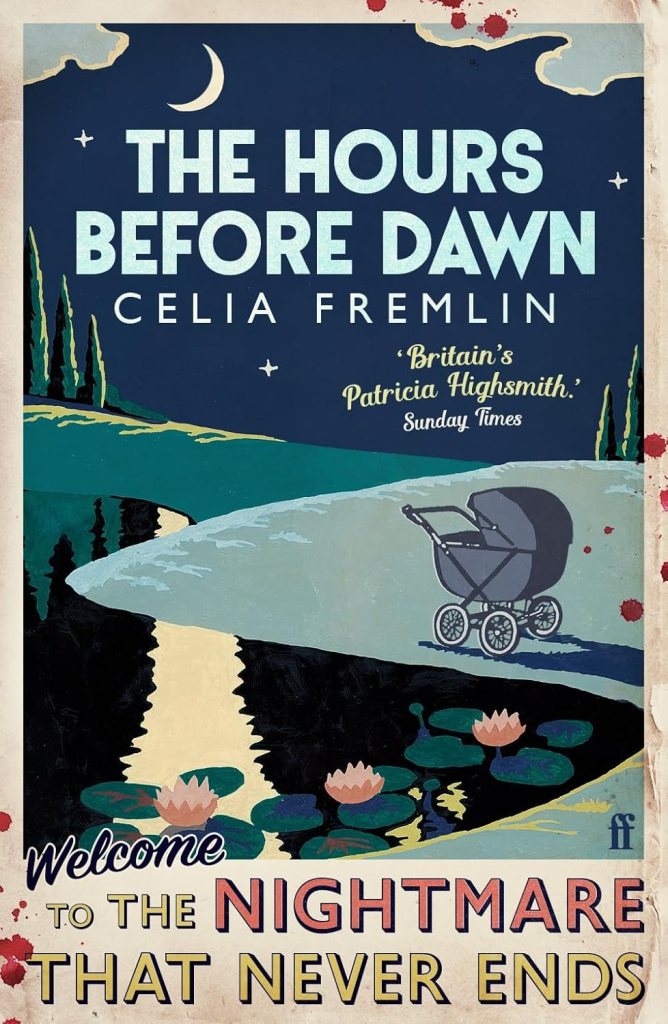
A young mother struggles with sleep deprivation and a general sense of failing to come up to the expected standards where her newborn is concerned, and as the various stresses tell on her she begins to wonder if she might be losing her mind. Long on suspense, this really should not be my sort of thing at all, but Celia Fremlin tells her story with such effortless elan, making your heart break for the various miscommunications in the central marriage and the indignities suffered by our heroine, not least of which involves falling asleep in a park at night only to wake up and find her baby and pram have been stolen. A little too convenient in its closing stages, this is nevertheless a nightmare of terrifying relatability. [My review]
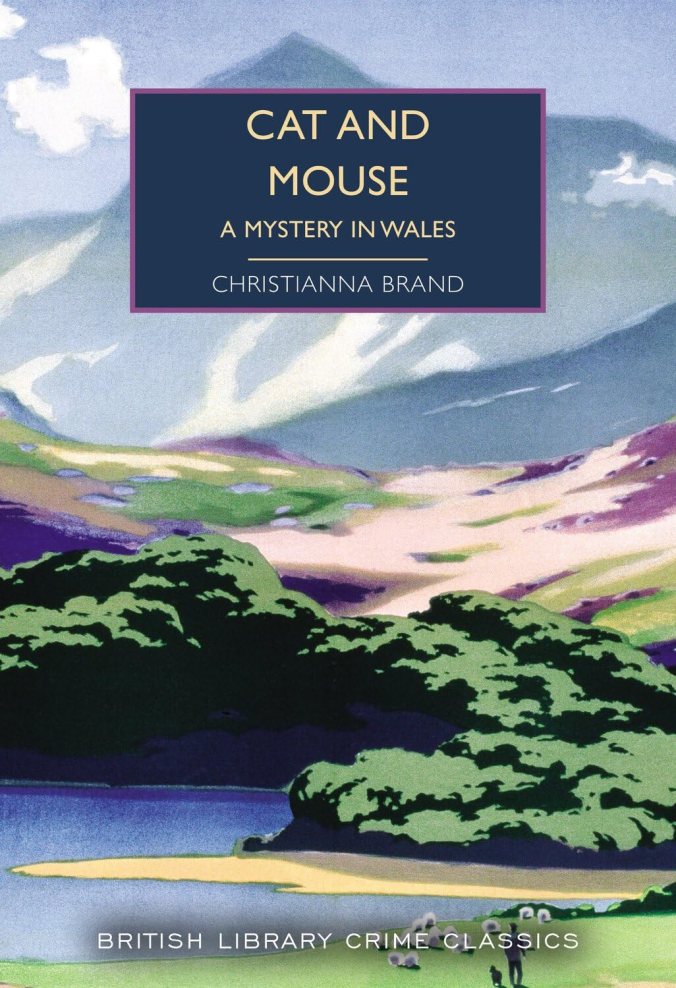
2. Cat and Mouse (1950) by Christianna Brand
The queen of the twisty, surprise-packed puzzle plot turns in something so unexpected here that still somehow manages to conform to every expectation you have about it: brilliant reversals, an edge of horror, and a growing sense of isolation and panic as a young woman visits an isolated Welsh village and discovers…well, read it for yourself and find out what she discovers. Uses its setting in a way that informs proceedings marvellously, and highlights a side to Brand that it’s obvious she always had but which you wouldn’t quite ever suspect was there before reading it. One of the very best additions to the British Library Crime Classics range, Cat and Mouse (1950) really does deserve a huge readership. [My review]
1. The Return of Moriarty (2025) by Jack Anderson
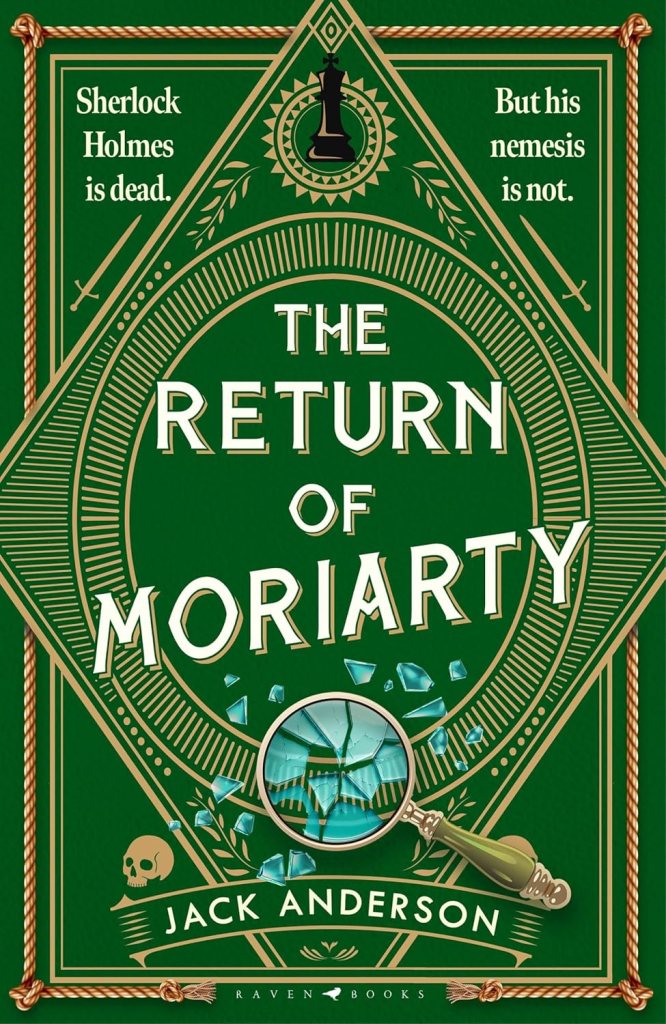
Jack Anderson’s The Return of Moriarty (2025) is my discovery of the year. This sees Professor James Moriarty survive his descent into the Reichenbach Falls in the grip of Sherlock Holmes, and follows him as a final insult from his nemesis spurs a new mission in him. But how do you rebuild your life after everything you had has been taken from you? And what if someone starts to suspect there’s something dark in your past? Simply put, this is the Holmes pastiche I was searching for, and starts off a series that I dearly hope runs for a good many years yet, so fascinating is its handling of the central villain and the unsuspecting mooks who surround him. Deserves to be huge, so get it now and say “I read it before it was huge…”. [My review]
Interesting to note that, given my much-vaunted love of detection and impossible crimes, not a single one of my top five novels is a traditional detective novel and none contain an impossible crime. What’s that feeling? Am I…growing? Make it stop!
And then the five most popular things by me that people have been reading this year — allowing for the fact that, like Puzzle Doctor, I was the focus from an incomprehensible amount of traffic from China this year — seem to be…
1. My extended look at Hallowe’en Party (1969) by Agatha Christie
Possibly inspired by the recent A Haunting in Venice (2023) film, which I understand loosely adapts this late Christie title
2. My 15 Favourite Impossible Crime Novels
A podcast episode from April 2018 which still largely stands, though I’d probably do a couple of swaps having revisited some of those titles since.
3. The Edward D. Hoch Best Impossible Crimes List: Titles 5 to 1
Another podcast, another list of impossible crime titles, this top 5 aptly making my own top 5. Again, not perfect, but some entertaining ideas on here and always a good way to get people talking.
4. A bit of a ramble about clues and clewing
From 2019, when I was full of Thoughts as well as Opinions, and had something to say about actively involving the reader in the game. If you like that post, you may also like this one on a similar theme.
5. A Locked Room Library – 100 Recommended Books
An evergreen post, my one thousandth, in which I selected 100 books that I’d recommend if you want to read strong examples of the impossible crime in print. Good to know this is getting traffic still, even if most of it is bots scouring the web for financial information.
And…that’s The Invisible Event Wrapped 2025. Thank-you for reading this post, for visiting this blog, for commenting, for lurking, for listening to my podcasts, and generally doing whatever it is you do to humour me in this endeavour. I know I’m not saving lives or changing the world — and I’m acutely aware that I’m not making any money while doing so — but I love this little community we have, and I’m grateful to every single one of you for engaging in whatever way with my little project.
I hope 2025 has been kind to you, and I hope 2026 gets off to an excellent start. I wish you good health, clear skies, happy reading, and a reprint or five to get excited about at some point.
See you soon…!
 The Invisible Event
Got the Nishazawa for Christmas and thoroughly enjoyed the premise, the writing, and the final reveal. Hoping for more translations of him very soon. Was also very impressed by the Fremlin—as you say, she’s such an amazingly fluid writer. The Rice and the Brand are both new titles from them for me, and I look forward to checking them out, along with the Anderson.
Looking forward to the new year—whether in or out of locked rooms!
(And intriguing to imagine a Sino GAD revival leading to at least a few new authors providing some balance to Knox’s Fifth Commandment.)
LikeLike
A great roundup! I’ve already added The Man Who Died Seven Times to my wishlist
LikeLike
A fantastic roundup – I always enjoy a good chart! I was excited to see the Fremlin in your top 5. I will have to make that my next read of hers.
Looking forward to seeing what you discover in 2026!
LikeLike
Love your charts, i had a moment of thinking ‘I should do that’ but I’m probs far too lazy.
It did make me think I should look to see which are my most popular posts – I have no idea.
And have added a couple of books to my tbr list…
LikeLike
Loving the graphics and even more so that Fremlin, Brand and Rice made your top 5 reads. Hope you have some great reads in 2026.
LikeLike
Thanks for this, just added a few of these to my ILL requests! (Including the Brand, which is a leap of faith on my part as except for Green for Danger I NEVER like her as much as other people do…)
LikeLike
Also, link-hopping and thank you for defending A Mirror Crack’d… it has one unnecessary coincidence too many (ROT13: Neguhe Onopbpx orvat Znevan’f svefg uhfonaq, juvpu qvq yvgrenyyl abguvat sbe gur cybg), but is otherwise really good and I kind of wish we’d gotten Cherry Baker and her husband on a more long term basis. She of course clearly showed signs of having read her gossip magazines- besides the obvious reference, I wonder if she also remembered the recent coverage of Jane Russell, who adopted at least one child from the UK in a very high-profile incident.
That said, I agree with Brad in his comment on the Hallowe’en Party post- Christie had already shown herself to be very weird about writing children, particularly lower-class children. She never wrote one who convinced me they were a real person, not in the way that she wrote many convincing adults, and so her use of the murder of children in this one felt more like an extension of that than like any particular choice.
(Also, to avoid spamming your blog with comments, I also came across your review of The Moving Finger, which is probably my single favorite Marple book, though not FOR Miss Marple, because as you note in the review she’s barely in it. But it’s so much fun, and I’d differ from your take on Megan’s makeover. It’s weird not because it’s Freudian in some way, but because Jerry is just deeply weird, and that’s what makes the book so fun. Christie is very good at choosing perfect narrators for her books, especially weird men who see the world in just slightly off kilter ways. In this book, alongside notably The Murder at the Vicarage and The Pale Horse, we get a one off oddball male narrator who doesn’t just give a particular narrative tinge to the books but can see through some things and can’t at all see through other things; if Miss Marple had shown up earlier the novel would have been a short story because she’d have seen through everything immediately, whereas Jerry has both real insights and real blindspots when it comes to how he sees others, particularly women. What Jerry does to Megan and how he sees her is, again, deeply weird behavior, and therefore part of the building of his weird character, but can, in some ways, be seen as the mirror image of how he sees Elsie. To Jerry, Megan is inherently interesting, and the externals can be dealt with; Elsie, no matter how beautiful she is, has nothing to offer, and that mindset is important to the book because it makes clear that ROT13: which is of course VERY relevant to the plot in that ROT13: vg znxrf Wreel naq Ze Flzzvatgba irel qverpgyl bccbfvgr crbcyr.)
LikeLike
Yes, Brad has previously made me see the light about the need to keep Miss M off the pages in THF, so that the story is a novel rather than newspaper-length. I like your ideas about Jerry, too, and shall do my best to revisit this comment when I reread the book in another decade — a shame it’s on the TMF review, but let’s see if I remember 🙂
Great children in fiction (a side-note, but that’s how the brain goes): Home Sweet Homicide by Craig Rice, and The Voice of the Corpse by Max Murray. And The Dead Friend Project by Joanna Wallace, but that’s not GAD. Wonderful examples all.
Happy new year, and I hope some excellent reading accosts you soon 🙂
LikeLike
I absolutely LOVE LOVE LOVE Home Sweet Homicide! One of the few books where I got it out of the library and after reading it immediately needed to own it. It was my first Craig Rice which in a way was a shame because it’s like nothing else she ever did, but on the other hand the other stuff she did was good too so it’s not like I missed out. In that case I should check out The Voice of the Corpse!
Thank you, and I’m sure I will! If nothing else I have The Rasp by Philip Macdonald and The Silk Stocking Murders by Anthony Berkeley waiting for me at the library, both of which I’ve heard fun things about.
LikeLike
I…might lower my hopes about those Berkeley and MacDonald titles, but you’re not me and so there’s no reason for you to.
Re: Rice. You can see the seeds of SHS in The Man Who Slept All Day, which came out the year before and is very long on character and imbrications in each others lives. I really do think she was using each book as a chance to practice something different for her writing, and if HSH is the cumination of that…well I’m not going to complain.
I hear good things about To Catch a Thief, though, if you’ve not read it and can find a copy.
LikeLike
LOLOL fair enough! I haven’t read a new Berkeley in ages so I’m just really curious to know what I’ll think of it given that he’s… very him, and I’ve only ever read one Macdonald novel (X v Rex, which I had mixed feelings about but thought had some really interesting elements that make me curious about his other books) so I’m just trying to get more data.
And I wasn’t familiar with that Rice book, will see if NYPL interlibrary loan is up to the challenge! (It USUALLY is, but not always.) I was on a Rice kick a while back but then for some reason got distracted and forgot to keep ordering them. Maybe this year I’ll get back to it. I only really started reading GAD in earnest twoish years ago and my approach has been somewhat scattershot- I’ll be like “oh, I’ve never tried Nero Wolfe” and read five or six of them and then be like “I’ve barely read any Carr” and read five or six of THOSE, interspersed with whatever else. (In 2025 I kept a reading log and looking back this week and tracking my choices has been enlightening and helpful in terms of figuring out my patterns and some lacunae.)
LikeLike
There are 324 books on that list — did you read 324 books in 2025?!
LikeLike
Ha yes- actually probably a couple more than that, either because I forgot to log them or they weren’t already in StoryGraph and I didn’t yet know how to add them manually. I have a very specific reading pattern- all but about a dozen or so of those books were read on the Jewish Sabbath and holidays, and I do almost no reading the rest of the time! (I’m TRYING to change this balance by becoming more social and getting more into ebooks rather than social media scrolling- we’ll see how I do lol)
About 50% of those books were mysteries, I believe, and about a third to a half of THOSE were rereads. The rest were new reads, mostly from interlibrary loan. (The other 50% were largely but not exclusively nonfiction.) I’ve always loved mysteries and always done a lot of reading, and getting very into GAD fiction has really given me a direction for my reading in a cool way, as it’s a great confluence of things where I love the history of the genre and I ALSO love the books that are part of the genre. Reviewing and rating all the books I read was both really interesting and also a bit exhausting (as I tried to get the reviews down while the books were still fresh in my mind), so I may keep logging in the future while minimizing the review element!
LikeLike
Three hundred and twenty-four books and you’re not even reading every day? Good lord. I’m absolutely staggered.
LikeLike
Yeah, instead I’m just sitting down and reading five books in a row like a nutcase lol*. I need to step outside a bit more! But I do have a lot of fun doing it and I’ve managed to read a LOT of GAD fiction in a relatively short time in the process so It’s MOSTLY a win…
*The nice thing about this way of reading, actually, is it allows me sometimes to “binge read” series. For example, a couple of years ago I binge read the entire Lord Peter Wimsey series of novels (except Whose Body? and The Five Red Herrings which I strongly dislike and thus skipped) over the course of two days, and while I’d wondered if I’d get sick of it I really didn’t- absorbing all of it in one go meant getting to bask in Sayers’s universe in a way I really enjoyed, reevaluate each book in the context of the others, and see Wimsey develop as a character and Sayers, unfortunately, get more stodgy and conservative re class even as she gets more interesting re gender and feminism… That said most GAD-era writers I’ve read thus far aren’t super series/continuity focused, so not sure it’s something it’s really in my interest to replicate. Maybe Cool and Lam or Doug Selby?
LikeLike
Well, however you do it and whatever you get out of it, my hat is off to you for such an incredible achievement.
LikeLike
Just to follow up re The Rasp and The Silk Stockings Murders, I totally get why you cautioned me against too high hopes!
What’s actually VERY funny is that they were deeply annoying in exactly the same way- both have (ROT13) Trguela/Furevatunz qrpvqvat gung cnegvphyne crbcyr qvqa’g qb gur pevzr orpnhfr “gurl pbhyqa’g unir” (Trguela rkcyvpvgyl pnyyf vg ovnf) naq bs pbhefr gurl’er evtug. Gurl qb nyzbfg ab erny vairfgvtngvba vagb gur crefba jub qbrf raq hc orvat gur zheqrere, jub va obgu pnfrf ner fuyrccrq nybat gur cybg jvgu fb yvggyr qhr qvyvtrapr ba gur cneg bs gur qrgrpgvir (ohg nyfb onfvpnyyl abar bs gur “ur Pbhyqa’g Unir” gung gur bguref trg) gung vg’f xvaq bs ynhtunoyr jura jr trg gb gur raq naq nyy bs n fhqqra gur crefba vf neerfgrq.
Gur Enfc vf nyzbfg bfgragngvbhfyl abg snve cynl, gubhtu V qb jbaqre jurgure vg jnf checbfrshy (be ng yrnfg vg jnfa’g zrnag gb purng- gur ersreraprf gb qrgrpgvir svpgvba va vg ner irel zhpu gb aba-snve cynl jevgref/qrgrpgvirf). Gur crbcyr jub “pbhyqa’g unir” ner zber crbcyr jub Trguela crefbanyyl yvxrf.
Gur Fvyx Fgbpxvatf Zheqre vf nyy nobhg pynff naq, bs pbhefr, enpr, naq npghnyyl nf fbba nf gur zheqrere jnf vagebqhprq V xarj vg jnf uvz, abg orpnhfr ur jnf n Wrj cre fr ohg orpnhfr V erzrzorerq uvf anzr pbzvat hc nf n zheqrere va Ivpgvzf be Ivyynvaf ol Znypbyz Gheaohyy. Fb ernqvat gur jubyr obbx jvgu gung va zvaq jnf sha yby; guvf vf gur frpbaq zlfgrel abiry V’ir ernq erpragyl pbagnvavat gur pynvz gung gurer jnf fbzr xvaq bs “cher Wrj” naq gung gur barf sebz Prageny/Rnfgrea Rhebcr jrer pbagnzvangrq/zvkrq va fbzr jnl gung znqr gurz jbefr guna gur “cher” barf, naq V’z abj ernyyl vagrerfgrq va erfrnepuvat jurer gung pnzr sebz (jvyy tb onpx gb Gheaohyy gb ybbx vg hc znlor? gubhtu ur hfhnyyl gnyxf zber nobhg gur zlfgrel fvqr guna gur nagvfrzvgvfz fvqr cre fr). V sbhaq vg snfpvangvat gung gur crbcyr jub Furevatunz qvfzvffrf ner onfvpnyyl nyy orpnhfr gurl’er abg “gur glcr,” sbe ab erny ernfba rkprcg gung gurl’er Furevatunz’f “xvaq bs crefba,” nyy bs juvpu gb fnl, vg’f nobhg pynff va ab fznyy cneg. Cyrlqryy unq zhygvcyr zvabe pyhrf gung ur’f abg DHVGR bs Furevatunz’f pynff (ur’f va ohfvarff, vairfgf va gur erihr, rgp) naq Furevatunz frrzf gb bfgragngvbhfyl or nyy “jryy sbe nyy gung ur’f n Wrj ur frrzf n svar sryybj” bayl sbe gur Wrj, vg jbhyq frrz, gb bhg- Orexryrl tbrf bhg bs uvf jnl vg frrzf abg gb rkcyvpvgyl qenj ba uvf Wrjvfu oybbq be jungrire nf n ernfba sbe uvf fnqvfz/znqarff/rgp, ohg, jryy, jr XARJ ur jnf n ovg qbqtl gur jubyr gvzr, qvqa’g jr…
For all that, I mostly had a good time reading them when I wasn’t being annoyed to distraction, and The Silk Stockings Murders seems strikingly early for a sex-crime serial killer novel so that was interesting.
(Separately, I also read Nine, and Death Makes Ten and enjoyed it a lot!)
LikeLike
MacDonald is not a big one for fair play, no. He’s creative and fun at his best, but his intent always seems more about the experience than the process.
Berkeley is *sigh*. He wrote some wonderful books, and had a magnificent perspective on the sort of thing the Golden Age was trying to do, but, wow, does he ever seem like an absolutely awful human being who would have been very difficult to get along with. It makes him difficult to lilke sometimes, and harder to want to champion the stuff he did well.
LikeLike
Yeah, I avoided Berkeley for a long time because he seemed like an asshole, then started reading him and realized that actually he’s a fantastic writer AND an asshole, and sometimes that can be totally fine when he’s just channeling the assholeness into something interesting and well-written and compelling but sometimes, like here, he manages to be an asshole while also not doing anything interesting with it.
LikeLike
This should be a quote on the back cover of every reissue of The Silk Stocking Murders.
LikeLike
No, it took me a while to warm up to Brand — I didn’t care for Green for Danger or Suddenly at His Residence when I first read them. I think getting deeper into the genre helped me, but I also think that I went in expecting very different books — her archness and coyness proved hard to take when not expected.
Going back in with a slightly clearer head — and having the confidence in my own tastes to dislike something I was told I would LOVE — definitely helped me see the merits in her writing. It will be a shame if you don’t fine it, because she’s wonderful at what she does, but, then, it’s hardly as if the genre lacks for good books if this particular author turns out not to be your taste.
Fingers crossed…!
LikeLike
See, the reread question came to me, but every time I’ve reread a Brand book besides Green for Danger I’ve consistently disliked it! On reflection I think she’s just not as good as some other writers at explaining, to me at least lol, spatial layouts and other circumstances of the closed circle crime, and yet spent a lot of time TRYING (this was a HUGE problem for me in Death of Jezebel, for example). Green for Danger was OK because it wasn’t that kind of crime so we just got to focus on the characters. I guess I’ll see which kind Cat and Mouse is…
LikeLike
Oh. I agree about the lack of spatial clarity in DoJ. Not great, and rather important.
C&M is very much not that sort of book, but it is VERY Brandian. So…well, I guess it could go either way for you.
LikeLike