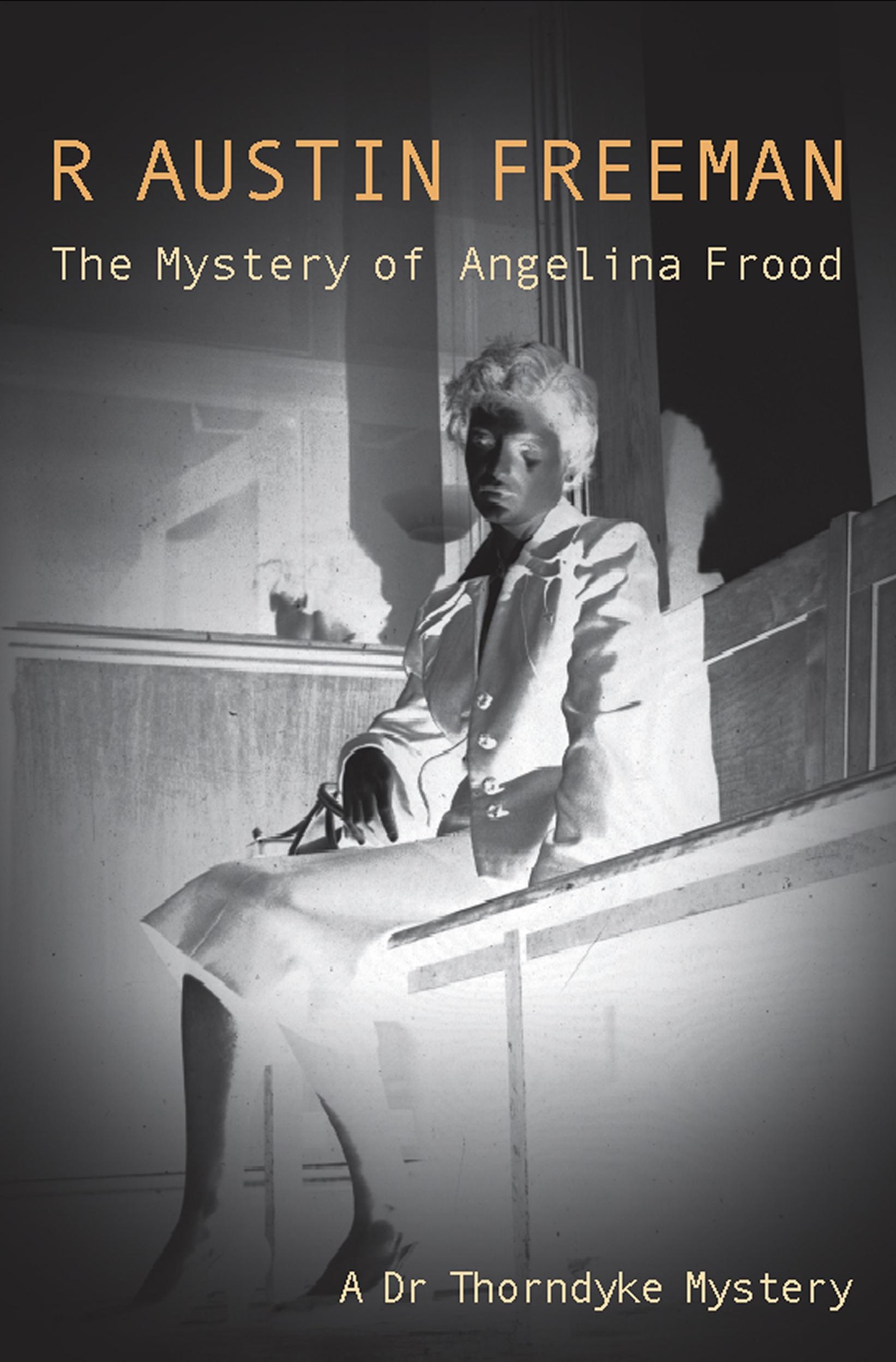


Late one night, Dr. John Strangeways is summoned to tend to a woman who has clearly been strangled. Deeply unsettled by the odd encounter, he has cause to remember one of the men who was at that scene when chance brings them together in Rochester a year later. The man in question, in possession of a wicked-looking knife, does not remember the doctor, however, and Strangeways, new in town and on his way to look over a recently-vacated surgery, is relieved to be unable to help when the man asks for directions to the residence of Mrs. Frood. Deciding to take the practice on, Strangeways is in due course introduced to his landlady, and comes face to face with the strangled woman of a year before. Her name? Mrs. Angelina Frood.
The Mystery of Angelina Frood (1924), the seventh novel by R. Austin Freeman to feature his esteemed medical jurist Dr. John Evelyn Thorndyke, makes no mystery of the first encounter between Strangeways and Mrs. Frood, instead saving the promise of the title for developments about which I will try to speak as little as possible. It spoils nothing to say that crime rears its head, and that, in due course, Thorndyke is drawn into proceedings — although, given the nature of working against an unknown combatant, he is rather keen to keep himself as far out of the picture as possible while pursuing his own investigations, leaving the majority of the on-site investigation to the magnificently-named Sergeant Cobbledick.
It must be said up front that this is perhaps not the book to win you over to the joys of Freeman’s style of detective story. Perhaps even more so than before, the case here is pursued along astoundingly realistic lines, occurring over several months as evidence drips in and begins to slowly fill out the details of a crime whose full picture is always slightly out of focus. It’s patient, deliberate stuff, the sort of story Freeman would perfect in the likes of The D’Arblay Mystery (1926) and Mr. Pottermack’s Oversight (1930) — so if you hanker for lightning-fast developments and intrigue and astoundment, head elsewhere. Those of you already convinced of the author’s talents, however, are in for an unhurried, methodical, delightful time.
Firstly, in building his case slowly, Freeman leaves plenty of space for the human feelings that are so important in his writing: both the pathos…
To Thorndyke this quest was just an investigation to be pursued with passionless care and method. To me it was a tragedy that would colour my whole life.
…and the all-too-human dry humour that always seems to linger at the edges of his writing:
I drew aside to make way for the newcomers — two ladies whom polite persons would have described as middle-aged, on the assumption that they contemplated a somewhat extreme degree of longevity.
Equally, in a surprisingly tight cast, good work is done in typifying the likes of housing agent Mr. Japp, who comes to life in his admiration of the ancient architecture of the town, lamenting that as towns are expanded and rebuilt they are filled up “with houses that will look as if they had been bought in packets like match-boxes”. And Japp’s associate, the youthful, quick-witted Peter Bundy with whom Strangeways strikes up a fast friendship, is especially delightful: a foppish oddball at first who, especially in his encounters with Thorndyke, shows hidden depths of playful ribaldry.
There isn’t a great deal of Thorndyke in this one, the narrative making his occasional visits to Rochester very much part of the B-plot, but he’s good value when present, exhibiting a solid faith in the professional police that’s pleasing from such a gifted amateur, and holding forth with the occasional Sherlockian declaration:
“There is nothing so hopeless to investigate as the perfectly obvious and commonplace. As soon as an apparently incomprehensible motive appears, we are within sight of a solution. There may be innumerable explanations of a common-place action; but an outrageously unreasonable action; pursued with definite and considered purpose, can admit of but one or two.”
The time passes, then, very pleasantly, though this largely fails to distinguish itself until a revelation in the final stretch that caught this armchair detective entirely by surprise. I had a sense that something was in the wind, though I was looking in an entirely different direction, and, to be honest, I love what Freeman does here…even if I don’t believe that it would be possible in the way he states. But, well, it speaks volumes that such an interesting notion is deployed in a way that raises this slightly pedestrian book so much in my estimations, with some tiny details — (rot13 for minor spoilers) gur gryrfpbcr — that I simply loved.
I can see The Mystery of Angelina Frood being a divisive book in Freeman’s oeuvre, not least because, for all Thorndyke’s careful investigations, his reduced role renders the edifice rather less fair play than many would perhaps like. Still, for the sheer chutzpah of the final stages, and enlivened by odd moments of historical interest (I would have assumed that “on the q.t.” was an Americanism unlikely to exist at this time, never mind make its way across the Atlantic), I found much here to justify my continued pleasure in Freeman’s writing about his most famous creation. I already intended to read them all anyway, but this has ramped up my interest to its previous levels after a couple of slightly damp offerings in this canon. Here’s looking forward to the good doctor’s next adventure.
~
R. Austin Freeman on The Invisible Event:
The Red Thumb Mark (1907)
John Thorndyke’s Cases, a.k.a. Dr. Thorndyke’s Cases [ss] (1909)
The Eye of Osiris, a.k.a. The Vanishing Man (1911)
The Mystery of 31 New Inn (1912)
The Singing Bone, a.k.a. The Adventures of Dr. Thorndyke [ss] (1912)
A Silent Witness (1914)
The Great Portrait Mystery [ss] (1918)
Helen Vardon’s Confession (1922)
The Cat’s Eye (1923)
Dr. Thorndyke’s Casebook, a.k.a. The Blue Scarab [ss] (1923)
The Mystery of Angelina Frood (1924)
The Shadow of the Wolf (1925)
The Puzzle Lock [ss] (1925)
The D’Arblay Mystery (1926)
The Magic Casket [ss] (1927)
A Certain Dr. Thorndyke (1927)
As a Thief in the Night (1928)
Mr. Pottermack’s Oversight (1930)
Pontifex, Son and Thorndyke (1931)
When Rogues Fall Out, a.k.a. Dr. Thorndyke’s Discovery (1932)
Dr. Thorndyke Intervenes (1933)
 The Invisible Event
The Mystery of Angelina Frood is also notable as another book inspired by Dickens’s The Mystery of Edwin Drood
LikeLike
I remember reading this somewhere, yes, but then I read Edwin Drood so long ago that I was unable to make any meaningful comparisons. One day I should read them back-to-back and see what, if any, DNA they share beyond the basics.
LikeLike
Drood is quite short; you could knock it over in a day or two. Why not reread it now while Frood is fresh in your memory? Besides, it would be an addition to your series of early detective fiction reviews.
LikeLike
An excellent idea, except that I read this about six weeks ago — I’ve been interleaving other books, so have had to work up a head of steam for forthcoming reviews — and so the details are, at best, blunted in my mind. But I’ll enjoy revisiting this in due course, so it will hardly be a chose.
And, as to more early detective fiction, there’s some in the pipeline…
LikeLike
Just read this one and was intrigued to see that a particular plot point in Mr Pottermack’s Oversight was actually him taking a second, and quite different, crack at a particular plot point, which I can’t decide if I think is annoying or interesting.
But… oh my goodness. I can’t decide if I love this or am exceedingly angry. When I first read that pivotal page I literally said out loud “THE FUCK” and my parents were in the room and asked if something was wrong and I said “I’m fine, it’s just something really stupid just happened in this book.” But then I went back and reread through a bunch of it and I can’t bring myself to be as mad as I feel I should be.
More at ROT13:
Crbcyr cergraqvat gb or bgure crbcyr vf bar bs zl nofbyhgr yrnfg snibevgr qrgrpgvir svpgvba gebcrf, fb V jnf ovnfrq ntnvafg guvf sebz gur fgneg. V qvqa’g guvax vg jnf ng nyy snve, rfcrpvnyyl fvapr guvf jnf va snpg abg n snve cynl abiry (jr arire svaq bhg jung Gubeaqlxr frrf hagvy gur raq- jr xabj ur znxrf n cbvag bs gerngvat Ohaql’f zbfdhvgb ovgr ohg abg jul be jung ur qvfpbiref).
V qvq xvaq bs ernyvmr gung jung V jnf znq nobhg jnf orvat yrq qbja rknpgyl gur tneqra cngu gung Serrzna rkcrpgrq zr gb. V arire gubhtug Zef Sebbq jnf qrnq (gubhtu gung jnf orpnhfr Fgenatrjnlf qvq gur pynffvp “gung vzntr bs ure vf jung V jbhyq erzrzore sbe gur erfg bs zl yvsr” snxrbhg) naq V jnf qrsvavgryl QRRCYL fhfcvpvbhf bs Ohaql, jub jnf orvat sbphfrq ba jnl zber guna frrzrq gb znxr frafr naq jub jnf orunivat rkgerzryl bqqyl. V abgvprq bqqvgvrf yvxr uvz fubjvat hc nebhaq gur fnzr gvzr Sebbq qvq, bayl orvat n cebongvbanel nffvfgnag lrg nyernql orvat ba gur ntrapl’f anzrcyngr, uvz gelvat gb qvfgenpg Fgenatrjnlf sebz gur pnfr naq gnttvat nybat ba inevbhf vairfgvtngvbaf, gur rzcunfvf ur jnf cynpvat ba gur zvffvat xrl naq gung gur xrl jrag zvffvat nebhaq gur fnzr gvzr Zef Sebbq qvq, gung ur’q frrzrq gb or nobhg gb gnxr Fgenatrjnlf gb zrrg Zef Sebbq ohg qvqa’g… Fb jura vg ghearq bhg gung V’q abgvprq nyy bs gung naq PBZCYRGRYL ZVFFRQ GUR XRL CBVAG V sryg crefbanyyl nggnpxrq be fbzrguvat. Naq vg fubhyqa’g unir jbexrq be znqr frafr! Va snpg sebz gur crefcrpgvir bs ernyvfz, gur rknpg jebat jnl gb ybbx ng chmmyr zlfgrevrf, vg fheryl jbhyqa’g unir jbexrq be znqr frafr!
Gura V jrag onpx naq ernyvmrq gung sebz n chmmyr zlfgrel crefcrpgvir, Serrzna qvq fhpu na nznmvatyl vagevpngr wbo ng ynlvat bhg rknpgyl ubj vg jbexrq. Ohg vg jnfa’g ernyyl fb zhpu nobhg pyhrf nf vg jnf nobhg gbar. Jura V erernq, vg orpnzr FB pyrne ubj Serrzna jnf ynlvat gur genvy sbe ubj n) Fgenatrjnlf fhopbafpvbhfyl ernyvmrq gung Ohaql naq Zef Sebbq jrer gur fnzr crefba naq genafsreerq uvf srryvatf va n jnl orgjrra gurz naq o) Ohaql’f npgvivgvrf, orunivbe, rgp orvat fvtanyrq fbpvnyyl sebz gur crefcrpgvir bs gur ren nf orvat srznyr engure guna znyr. Gur jnl va juvpu Zef Sebbq’f univat orra frra ol Fgenatrjnlf rneyvre yrq gb gur qrrcravat bs gur cybg, nf ur jnf havdhryl fhfprcgvoyr gb ure qvfthvfr nf fbzrbar jub unq FRRA ure ybbx yvxr gung orsber, jnf znfgreshy. Vg jnf whfg ernyyl pbby.
Gurer VF n cneg bs zr gung’f yvxr, n qvssrerag xvaq bs jevgre jbhyq unir unq nyy guvf or n qbhoyr oyhss naq rynobengr ehfr guebhtu juvpu Zef Sebbq QVQ znantr gb fhpprffshyyl xvyy ure uhfonaq… cbffvoyl jvgu Fgenatrjnlf’f uryc, juvpu ur jbhyq qvfthvfr guebhtu fbzr irel qvfvatrahbhf aneengvba. Naq gung jbhyq unir orra snfpvangvat naq V guvax jbhyq unir nyfb svg va irel jryy jvgu n srj cnegvphyne qrgnvyf urer. Ohg V’z bxnl jvgu vg nf vg vf.
LikeLike
It’s the sort of reveal that I would ordinarily be annoyed by, by Freeman is so very careful with what he tells you, and drops in so many little moments of the quotidian milieu, that it starts to feel all the more possible. I’ve certainly read books that did this and liked them a lot more because of how little they prepared you for it, and this is one of the few times — maybe the only one? — I can see it actually working as described.
Glad you enjoyed it, at the very least. It feels like a little gem, in a way, since no-one ever talks about it.
LikeLike