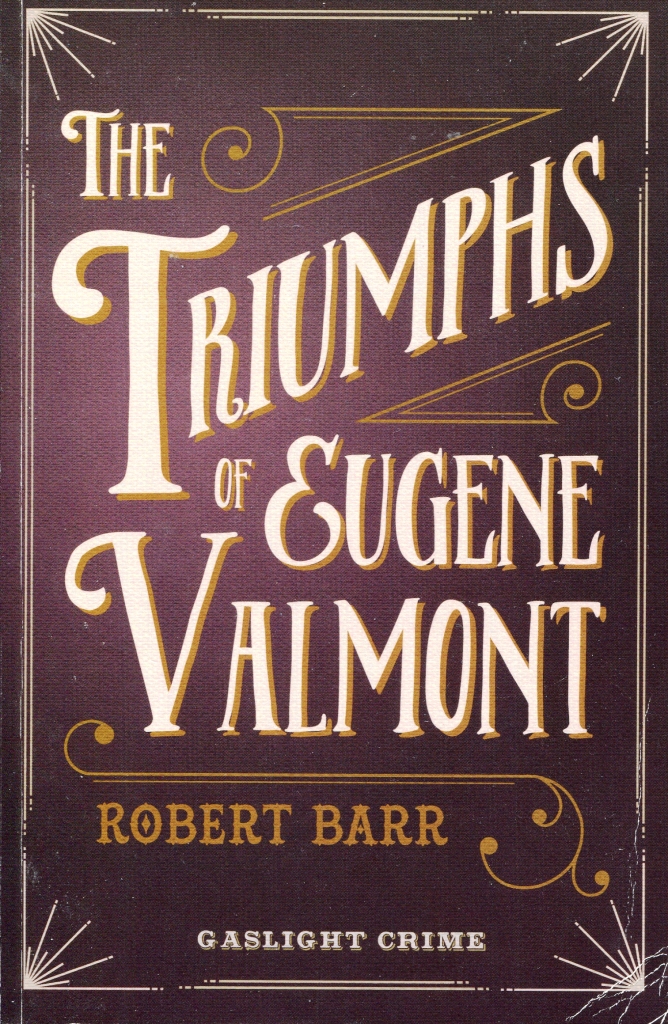
I first encountered the work of Robert Barr in the superb Penguin Book of Gaslight Crime [ss] (2009), and when Countdown John offered to lend me The Triumphs of Eugène Valmont (1906) — one of the Haycraft-Queen Cornerstones, no less — to continue my education, I leapt at the chance.
I understand Barr to be one of the authors who was inspired to write detective fiction in the wake of the popularity of Sherlock Holmes — and, indeed, Barr, like E.W. Hornung, could claim an association with Holmes’s creator, Arthur Conan Doyle. As with this great swathe of imitators, Barr seems to have been largely overlooked in the century since, but the more I read of this later Victorian detective fiction the more I become convinced that there’s a tranche of extremely talented, influential authors who deserve better than to simply be churned out in cheap, copyright-free editions with bad proof-reading and, in the rare occasions they make it into physical form, thin paper.
For all the vainglorious pretensions of this volume’s title, it’s clear that Eugène Valmont, one-time head of the Paris police, doesn’t always triumph — indeed, why else, as he implies in the opening paragraphs, would he be living in exile in London? Lets get into it…

First, the story which put me on to Barr and Valmont, ‘The Mystery of the Five Hundred Diamonds’ (1904), in which the eponymous gems — part of a dazzling necklace which seems to bring nothing but bad luck upon those who possess it — are sold at auction in Paris and Valmont, still head of the police at this point, is charged with ensuring that nothing untoward happens to the successful bidder while they are within French borders.
If I failed there should be no one to blame but myself; consequently, as I have remarked before, I do not complain of my dismissal by the Government.
There’s much to enjoy here, from Valmont’s dismissal of the average French policeman to the admission that failure means something different across the Channel (“Ridicule kills in France. A breath of laughter may blow a Government out of existence in Paris much more effectually than will a whiff of cannon smoke.”). This feels, too, like a meaningful step on the road towards the puzzle plot, with dual identities and plenty of false moustaches holding hands with genuinely clever plotting misdirection. I likened this to The Cask (1920) by Freeman Wills Crofts before, and I can see what I was thinking. Not groundbreaking, but definitely not the usual style of story being written at this time.
Overlong, but full of fascinating detail, ‘The Siamese Twin of a Bomb-Thrower’, a.k.a. ‘The Fate of the Picric Bomb’ (1905) sees Valmont indulge in a Sherlockian talent for disguise — creating the identity of down-at-heel language teacher Paul Ducharme, he joins an anarchist organisation and sets about foiling their plans to bomb a delegation of English businessmen who are visiting France. This bombing plot will, incidentally, be the least interesting part of what ensues.
We see here Frenchman Valmont’s difficulties in dealing with English self-absorption (“Lord Blank’s mind is entirely occupied by his own greatness. Chemists tell me that you cannot add a new ingredient to a saturated solution; therefore your revelation will have made no impression upon his lordship’s intellect.”), the struggles of ingratiating himself with Inspector Standish of the Metropolitan Police (“He always supposed me to be a frivolous, volatile person, and so I was unable to prove myself of any value to him in his arduous duties.”), and his incomprehension of the British regard to law enforcement, evidence, and more besides.
Through all this, however, he remains wonderfully human — doubling his bill in a fit of pique when a client is rude to him, learning from the mistakes of his own informants when obscuring his identity (the variety of boat trips and disguises here must have once again warmed Freeman Wills Crofts’ heart), and learning of the consequences of his own dismissal from France. The story, frankly, is trying to do far too much, but Barr writes well and it’s interesting to think how this might set up future tales in this canon.
‘The Clue of the Silver Spoons’ (1904) offers up our first truly Sherlockian case: Valmont is engaged to discover which of six highly reputable men committed a theft of £100, and hones in on his suspect very quickly indeed, in true Victorian detective style. Then the chief suspect request an audience with Valmont and, pointing out the many reasons why he should be suspected, nevertheless insists on his innocence. How do the eponymous spoons tie into a second possible explanation?
Not only is the use of the silver spoons an ingenious conceit, the story includes, simply for good measure, some startlingly advanced ideas: a reflection on the detective’s responsibility to the accused, for one, and the surprising actions of a manservant for another. There is a great deal of personality in Barr’s writing, and, if the ideas presented herein are in any way representative of his writing in the genre, it’s a tremendous shame that he’s not more widely known.
Approached by a newly-minted member of the upper house, who has inherited an entailed estate from an aged forebear who “denuded the estate and made an empty barn of [the family pile]”, Valmont is charged to find ‘Lord Chizelrigg’s Missing Fortune’ (1905). That the fortune exists somewhere the new Lord Chizelrigg has no doubt, his uncle having liquidated almost everything of value in the later years of his life, but the letter left for the young lord promising that “[y]ou will find your fortune between a couple of sheets of paper in the library” seems to be for aught: a thorough, six-month search has revealed none of the gold that should reside there.
There’s a pleasing rigour to the investigation here, which could be undertaken in half the pages but instead has a merry old time running up against false trails, showing Valmont to be in no way a mere facsimile of the superhuman detective who inspired him. Good reasoning and an entertaining solution — referenced in a Three Investigators novel, if you can believe it — make this among the more interesting of later Victorian detective stories, even if it lacks a superlative hook from which to better display its cleverness. I’m also not sure that the bit about Thomas Edison really adds anything, but it’s an interesting little diversion at the start.
‘The Absent-Minded Coterie’ (1905) is something of a masterpiece of ingenuity, and speaks volumes of the creativity that was allowed to spring up in the wake of Holmes’s popularity. The arch tone of Valmont’s frank incomprehension at the niceties of English legal processes concerning, say, warrants is hilarious (“[I]f you are compelled to march up to a man’s house, blowing a trumpet, and rattling a snare drum, you need not be disappointed if you fail to find what you are in search of when all the legal restrictions are complied with.”) and the problem, obscure at first and slowly dawning as things progress, is magnificently clever and resolved ingeniously.
It does, though, perhaps highlight why the likes of Barr have fallen by the wayside while Doyle remains popular over a century after his creation’s first appearance: many of those who swept into Doyle’s wake simply lack his clarity and directness of language, and so, while Doyle perhaps lacked the nihilistic edge to devise something as wonderful as this, he would have told it in a manner that remained crystal clear even these 119 years later. Barr is good, don’t get me wrong, and writes magnificently dunderheaded policemen, but he’s more dated in his expression and you feel it at times, even when caught on the compelling tide of this one.
Perhaps salting the mines plundered by the likes of Carnacki, the Ghost-Finder ‘The Ghost with the Club-Foot’ (1905) has all the spooky ingredients that would oft confront the Victorian detective: unyielding landed gentry, terrifying butlers, an ill-regarded marriage, sudden death, and a spooky old mansion for it all to go down in. Barr’s more languid tone suits this shiversome setup, and it’s to be regretted that more of the Carnacki stories don’t exhibit the skills on display here…all the more vexing when you realise that this predates everything Carnacki ever did.
And yet we never lose sight of this being a Eugène Valmont story, complete with that gentleman’s wonderfully cutting eye for trivialities (“[He] kept on his hat in my presence, which he would not have done if he had either been a genuine nobleman or a courteous businessman.”). Fun, too, is the flurry of closing revelations where someone insists they be tried for a murder that the courts have already deemed an accident…of little consequence, but it feels like the sort of trifle Barr took particular interest in working into what might have otherwise been a series of fairly uninteresting reheatings of poorly-rendered Holmesian pastiches.
If you enjoy this very enjoyable story, then you need to get yourself a copy of Ghosts from the Library (2022), too.
Charged with freeing the scion of a wealthy English family from jail in America, ‘The Liberation of Wyoming Ed’ (1905) seems like it might take on a caper aspect…but then Valmont gets cagey about what happens across the Atlantic (“[M]y American experiences are those of which I am least proud, and all I care to say upon the subject is that my expedition proved completely successful.”) and more surprises await us back in England.
We see here a streak of amorality — the sort that would surface only occasionally with Holmes, and never, in my experience, with the likes of Martin Hewitt and many of the Holmesian facsimiles — in the conclusion of this tale, and it’s both striking and slightly disappointing to see how little of this relies on anything close to clever reasoning or intelligent interpretation. In a way this comes across much more like a Raffles story…but I suppose, given that the imitators of Doyle who have persisted in some little way in the public memory were at pains to try to do something new with the Sherlockian conceits they adopted, that’s not entirely surprising.
We say goodbye to Valmont in ‘Lady Alicia’s Emeralds’ (1905), in which the eponymous gems, making up a necklace of great value, are stolen and the culprit made obvious by the small matter of footprints in wet ground showing the coming and going of the thief from a certain location. Of course, nothing is as doubtable in classic detection as footprints leading one right to the door of a supposed thief, so what else could be going on here?
Again, there’s no detection here, and the way to story plays out raises a question or two, but, well, it’s fun and the ending is rather hard to dislike in light of the setup that leads us there. Additionally, the opening, in which Valmont seems to finally burst his banks with regard to the disdain with which he is treated by the English, is sort of fabulous.
When [the regular police] are utterly baffled; when their big boots have crushed out all evidences that the grounds may have had to offer to a discerning mind; when their clumsy hands have obliterated the clues which are everywhere around them, I am at last called in, and if I fail, they say:—
‘What could you expect; he is a Frenchman.’
I’ll miss Valmont; he may not occupy the highest rung on the ladder of Holmesian pretenders, but he’s been great company.
The collection concludes with two out-and-out Holmes parodies, the first of which, ‘The Adventures of Sherlaw Kombs’ (1892), sets its stall out pretty quickly:
So great was Sherlaw Kombs’s contempt for Scotland Yard that he never would visit Scotland during his vacations, nor would he ever admit that a Scotchman was fit for anything but export.
Barr has fun with Kombs’s lighting fast deductions and condescending manner (“These facts are unknown to you, I imagine, because you are a doctor.”) and then turns the whole thing inside out again with a pleasingly Croftsian explanation which shows our genius up. Not to be taken too seriously for best results, and huge fun when treated as such.
‘The Adventure of the Second Swag’ (1904) is a slightly more subtle affair, with a good air of menace built up in an opening passage that nevertheless isn’t quite taking things seriously. And while the passage of time has doubtless robbed one or two of the jokes herein of their impact, the direction this takes is crowded with such delightfully ghoulish attitudes (“The number of burglars I have turned over to the parish to be buried will prove that this…was not premeditated by me.”) that there’s still plenty to smile about. Everything build to a pun, too, which is always pleasant when you’re not made to wait too long for it.
I tend to pick a top five for any collection of ten or more stories, so here it would be:
- ‘The Absent-Minded Coterie’ (1905)
- ‘The Clue of the Silver Spoons’ (1904)
- ‘The Adventure of the Second Swag’ (1904)
- ‘Lord Chizelrigg’s Missing Fortune’ (1905)
- ‘The Ghost with the Club-Foot’ (1905)
It’s true that Barr lacks Doyle’s linguistic endurance and clean plotting, but there’s a satirical edge here that deserves remembering — the glint in the eye of the Scottish-Canadian author as he takes swipes at the English and the French is undeniable, and a large part of the fun to be had in these pages. That these stories linger largely forgotten is a shame that warrants addressing; if you get the chance to check them out, I recommend them to anyone interested in the genre gene pool that resulted in the Golden Age’s many triumphs.
~
See also
Martin Edwards in The Life of Crime (2022): An early parodist of the [Sherlock Holmes] stories was Conan Doyle’s smoking companion, the Scottish-born, Canadian-raised Robert Barr. His major contribution to the genre was the satirically titled The Triumphs of Eugène Valmont, featuring a French private detective based in London and including one of the most highly regarded short mysteries of the era, ‘The Absent-Minded Coterie’.
Michael Sims in Penguin Book of Gaslight Crime [ss] (2009): History has demoted Barr’s French detective, Eugene Valmont, to ancestor status. In other Valmont stories — there are only eight — he seems a predecessor to Agatha Christie’s vainglorious Hercule Poirot. But Valmont, while not as vivid as Poirot and lacking his staying power, has virtues of his own, including a glib narrative pace with just the right amount of detail. Although he isn’t precisely a satirical writer, Barr has fun mocking the English, the French, and some of the already hoary traditions of the genre.
 The Invisible Event
Really appreciate the subtle gradations of appreciation for this fabulous writer. My theory for the strength of such then-illustrious visiting writers as Israel Zangwill, Barr, and Grant Allen is that the genre’s relative youth kept them–in the case of the Valmont stories, just barely–from the temptation for outright parody, allowing their various strengths as pure writers to animate their plots without an ironic distance from the material. They all have a pure energy I always come back for.
LikeLike
You make an excellent point about the relative newness of the genre informing a sort of pureness to the energy put into it by these Victorian writers. The Michael Sims-edited collection which put me onto Barr, Allen, and others demonstrates that superbly — it’s a wonderfully energetic collection of stories written almost for the pure glee of being able to do something so new and exciting.
The ironic distance you speak of — a wonderful phrase, by the way — is wonderful to see when done well a la Berkeley, but sheer joyful ebullience is, I agree, hard to top.
LikeLike
I know so little about early detective fiction – The Invisible Event is part of my education – so was curious to know your thoughts. The Triumphs of Eugène Valmont is a favourite. I’ve read it only once, and yet your review brought it all back. You’re right about it being a shame these stories linger largely forgotten, but once read they have staying power. If interested, my 2018 review:
A Conceited, Entirely Likeable Private Detective
I was interested to see gordontbean linking Barr with Grant Allen. Both were such good craftsmen that one continues reading even when their imaginations fail.
With Triumphs, I recommend Barr’s even more obscure Revenge! (1896), a collection of short stories with a unifying theme. Fans of Tales of the Unexpected will not be disappointed.
LikeLike
Thank-you for the link, and highly amusing to note that we’ve quoted some of the same stuff — when Barr makes an impression, it really sticks, eh?
I doubt I’ll ever lose interest in the Golden Age, but I do find myself increasingly drawn to the antecedents of the genre, helped by that Michael Sims collection which put the likes of Barr, Allen, and Arnold Bennett on my radar. There’s something about these early forays into crime and detection that undeniably appeals very strongly indeed.
Thanks, too, for the recommendation of Revenge. I shall absolutley be on the look out for more Barr, and that sounds like it fits the bill wonderfully.
LikeLike
Thanks for the recommendation. I picked this up at an inexpensive price and thoroughly enjoyed it … mostly as a change of pace from my usual GAD reading. It was fun seeing Valmont’s ego on display (he does admire himself greatly) and yet he is not always successful.
“The Absent-Minded Coterie” (I enjoyed the MacPherson character there) and “Lord Chizelrigg’s Missing Fortune” were the highlights for me.
LikeLike
Lovely to hear that you enjoyed this; I’m finding this era of story increasingly appealing, and Valmont is, as you say, fun company. Not much in the way of detection, but there’s a creativity here which reminds me of Maurice Leblanc — that same arch way of looking at the tropes and trappings, be they genre-focussed or otherwise,
Expect more Victoriana in due course…
LikeLike