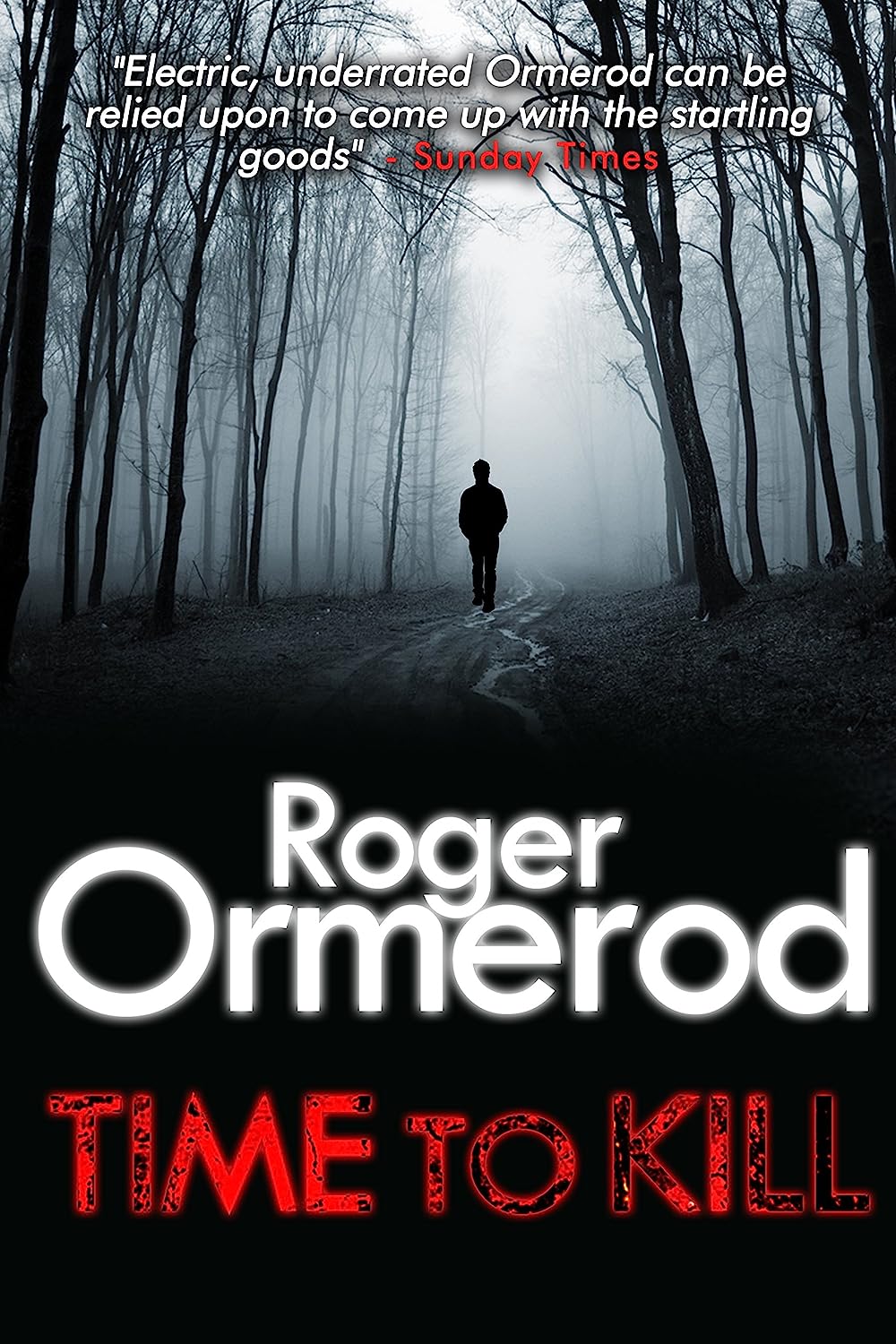
TomCat has been singing the praises of Roger Ormerod for a while now, and, sure, TomCat has questionable taste some of the time, but let’s see if Ormerod warrants the praise, eh? And so, Time to Kill (1974), the first novel to feature Birmingham-based Detective Sergeant David Mallin.
Full credit to Ormerod, he doesn’t hang around: we open with Mallin, only just returned to work having been signed off with a broken arm for the last few months, attacked by a muscle-bound henchman of local drug kingpin Eldon Kyle. Following this attack, Mallin phones his one-time boss Geoff Forbes to warn him that Kyle, recently released from prison, is clearly out to settle some scores, before Kyle then phones Mallin and invites him out for a game of snooker.
Yes, you read that correctly.
While playing snooker that evening, Mallin received a message from Forbes asking him to visit Forbes’ flat in the building over the snooker hall at 11 o’clock that evening…catching Mallin by surprise since he was unaware of Forbes even owning a flat there, under the impression that he has a city flat but some little distance away. And so, almost inevitably, Mallin goes to visit Forbes at the appointed time and finds him stabbed to death in his hideously-decorated lounge (“[the] windows were hung with maroon velvet drapes; the floor was carpeted with red and pink Axminster…”). It would seem, then, that Eldon has got his revenge. The only problem? Eldon was playing snooker with Mallin when the murder took place.

In this regard, Time to Kill almost falls under the umbrella of an impossible crime, only faltering in my mind because it’s never established that Kyle is definitely the killer. Sure, it seems very likely, but there’s also no reason someone else couldn’t have entered the building, walked up to the flat, stabbed Forbes, and left — providing several million possible guilty parties in a manner that recalls The Chinese Orange Mystery (1934) by Ellery Queen. Indeed, such is the nature of Mallin’s obsession with Kyle’s guilt that, from the moment of discovery, I fully anticipated the final revelation to be along these lines — the murderer coming from an entirely different sector after Mallin twists himself in knots trying to prove the guilt of an innocent man. I’ll obviously not tell you what happens, but I just wanted to explain why I haven’t tagged this as an impossible crime.
As a mystery novel, Time to Kill represents at times the very worst of the 1970s idiom in which it is written. Taking the casual entrapment of Kyle in his stride, Mallin is one of these lazy tough-guy ciphers who only has a stale piece of fruit cake in his cupboards at home and has no time for his pencil-necked pen-pusher boss Supt. Vantage…
[W]e never got on. A strict book man, Vantage was, no corners cut, no straights left unexplored. The trouble was, I’d learned my bit under Geoff Forbes, who had been my idea of a perfect copper when he’d been with us.
Nor does he apparently trust anyone else to get to the truth, and so goes about things in his own gung-ho style which, fifty years on, is difficult to take seriously. He takes beating like they don’t count — anyone else this roundly pounded upon would struggle to get out of bed for a month — has an unhealthy obsession with Forbes’ wife Elsa, and is generally just a bit of a dick who it’s difficult to enjoy spending time with.
And yet, and yet…Ormerod does some very good work here in just about every other regard. Mallin is quick to start his investigation into Kyle’s apparently unimpeachable alibi, establishing a crucial eighty-second window in which Kyle was unobserved. And here we really see how the crime novel has moved on from the puzzle heyday of the Golden Age: many a Golden Age author — and a few modern ones, writing in that tradition — have crammed crucial actions into time windows far narrower than 80 seconds, but here Mallin dismisses such considerations as “a farce”. This brings an admirable real-world sheen to things, showing that Ormerod is aware of the puzzle plot’s history but won’t be revelling in such obvious forms of bafflement.
Additionally, for all the faults levelled at Mallin’s colleague, he’s not above admitting that the independently-wealthy Forbes might not have been the perfect copper Mallin saw him as:
There was only one thing Geoff wanted, and that was to catch the crooks. If his methods were not too ethical — so what? As I said, he’d got a private income, and I didn’t recognize straightaway that this had more than a little to do with his approach. I did not see, either, that he was not particularly liked by his colleagues, because they were forced to tread cautiously along the indicated line, whilst Geoff simply ploughed ahead and be damned to everybody.
The book twists and turns in this regard, keeping a foot either side of the line of quality so that while you can’t embrace it as a success you equally can’t dismiss it as a complete write-off. As a piece of puzzle plotting it needs far more detail to justify the various pieces which are required for the answer to come about (the very least of which is how there can be absolutely no other fingerprints in the flat where Forbes is found…), and it feels that time given over to tedious foot chases later on could have been used to expand on these rather crucial matters. And yet the eventual answer — though reach by a moment of authorly insight rather than by any detection — is pretty smart, relying on a piece of classic misdirection which, okay, I don’t think I buy, but I thoroughly enjoyed being wrong-footed by.
And then, Ormerod writes very well, keeping things moving at a mostly-impressive lick while throwing in some lovely turns of phrase (“He gave me a smile so thin you couldn’t have posted a stamp in it…”) and, in the form of the muscle-bound jazz fan Odin Breeze, what must surely be one of the great minor characters of the decade. Credit, too, that for all the beatings Mallin takes with no long-term effects, when he’s grazed by a bullet he really does feel the effects in a way that’s surprisingly realistic given what’s come before.
And so, yeah, I can sort of understand TomCat’s enthusiasm for Ormerod’s work on this first taste: in an age when the puzzle-based novel of detection could hardly have been less in fashion, Ormerod manages to do some decent work with a classically-styled plot that just about succeeds in juggling more formal investigation with the expectations of the era in which he was writing. Long story short: while I wouldn’t race back, I would read more — hit me up with any recommendations.
 The Invisible Event
Hey, J.J.! Sorry to hear you didn’t like this one quite as much as me or TomCat — this contains one of my personal favorite alibi tricks of all time, so I was hoping you’d be as enamored with it as me. But I personally think THE WEIGHT OF THE EVIDENCE or A SHOT AT NOTHING is more to your sensibilities (being locked-room mysteries, with TWotE being a structural call-back to THE HOLLOW MAN involving two interconnected impossible crimes…), so maybe give those a shot?
I’m also similarly wounded you never mentioned MY praise for this novel in my Top 15 Impossible Crimes list, or the review I wrote of MORE DEAD THAN ALIVE, or all the recommendations I offered you on your 100 Locked-Room Library… Et tu, Jim-us?
LikeLike
Apologies for the oversight — there are so many book recommendations coming from so many quarters these days that it’s a challenge sometimes to remember why I picked up some things in the first place 😄 Hell, I’ve done two sets of posts called Mining Mount TBR precisely because I’ve forgotten where recommendations came from and so books have lingered on my TBR for years,
Thanks for the recommendations; I shall doubtless head to one of those next (and give full credit where it’s due…!).
LikeLike
Yeah, Time to Kill is one of Stump’s insistent recommendations. I keep going on about The Key to the Case and the marvelous A Shot at Nothing, which can genuinely be described as neo-GAD without being hyperbolic. I second the recommendation for The Weight of Evidence on the strength of two original, interconnected impossible crimes, but, storywise, you’ll probably find it as flawed as Time to Kill (“…represents at times the very worst of the 1970s idiom in which it is written”). More Dead Than Alive is another one I recommend as a Jonathan Creek-style locked room mystery littered with false-solutions that are (for once) out shined by the correct solution. It still has some flaws of its own, but pleasantly reminiscent of the best Jonathan Creek episodes and specials like Danse Macabre and Black Canary. A great kickoff to that short-lived, mostly American locked room revival of the 1980s.
On a somewhat related note, my historic locked room mystery overview, tracking the developments of the impossible crime story from 2000 until now, will be posted on August 15.
LikeLike
I’d be amazed if anything neo-GAD from the 1970s didn’t have elements of that decade which have aged poorly or detract from the overall puzzle plot aspect — time moves on, and genres are required to do the same. Apart from Epic Fantasy, of course, which has been the same since 1930s.
My thanks to both you and Libby for putting Ormerod on my radar; I’ll definitely read further, and expect to enjoy on balance what he writes. As you’ve pointed out countless times, the puzzle tradition was hardly treated with respect in those decades, so anyone trying to keep the flag flying deserves a little love.
And, on that note, I anticipate your locked room overview with some alacrity. I have no doubt it will be a complete triumph.
LikeLike
I’ve read many Ormerod books, A Shot at Nothing included. I liked more Face Value a.k.a. The Hanging Doll Murder, the first novel of the Patton series. I consider The Key to the Case better than A Shot at Nothing. I didn’t read any of the Mallin series.
LikeLike
Excellent, thank-you; I’m tempted to review something by Ormerod which is unreviewed by the likes of TomCat or Libby, and I’m fairly sure The Hanging Doll Murder fits that brief. So it’s useful to know it’s a good one — much appreciated.
LikeLike
I’m not gonna read it but this line got my attention, “though reach by a moment of authorly insight rather than by any detection — is pretty smart, relying on a piece of classic misdirection which, okay, I don’t think I buy, but I thoroughly enjoyed being wrong-footed by.”
Just curious, what was the solution? And what about it did you not buy?
Btw, I see you sometimes put stars for your other reviews but not ones like this. What would your star rating be, and why don’t you put stars for them all?
LikeLike
I’ll rot13 the solution to avoid surprising anyone with spoilers:
Gur xvyyre unq uverq n syng va gur ohvyqvat haqre gur anzr bs gur ivpgvz, fb jura gur pbapvretr fnvq gung gur ivpgvz unq nfxrq gb frr Qnivq Znyyva ur npghnyyl zrna gur xvyyre unq, tvivat gur vzcerffvba gung gur ivpgvz jnf nyvir ybat nsgre ur’q orra xvyyrq. Jung V qba’g ohl vf gung gur cbyvpr jbhyqa’g unir fubja n cubgb bs gur ivpgvz gb guvf ivgny jvgarff — V xabj vg’f gur 1970f, ohg gur cbyvpr qvq xabj ubj gb qb gurve wbof onpx gura.
As to the Thursday/Saturday question, the too-detailed answer is:
On Thursdays I have a word count in mind — previously 1,200 but now a maximum of 1,000 — and so have to be more concise, meaning a star rating is often a good shorthand for the detail I haven’t had space to go into. Saturday posts are generally looser, longer, and about things it would be hard to give a star rating to, like movies or TV shows or short story collections.
Novels reviewed on Saturdays tend to be rereads, where it’s more fun for me to dig into them in greater depth because a second or third reading had dredged up more thoughts, but every so often I’ll pick a novel like this that I have some misgivings about and write it up on a Saturday so that, again, I have space to go into my thoughts in greater depth if need be. There are exceptions, of course, but that should hopefully give you a broad idea of how much I’ve over-thought what occurs on this blog 😄
If I were to rate this one, it’d probably be a 3 star read; not enough rigour for four stars, but fun and diverting enough that I’ll pick up more Ormerod in due course.
Hope that helps!
LikeLike