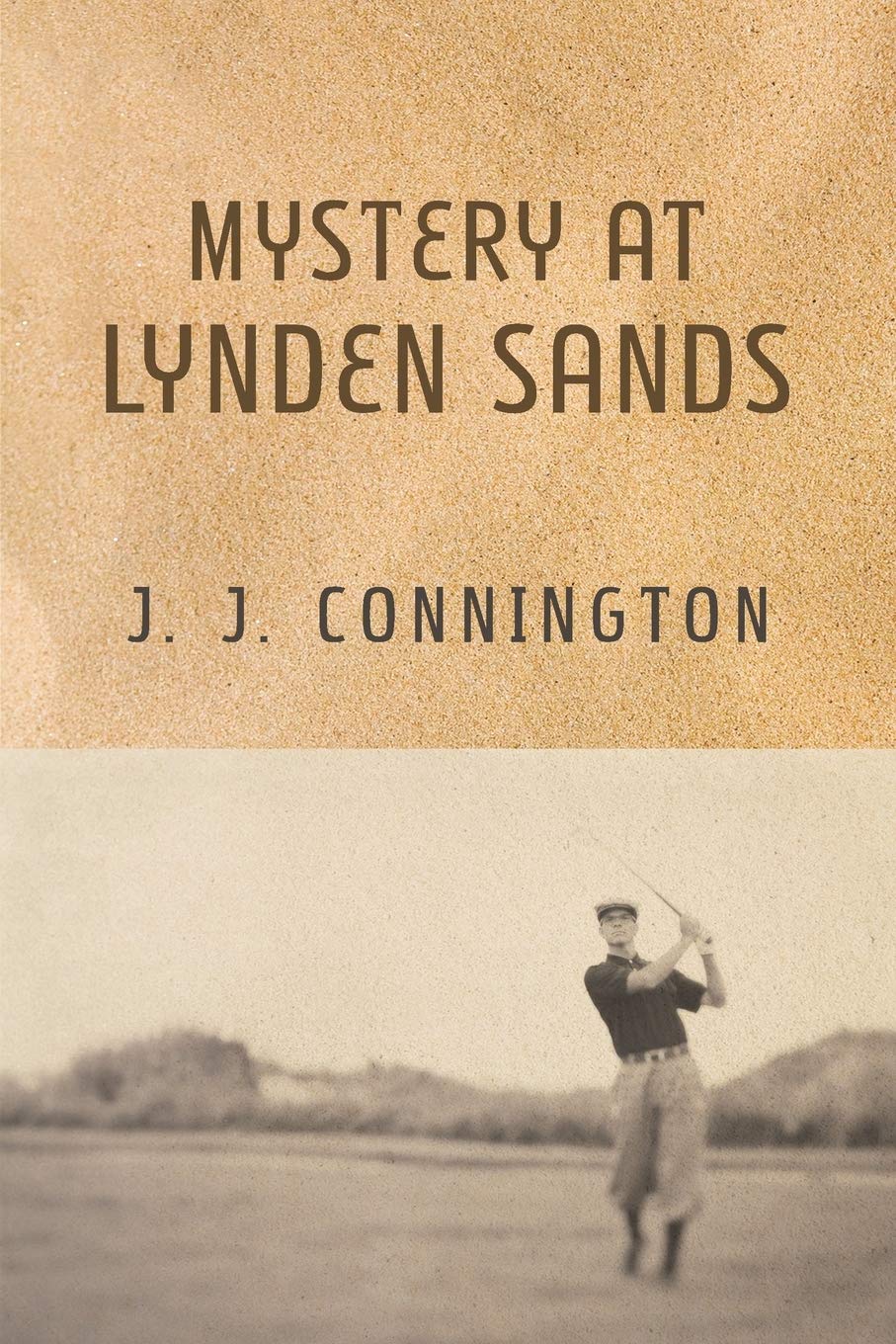


When Derek Fordingbridge, long-supposed-dead heir to the family fortune, apparently resurfaces, his face mutilated in the war and all other identifying characteristics similarly compromised, his uncle Paul is naturally sceptical. When this re-emergence is followed hard upon by the murder of the old family retainer who cared deeply for Derek and the theft of Derek’s diaries from family pile Foxhills…well, it’s almost like we’re in a classically-styled piece of detective fiction, eh? Thankfully Chief Constable Sir Clinton Driffield is in the area and ready to help out Inspector Armadale with his investigations into which of two possible interpretations this should be taken as.
Having perhaps used up his stores of ingenuity in 1928 on The Case with Nine Solutions (1928), Mystery at Lynden Sands (1928) finds J.J. Connington on good, solid, slightly underwhelming form. Murder, mysterious attacks, and multifaceted malfeasance are all present and correct, and Connington brings his usual form of intelligent scientific reasoning to things — the discussion about footprints is, of course, excellent — but the plot feels undercooked; there should be a second string to events, allowing the reader to be misled by foreground events, but instead what we get is linear and underdeveloped.
Thirteen books into the man’s career, however, I won’t deny that a lot of what is here is very enjoyable. Driffield is accompanied, for the first time since Murder in the Maze (1927), by ‘Squire’ Wendover — “a faithful reader of the classics, and he simply can’t imagine anyone going in for detective work without a steely eye and a magnifying glass” — who, at this stage of things, isn’t as pompous as he would become. Wendover’s sudden fixation of the innocence of Cressida Fleetwood is a little unusual (all the more so since she isn’t a single lady who will swoon gratefully into his arms in the final chapter — a real innovation!) but it drives a good three-headed narrative, with Driffield, Armadale, and Wendover looking at the evidence from differing perspectives and bringing new interpretations to events as they mount up.
Driffield remains a delight, too, veering from obscure questions in the Great Detective mould (“…did you notice if there was a heavy dew last night?”) to an intelligent forensic investigator (the method of taking the footprints in the sand is ingenious), all the while reminding Wendover that his antagonism towards Armadale is, while human, entirely unwarranted:
“It’s a dangerous game, making the police look silly. And the inspector’s too good a man to hold up to ridicule. He makes mistakes, as we all do; but he does some pretty good work between them.”
He also gives, in the closing stages, one of the best arguments for the detective playing his cards close to his chest that you’ll read in the genre — none of the ‘I don’t want to be seen to make an error’ hubris of young Ellery Queen here, but instead a genuine concern for the wellbeing of those within his purview. But he’s also human enough to be both very funny when it pays off (his riposte to Wendover’s cry of something being “self-evident” is delightful) and ruthless to an uncommon degree when it comes to transgressors of the law. In certain regards, he really is a most fascinating character.
Some interesting historical principles are in evidence, too, from the still-strong fashion for post-war table turning and spiritualism (the medium D.D. Home gets a passing mention) to the evidently fairly new notion that someone accused of murder can ask for legal advice before speaking with the police (“Armadale had never seen a move of this sort, and his discomfiture was obvious.”). The classic novel of detection has always served a secondary purpose as an historical document, and the paucity of cars, the easy availability of firearms, and the general sense of how an investigation is conducted all feed into this milieu.
It’s a shame, then, that more isn’t done with the Tichborne Claimant principle at its core — indeed, this gets swept aside pretty quickly in favour of interpreting footprints on the beach and figuring out the nighttime comings and goings of the local hotel’s denizens. Connington is very readable, and it’s difficult to begrudge time spent so agreeably, but a trifle more twisting of his plot strands might have resulted in something very memorable indeed here; instead, it’s fine, another example of why he’s a minor player in this genre despite the strength of his writing and the intelligence of his ideas. It seems as if he was still feeling his way despite his prodigious output, and, without the innovation displayed in his work in the 1930s, the genre might well have left him behind altogether. Better novels by Connington exist, but there’s nothing here to make me regret reading it.
~
See also
D for Doom @ Vintage Pop Fictions: This is fairly typical of Connington at his best. The plotting is intricate and very tight. Sir Clinton’s approach to the investigation is uncompromisingly logical and rational. His old friend Squire Wendover is naturally involved, and just as naturally the good-hearted Wendover can’t help seeing the case in purely emotional terms.
Nick @ The Grandest Game in the World: [Sir Clinton] soon takes charge, and reconstructs two murders and a disappearance from physical clues, including one victim’s clothing, footprints, and motor car tracks – impressive to watch. Wendover far from a thick Watson. His deductions from the victim’s overcoat, the time of rainfall, and his knowledge of detective fiction poke holes in the police inspector’s circumstantial case.
~
J.J. Connington on The Invisible Event
Standalones:
Featuring Sir Clinton Driffield:
Murder in the Maze (1927)
Tragedy at Ravensthorpe (1927)
The Case with Nine Solutions (1928)
Mystery at Lynden Sands (1928)
Nemesis at Raynham Parva, a.k.a. Grim Vengeance (1929)
The Boathouse Riddle (1931)
The Sweepstake Murders (1931)
The Castleford Conundrum (1932)
The Brandon Case, a.k.a. The Ha-Ha Case (1934)
In Whose Dim Shadow, a.k.a. The Tau Cross Mystery (1935)
A Minor Operation (1937)
Truth Comes Limping (1938)
Jack-in-the-Box (1944)
Featuring Superintendent Ross:
Featuring Mark Brandon:
The Four Defences (1940)
 The Invisible Event
It’s a shame to hear that the Tichborne Claimant plotline peters out here, especially since it sounds to me like it’s closer in nature to the actual Tichborne case than The Crooked Hinge’s or Brat Farrar’s claimant plots are, because it actually addresses how different the claimant looks from who he may once have been (Tichborne/Orton’s corpulence vs. Fordingbridge’s war injuries.)
I guess part of the problem is that there’s only so much suspense one can prolong with the “is he or isn’t he” question compared to the “whodunit” question. Crooked Hinge did a good job of keeping that suspense albeit only to the halfway point (it also subverts the fate of the “family retainer” character;) whereas Brat Farrar lets you in on the con from the get-go.
I think I’ll still save The Case with Nine Solutions to be my first Connington, whenever I actually get around to that…
LikeLike
Nine Solutions is a good Connington, but it feels atypical among the 13 I’ve now read. No less clever, but somehow like he made a deliberate decision with that to focus more on the minutiae of the puzzle over the setting and environs, which usually come across so well elsewhere.
And, yes, the claimant part of this is quickly demoted to background material and that’s a shame — others have, as you say, taken a different approach, and I can see that it’s not really Connington’s intent to play with that too much (he loves the reinterpretation of physical clues too much to delve into psychology or play identity games)…so, really, I guess I’m the one at fault.
Typical.
LikeLiked by 1 person
Idk anything about this book, but I wanted to say it’s crazy that you’re reviewing Death Within the Evil Eye next week because I just got the book literally yesterday! Looking forward to seeing what you think
LikeLike