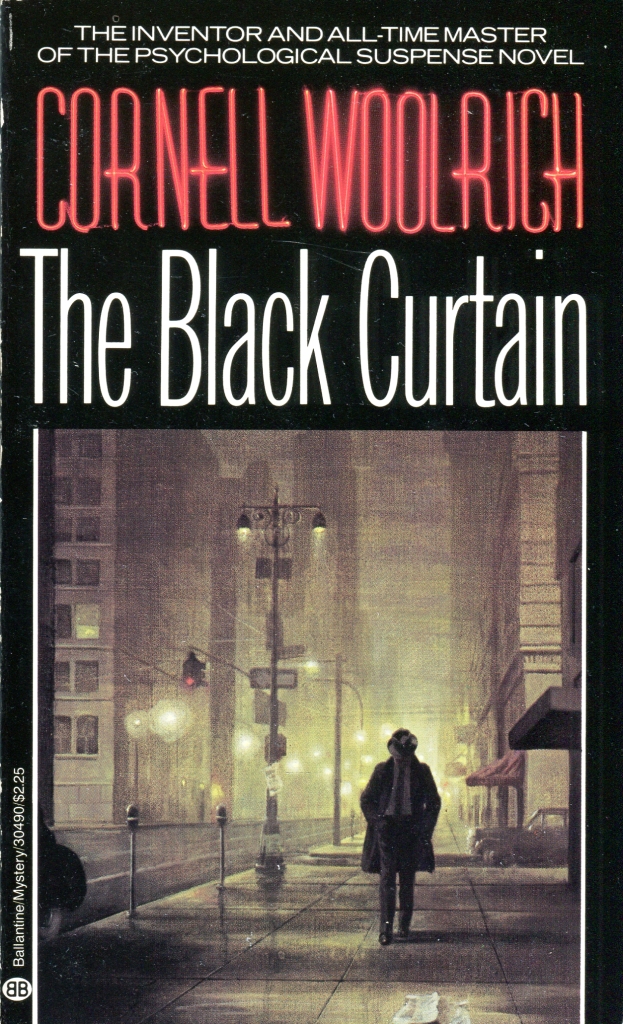


I’m starting to develop the belief that the novelistic output of Cornell Woolrich can be broadly summed up in a single word: ‘Loss’. The six novels of his I’ve read so far all concern the desperate search for — and horror associated with — something either already lost or on the verge of being so, be it love, opportunity, or escape. And The Black Curtain (1941) extends this theme by finding yet another string of loss to add to the great man’s bow in Frank Townsend’s misplacement of perhaps the most crucial of all things: himself. And, this being a work of suspense writing, when he starts to uncover what the eponymous curtain obscures, he’s not necessarily going to be thrilled with what he finds.
Struck on the head by a plaster moulding which falls off the front of a building, Townsend dusts himself down and continues on his way home to his wife Virginia…only to discover that he doesn’t live in the flat he has headed to. When he eventually tracks Virginia down, a further revelation awaits him: he has been missing for three years, she having assumed that he simply walked out on her on 30th January 1938 — a day he remembers minutely, though the time since is a complete blank. This, those acquainted with Woolrich’s brand of nightmare will be unsurprised to learn, all occurs in the first chapter, and the ordeal only builds from there when — surprise, surprise — it turns out that he may have forgotten them, but those three blanks years certainly remember him:.
He only knew that the bottomless black abyss of that anonymous past was not passive, lifeless, after all; it had just emitted a blood-red lick of flame toward him, as if seeking to drag him back into its depths and consume him.
Of the plot that unfolds I shall attempt to say as little as possible, since it’s best left to the reader to go on Townsend’s journey with him, through the “scary array of goblin trees” which represent an unknown threat which must be discovered and faced. Along the way, Woolrich expertly runs up and down the xylophone of emotion, from terrifying pursuits — “This was a manhunt in every sense of the word.” — to heart-breaking moments of filigree’d glass-like delicacy (“He’d never thought a taxi horn could hurt you in the chest like this one did.”) with barely a pause for breath in between.
Each of the three parts this is divided into represents a step on that journey to rediscovery, and Townsend’s gradual transformation from a hunted thing to a man who begins to wish impatiently that he might face the cause of this unhappiness is weighted perfectly as we progress. The usual coincidences we’ve come to anticipate, almost require, in Woolrich’s work rear their head, but for two-thirds of the book they fold in well, telling us always a little bit more and never quite enough, requiring our protagonist to emerge as an intelligent and resourceful soul feeling his way in the dark alongside those who would abandon him were they to learn of his blindness. Inevitably, things go wrong, and each inch of progress is almost not to be trusted (“Doom must have been pulling its punches, saving them for the rounds ahead.”), so unreachable does that final goal seem from the starting line…but always there is forward motion, Woolrich rarely being one to flounder in his own purgatories for too long.
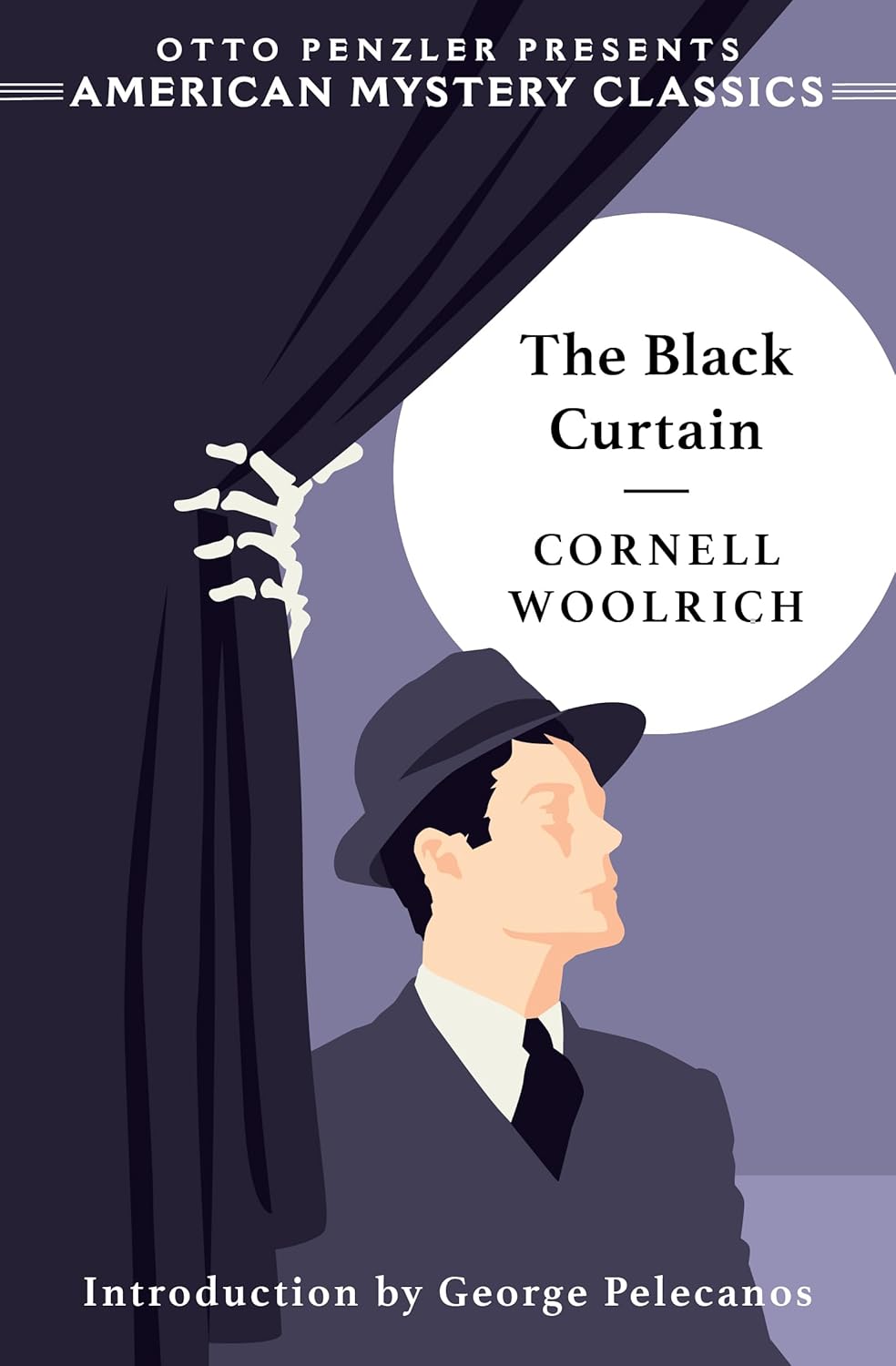
Only really in the final section do things fall apart, the task he has set himself perhaps too great to be achieved without the deus ex machina which hoves into view and strips away so much of the enjoyably-stacked odds which make Townsend so easy to root for. It’s still fabulously written, with houses as gloomy vessels of deliverance and some wonderful reflection on the semiotics of chairs — hell, there’s even a piece of wordplay which might qualify as the darkest joke Woolrich ever told — but the extended suspense sequence which makes up the denouement feels a little too limp to excite (it oddly parallels another book recently reviewed on this blog), and Woolrich starts withholding information to better spring a surprise on you which is never really in doubt…so it all sort of stumbles to a halt.
We don’t necessarily come to Woolrich for his plotting, though, and his prose is as sharp as ever (Townsend emerging, relieved, from a hiding place “feeling like a bath towel after three people have used it” is possibly my favourite simile in fiction). Fans will find much here to enjoy, but those of you new to the man and his work would be advised to check out The Bride Wore Black (1940) or Phantom Lady (1942) before testing your mettle here. And that, without divulging more about the plot, is all I’m willing to say!
~
Cornell Woolrich on The Invisible Event
Novels:
The Bride Wore Black (1940)
The Black Curtain (1941)
Phantom Lady (1942)
The Black Angel (1943)
Deadline at Dawn (1944)
Waltz into Darkness (1947)
Rendezvous in Black (1948)
Short story collections:
Nightwebs (1971)
Darkness at Dawn (1988)
Individual stories/novellas:
 The Invisible Event
Like you, when I first read it I did find the convolutions of the plot in the final act a bit of a let down (Woolrich could also get a bit too gimmicky in his plotting for my liking). But I’m a sucker for amnesia stories and it is such a perfect fit for Woolrich. Not his best but indispensable.
LikeLike
Amnesia is a tricky prospect in crime fiction — it feels better suited to thrillers, like The Bourne Identity — but Woolrich does a great job turning this in to a series of detective novelettes. Each stage has a clever new focus, and the methods employed are very intelligent…just a shame it all comes tumbling down in the final stages.
But, it’s Woolrich, and as such difficult to dismiss entirely.
LikeLiked by 1 person
Yeah, a story kind of loses me the second amnesia enters the picture, so I’m a bit apprehensive about this one. Still, it’s Woolrich…
I like the sound of “a series of detective novelettes”, as the episodic nature of Woolrich’s novels is one of the things I enjoy about his writing.
LikeLike
At each new beginning it sort of feels like the story could be starting there; I’m glad he wrote it in three parts, but you could take each section and have the first two as wonderful setups with no payoff, just some bewildering events and clever reasoning.
But, yes, the amnesia element does take a lot of swallowing. Thankfully you’re kept pretty busy, so it doesn’t detract from the overall effect.
LikeLike
An enjoyable and helpful review as I am not so well versed in Woolrich’s work. It is good to know which ones should be put at the top of the list to find. Is amnesia a theme Woolrich uses a lot?
LikeLike
I’ve not yet read enough to know how common it might be, but I’ve not encountered it in my little reading of him so far. Or, if I have, I don’t remember 🙂
LikeLiked by 1 person
Not common in his novels but “blackouts” do occur in more of his short stories, inclyding:‘You’ll Never See Me Again’ (1939), ‘Cocaine’ (aka ‘C-jag’) and ‘I Won’t Take a Minute’ (both from 1940) and ‘If the Shoe Fits’ (1943). His 1941 novella “Nightmare” is a great variant – I did a piece on it here: https://bloodymurder.wordpress.com/2012/11/23/nightmare-1940-by-cornell-woolrich/
LikeLike
I suppose there’s a collective amnesia element to All at Once, No Alice and Phantom Lady…but they’re not traditional amnesia stories as we think of them.
LikeLiked by 1 person
No ….
LikeLike
😁
LikeLike
This weekend I finished “The Black Curtain” and agree with your review. As with other Woolrich books, the prose is urgent and atmospheric full of tension. No one writes desperate people driven to ever more extreme actions than Woolrich and Frank Townsend is yet another of those anguished individuals in a terrifying situation.
The pacing is relentless, with Frank barely having a moment to breathe before another revelation or close call pulls him deeper into the mystery of his amnesia.
If the book has a weakness, it is as you say the ending. After the breathless unease of the first 3/4 of the book, the last 1/4 suffers from the tonal shift (like a leaky balloon slowly deflating) that was wasn’t as strong as what preceded it.
Nevertheless, I still enjoyed this immensely and Woolrich remains a favourite author.
LikeLike
It’s a great ride for the first section, and it would have taken something really special to maintain that to the close…but, man, I thought Woolrich was the guy to do it, y’know?
I should get back to more of Woolrich’s novels soon. I’ve been reading his short fiction, and it’s…not great. I appreciate the guy wrote a lot, and so it can’t all be great, but, wow, I’ve really struggled to sustain interest in some of his shorter plots.
A novel might be the way to go, so thanks for the nudge to get me started.
LikeLike
One that I don’t see in your list of Woolrich reviews and that I recommend is “Fright”. The book has Woolrich’s main character caught in a spiral of despair, guilt and lies that gets worse and worse. It has been reprinted and is available from the usual places.
LikeLike
That’s one I don’t have — thank-you, I’ll keep an eye out.
LikeLike