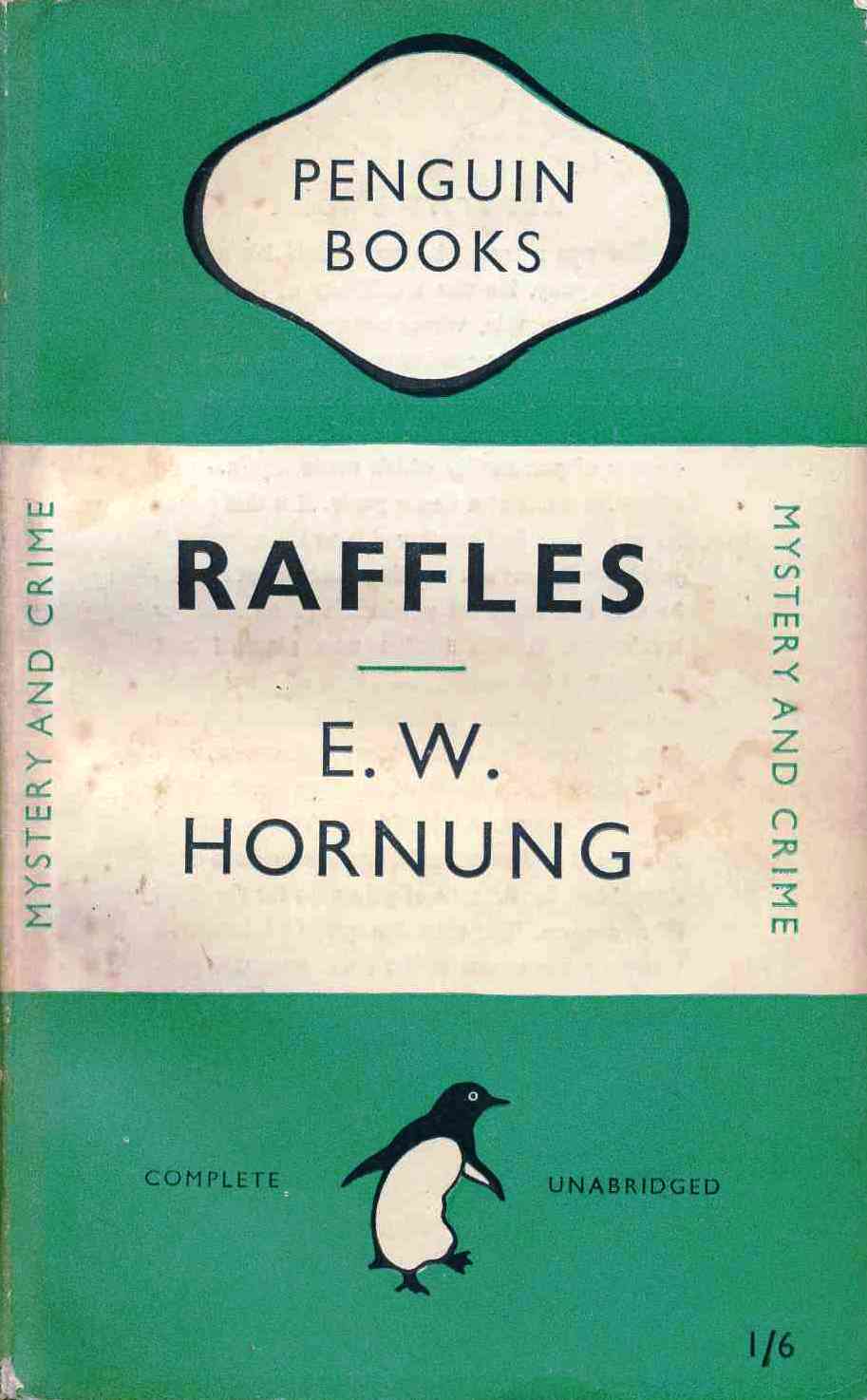
As discussed previously, Tuesdays in February will feature four collections of short stories on the Haycraft-Queen Cornerstones list, selected on account of my ever-growing interest in what the genre looked like before the advent of the Golden Age in (no arguments here…) 1920. Confusingly, my 1950 green Penguin paperback of gentleman thief Raffles stories by E.W. Hornung shown above contains 14 tales, only the first eight of which concern us today, comprising as they do the first collection to feature the character, The Amateur Cracksman (1899).
The Raw Materials
One evening, having lost heavily at cards and paying his debts with cheques he knows will bounce when presented at the bank in the morning, gentleman-about-town Harry “Bunny” Manders returns to his rooms at the Albany club in imminent disgrace. There he encounters A.J. Raffles, who was at the card game which has cleaned Bunny out so disastrously, and for whom Bunny had fagged while at public school. Confessing his situation to the wealthy, debonair Raffles, Bunny contemplates suicide only to back out at the last minute and for Raffles to then make a shocking declaration of his own: he is no independently wealthy layabout “rich enough to play cricket all the summer, and do nothing for the rest of the year” but is instead living an equally hand-to-mouth existence which he supplements by stealing and selling other people’s valuables.
That very night, they commit a robbery and, from that point on, are as thick as, er, conspirators, despite Bunny’s occasional moral misgivings (“I had still enough of the honest man in me to welcome the postponement of our actual felonies, to dread their performance, to deplore their necessity”). All the while, might the repeated appearances of Scotland Yard’s Inspector Mackenzie betoken some comeuppance in their future, or is Bunny simply looking for an excuse to drop the criminous game for good?
The Foundations
Written when the thrall of Sherlock Holmes was strong — I’ll point out here that Hornung was married to Arthur Conan Doyle’s sister, not because it seems relevant but because someone will call me out on it if I don’t — the relationship of Raffles and Bunny draws heavily on the Holmes/Watson dynamic, with Mackenzie a sort of Bastard Lestrade as the regular policeman on the scene…albeit one whose relationship with our central pair is seemingly always in flux.
Raffles is, naturally, the Holmes: always instigating the schemes in which they find themselves embroiled, fond of keeping his cards close to his chest, evincing a talent for disguise that gives a literal interpretation to ‘A Costume Piece’ (1898). He has, too, no small sporting prowess to his credit, being something of a terror on the cricket field, acknowledged as “a dangerous bat, a brilliant field, and perhaps the very finest slow bowler of his decade” despite scorning his talents and taking “incredibly little interest in the game at large”. Unlike Holmes, Raffles is noted for his charm and, we’re told, especially his success with the fairer sex — “a side of his character upon which I have purposely never touched, for it deserves another volume” Bunny tells us.
Bunny, then, is cast as “the inevitable appendage of the invaluable Raffles” who, like all good sidekicks, is kept in the dark until the last possible moment (“You lay your plans and never say a word, and expect me to tumble to them by the light of nature.”), and is generally there to be incensed at the ease with which his friend will turn felonious. He is also astonishingly dense, as demonstrated in first story ‘The Ides of March’ (1898) when — having confessed his insolvency to Raffles and been asked if he’d be willing to commit a crime — he is surprised that Raffles saying they can call upon a friend of his for money at two o’clock in the morning turns out to be a criminous endeavour.
So now, when I heard him kick off his own shoes, I did the same, and was on the stairs at his heels before I realized what an extraordinary way was this of approaching a stranger for money in the dead of night. But obviously Raffles and he were on exceptional terms of intimacy, and I could not but infer that they were in the habit of playing practical jokes upon each other.
Other fingerprints of the Holmes archetype can be found in broad hints towards tales not here related (“In short, our most successful escapades would prove the greatest weariness of all in narrative form; and none more so than the dull affair of the Ardagh emeralds…”) and the fact that, much as with Holmes in ‘The Adventure of the Gloria Scott’ (1893), we get an origin tale of Raffles’ first theft in the shape of ‘Le Premier Pas’ (1899). There’s even a key way in which final story ‘The Gift of the Emperor’ (1898) — though, as mentioned above, six more follow it in this collection, not quite completing the second anthology of Raffles stories, The Black Mask (1901) — bears a great deal of comparison to one particular Holmes story, but I’ll veer away from any hints lest the outcome spoil it for those of you yet to encounter either.
Flourishes
It’s tempting, on the evidence above, to see Raffles as little more than a cash-grab predicated on the popularity of Holmes, but Hornung brings to his creation two things that the Holmes stories — and most of their imitators — failed to leverage to any meaningful extent.
The first is that, while undoubtedly a man of great nerve and tremendous conviction, as befits all Great Detective archetypes in the shadow of Holmes, Raffles is, well, he’s a bit shit. For all his smugness at his astonishing tactics in pulling off the robbery of ‘The Ides of March’ (“Even that little business last month was a sordid affair, but it was necessary, and I think its strategy redeemed it to some extent.”) he really does nothing even moderately cunning — picking a few locks, getting very lucky that the security of a jeweller is pretty damn slapdash, and then running away. “In point of fact our plans were so craftily laid (by Raffles) that the chances of a hitch were invariably reduced to a minimum before we went to work,” Bunny tells us in ‘Wilful Murder’ (1898), when the experiences preceding this have boiled down to (in publication order) brute force, abject failure, serendipity, and serendipity again.
There’s something almost charming in the ineptitude of a man who thinks that, as a cricketer of some note, he can simply turn up to a job of questionable morality and give a pseudonym as a way of protecting his identity, as he does — and finds out he can’t — in ‘Nine Points of the Law’ (1898). Or thinks that the theft of a priceless pearl in ‘The Gift of the Emperor’ will be “the biggest mystery that ever was made!” because he won’t be seen outside his room when the crime is committed…despite a ventilation shaft connecting his room with that from which the abstraction is to be made. And, I’ll be honest, his insistence on committing that theft while starkers feels like the sort of bizarre touch you’d find in a Naked Gun movie. What the hell is that about?!
It’s actually rather refreshing not just for the criminal to be the protagonist — Maurice Leblanc’s Arsene Lupin was still some seven years away — but also for the protagonist to be almost self-gaslighting with his overbearing self-congratulatory manner when he has, at one point, jumped out of a window and run away from the most agonisingly stupid failure without securing Bunny’s freedom…leaving our narrator to hide in a wardrobe for half an hour before being discovered, dragged downstairs, and shot at. And yet, for all this apparent farce, Hornung plays Raffles’ capabilities with a surprisingly straight face, as if the author is unaware of the ineptitude of his own creation. It matters to Raffles that he is taken seriously in the commission of his crimes (“Did it look like a first attempt? Of course I have done it before.”) and his motives are hilariously high-falutin’ given his methods:
“Does the writer only write when the wolf is at the door? Does the painter paint for bread alone? Must you and I be driven to crime like Tom of Bow and Dick of Whitechapel? You pain me, my dear chap; you needn’t laugh, because you do. Art for art’s sake is a vile catchword, but I confess it appeals to me.”
The second notable adjunct is Hornung’s use of the emerging tropes of detection, as had been seeded in the public mind through the Holmes stories. Where Holmes and his offspring would use, say, the detection of footprints to identify a criminal, Hornung time and again uses these principles against Raffles and Bunny: footprints give them away in ‘A Costume Piece’, the presence of a policeman disguised as a guest at a house party is seen from the outside in ‘Gentlemen and Players’ (1898) where it would usually be the protagonist who was the disguised party, and Bunny and Raffles stumble into the parallel plots of ‘Wilful Murder’ in a way that the detective would usually be the one to separate out. Even the identity games of ‘Le Premier Pas’ are utilised accidentally, for want of a better word — the criminal’s misdirection known to the reader first.
These are not inverted mysteries. there being no detection on the other side, but rather inversions of the principles of the mystery story: these are rarely breakthroughs used to advance the protagonist’s cause, but instead obstacles that are thrown in his way to unseat him or test his mettle. And, interestingly, this must surely be one of the earliest instances of lore rearing its head where stories represent individual cases — not just because ‘The Return Match’ (1898) sees a villain from a previous story reappear and make demands of Raffles and Bunny at the threat of exposing their game, but because — moderately hinted-at spoilers of a sort — the collective outcomes comes to matter beyond simply adding verisimilitude by referring to earlier cases in later ones.
Hornung is cautious, too, not to abandon the moral qualms of Bunny, perhaps in deference to potential misgivings of his Victorian audience. Raffles may be the irresistible, inciting presence throughout, but just as Dr. Watson humanised Sherlock Holmes so Bunny is the reader’s closer companion who should, perhaps, sail a little closer to mainstream expectations:
I had turned into Piccadilly, one thick evening in the following November, when my guilty heart stood still at the sudden grip of a hand upon my arm. I thought — I was always thinking — that my inevitable hour was come at last.
One story even has the two meeting after a significant separation, Bunny having vowed to make good on his criminal career, which Raffles refers to as “turn[ing] pi” — an expression I’ve never encountered before and do not understand (maybe police informant?, except that Bunny squarely keeps his own counsel where his crimes are concerned) so any thoughts are gratefully received. Still, it seemed worth noting that fiction was not yet at the point of being able to celebrate in watching a miscreant thumb his nose at the law, and perhaps it took Leblanc and the greater ethic scope permitted by 19th century French society to allow Lupin to come into being and finally allow everyone to relax a bit (and he wouldn’t be the only early, highly influential French text in which the criminal gets away with their crimes, hein?).
Interesting Features
Most additional points of interest come from the attitude Hornung displays in the time he was writing. It feels faintly daring in the late 19th century to typify the Dowager Marchioness of Melrose as “flourishing her ear-trumpet, and drinking champagne with her usual notorious freedom”, just as it must have raised a few eyebrows to have one state so freely — in a work of fiction, no less, with the social expectations and niceties observed above — the “profound conviction that Jack the Ripper was a really eminent public man, whose speeches were very likely reported alongside his atrocities”.
There’s also a pleasing hint of meta-awareness in Raffles relaying the story of ‘Le Premier Pas‘ and then admitting that “the thing should have ended with an exciting chase” but did, in fact, come to a far less thrilling end. Were these sorts of touches to be included in a story written today but set in the late 19th century, I’d cry “Anachronism!” and lament the drop in standards of historical fiction. And I’d be wrong, because these weirdly modern touches have aged superbly in the 124 years since A.J. Raffles first strode out onto the Lord’s pitch to dispatch some uppity bowler and save the day, before crying off sick and robbing the man’s hotel room.
The Judgement
Had Hornung merely swapped out a moral, law-abiding and -enabling Holmes for his criminous shadowy twin, there would still be enough here to credit him with legitimately adding something new to the expansion of the genre. The likes of ‘The Suicide of Kiaros’ (1897) by L. Frank Baum had already shown us the criminal being successful in his endeavours (or so we must assume…), but Hornung invited us to meet these people again and again, to long for their company — or maybe he was simply teasing his audience with the schadenfreude of awaiting their comeuppance, delaying it and delaying it and delaying it to greater increase their eventual delight.
Either way, Hornung showed us that the criminal need not be the grasping, avaricious figure of Victorian lore, that he may be debonair and charming, even when unmasked, and that the moral qualms of wrongdoing could add a dimension to our characters even while they allowed themselves to be drawn back into the perceived necessity of crime. In short, Hornung made the criminal empathetic rather than merely sympathetic, not relying on the usual staples which usually justified crime — an unscrupulous money-lender, a wronged love, an unsuspected murderer — allowing the reader to (however tacitly) understand their reasons while not always having to find them agreeable.
A few years later, R. Austin Freeman would enlarge upon this theme with the inverted mysteries that would blow the lid off the genre, and yet even he would lean more into sympathy. Hornung here arguably laid the groundwork for the likes of Frances Iles’ Malice Aforethought (1931) in which criminals commit crimes for selfish reasons, and stirred in the sprinkling of satire that made such a bitter pill slightly easier to contemplate swallowing. It’s a delicate balance, even more so given the time in which he was writing, and to see it managed with such aplomb is wonderful.
So, does The Amateur Cracksman (1899) pass muster as a Cornerstone? You’re darn tootin’.
 The Invisible Event
“Pi” in this case is just short for “pious”. Often found in school stories, someone being “pi” is pejorative – they’re normally above themselves, a goody two shoes and possibly a sneak. They won’t join in with the fun of a midnight feast.
LikeLike
Ah, fabulous! That makes a lot of sense in context, especially as it’s an explanation I’d failed to consider. Much appreciated.
LikeLike
A “pi-jaw” is a tedious lecture by the headmaster on the necessity of pulling up one’s socks and remembering the honour of the school, blah blah.
LikeLike
Good heavens, I’m learning a lot today 😄 I can’t believe my grant for this blog as an education resource was turned down by Her Majesty’s Customs and Excise….
LikeLike
I have long wanted to read the Raffles stories so your review is a tantalizing one. I think it’s kind of inevitable that we view these stories through a Sherlockian lens simply because the ACD stories were so tremendously popular in their day, though I wonder if a closer analogue to them as tales of investigation from the perspective of someone completely outside the law would be the Horace Dorrington stories written by Arthur Morrison. I cannot speak about them with much authority since I only know them from the two episodes of The Rivals of Sherlock Holmes , but they could make an interesting point of comparison if you are able to track them down. I also didn’t realize these predated Lupin by a couple of years. I feel like he is certainly the more well-known gentleman thief of fiction and I wonder if the obvious Holmes parody included in those works goes some way toward strengthening that legacy?
I look forward to more of these reviews of foundational works. Any chance we will get a word or two about a close personal friend, Mr. Carnacki?
LikeLike
I know of Morrison’s Dorrington stories, but I’ve never read a single one. My interest in pre-GAD gets deeper with every story, however, so you can practically guarantee that they’ll feature on here eventually.
And, yes, I reckon it’s safe to say that the parodies of Holmes in the Leblanc tales is what secured their legacy — the threat of legal action has a habit of doing that! Plus, well, they’re absolutely superb parodies — probably the sharpest mickey-take of the Holmes/Watson dynamic I’ve ever encountered.
As for Carnacki, I really do want to write about him at some point, but he won’t be in this series as they’re not on the Cornerstones list. I mean, they should be, but who am I to argue with Haycraft and Dannay??
LikeLike
The Dorrington and Raffles stories are both on Gutenberg. The Dorrington stories are depicted from the view of his rivals/victims rather than himself so he seems more skilled – though no more successful in the end – than Raffles..
The relationship between Raffles and Bunny raises interesting questions, Graham Greene wrote a play in which they are lovers.
George Orwell’s essay “Raffles and Miss Blandish” is an interesting look at pre- and post- GA crime fiction with some good points about Raffles.
LikeLike
Thanks for the pointer to the Orwell essay, I’d not heard of that, and I promise I’ll get to Dorrington at some point — you make them sound even more intriguing now!
Graham Greene wrote a play in which they are lovers.
Hasn’t this been done with every single pair of Victorian gentlemen at some stage? It feels less like a crafty reimagining than a sad attempt to be daring by outdated minds, as if there’s anything shocking about homosexuality.
LikeLike
Not 100% sure how I randomly ended up here (I didn’t even read Raffles that recently!) but did just want to make one note-
Whatever may have been/has been done with other pairs of Victorian gentlemen (and I come from Tumblr culture so I know all about it if from a very different milieu than Greene lololol), there’s a LOT of basis for queer readings of Raffles and Bunny. In fact, in this context I’ll note one thing I disagree with you on in your excellent review- you note disbelievingly that Hornung writes Raffles as being this amazing thief despite him objectively not doing a great job, when it’s actually Hornung writing BUNNY writing Raffles that way. Bunny is a MUCH less reliable narrator than Watson is! From the very start, Bunny’s emotions and attachment to Raffles are intensely intertwined with the way he writes about him, including the ways that his successes and failures are characterized. (But not only that- Victorian schmictorian, some of the specific ways that Bunny talks about Raffles’s body and attractiveness can be a Lot lol, not to mention the various forms of his jealousies.)
Besides for that, there are a bunch of metatextual elements that pertain to this- aestheticism is a significant undertone in the stories and of course at the very time these stories were being written one of the leading aesthetes was being HEAVILY associated with homosexuality (Hornung knew Wilde and named his son after him, as it happens); much of Raffles’s character- and his place of residence- was based on that of Hornung’s friend George Cecil Ives, who was openly gay. I’d add, too, that the surreptitious yet flamboyant criminality of two men, one of whom is much more anxious about this criminality than the other, can seem laden with subtext.
But what, one might ask, about Bunny’s offhand reference to Raffles’s many adventures with women, which he says could fill another book? It certainly fills in a part of Raffles’s character that is missing from the stories thus far (and might have seemed glaring in its absence), but I’d also add that on ALL the several occasions in the later stories in which female love interests are introduced for both Raffles and Bunny, there are some serious queer undertones. There’s Faustina, whose entire story (and Raffles’s entire regard for her) is redolent with aestheticism; there’s Jacques Saillard, who we’re told is a woman with a man’s name for some reason; there’s Bunny’s unnamed former fiancee, whose representation in two stories in the final collection is FASCINATING. Then there’s Amy Werner, whose entire role is to induce a jealousy so acute in Bunny that he expressly compares his own situation with that of another male character who’s in love with Amy! It’s all fascinating.
It’s ironic- in an opposite situation to what you describe as an attempt to be awkwardly transgressive in the 70s by Greene (and I’ve read his play, it’s not very good), these days, in online fan circles there’s more of a very earnest attempt to read pretty much ANYTHING as queer, which, you know, if it makes people happy… But Raffles and Bunny I do think are different, which Caroline Crampton and her interviewee also commented on in her recent Green Penguin Book Club episode.
LikeLike
Yes, I should have attributed the fan service being paid to Raffles to the narrator rather than the author — thank-you for the correction, and the many interesting points in the above.
I’m keen to read this series further — which will require tracking down the books first — but will absolutely keep your comments in mind when I get there.
I wonder to what extent Hornung was motivated by tweaking the nose of Arthur Conan Doyle, putting in subtle gay references as a commentary on the tired old horse of Watson and Holmes being in a gay relationship. I’d say “We’ll never know”, but doubtless someone does…
LikeLike
I’m pretty sure that the stories are out of copyright in the UK (they certainly are in the US)- as such this excellent site might be useful! It includes all the stories (excellent) and the novel (not very good, sadly) along with some really helpful annotations. It appears to be a labor of love by fans.
And my apologies, at some point while writing I’d forgotten that you had mentioned only reading the first volume of stories! For what it’s worth, nothing I mention above is a spoiler. (I was going to say that I recommend Caroline Crampton’s episode as it only covers that first book, but I just skimmed the transcript and there is a spoiler for a relatively significant development that’s NOT in that book, which surprises me as she’s usually very good with that kind of thing. So it’s worth a listen but not til after you’ve read all the stories, novel not necessary.)
The further collections are excellent- for a variety of reasons my favorite is actually the third, because of some REALLY interesting storytelling approaches that Hornung uses. (There’s also one objectively fun story that’s often used as fuel for the Tumblrified queer readings lol.) But you’ll note there’s one particular trick that Hornung uses more than once that will FEEL like another thing he copied from ACD… only Hornung did it first! All the short stories are great and it’s really unfortunate that the novel sucks as much as it does because there are a few excellent moments in it. And they’re fast reading- I read them all in one weekend.
In terms of queerness and the Holmes/Watson comparison, I’ve wondered this myself! It’s interesting because when you read the kinds of essays that have people in the 20/21st centuries doing queer readings of Holmes, they tend to use Victorian context clues (for example, they mention that Holmes and Watson go together to the Turkish baths, which incidentally they don’t do until AFTER Hornung has Raffles and Bunny do the same!). There’s all the same use of themes related to aestheticism (to a less obvious degree than Raffles but definitely there), ACD knowing Wilde*, etc. But more to the question you ask- one thing I’ve never really seen is stuff about VICTORIANS perceiving Holmes/Watson as queer, which would be more related to your point! My guess is that if that was happening it wasn’t being written down and that it might have been too early for it- after all, Hornung wrote most of Raffles during ACD’s hiatus. My guess is that any queerness Hornung put into the narrative was honestly done (there are arguments that ACD did the same but I’m not sure myself). That said, I’m sure there’s stuff that’s more to the point that I just need to find when I have my amateur-Sherlockian hat on.
*ACD of course did know Wilde and had that famous dinner with him and the publisher of Lippincott’s- but his reminiscences of Wilde in his memoirs are not positive, whether that’s a reaction to Wilde’s tainted reputation (and thus not wanting to be seen as supporting him) or not. But, of course, the character of Holmes was created before the trial so…
LikeLike
I’m glad you rate the later stories, because I feel a lot of these post-Holmes characters tend to start strongly — pr perhaps interestingly — and then fade as their authors have to keep up the volume to get paid. I desperately want to track down more Max Carrados having thoroughly enjoyed his first collection, and I wish some reputable publisher would commit to The Great Forgotten Detectives and produce high quality paper editions of Carrados, Reggie Fortune, etc. All that seems to be available in the UK is dodgy ebook editions, and I feel these characters and writers deserve better.
Anyway, the soapbox is being taken away from me now…
LikeLike
I really do rate them! I think it helps that Hornung very clearly wrote each collection as a unit, even if the stories were published separately- as you noted in your review, there are narrative through-lines between stories beyond just random details, and if anything that’s MORE the case in the second and (IMO especially) third collections. This almost novelistic attitude to the short story collections makes me even more frustrated by how shit the actual novel was…
And completely agreed! The nice thing about being in the US with our copyright, of course, is that lots of the old stuff is out of copyright- so I actually bought someone’s omnibus volume, clearly created from the open access documents, of the first four collections of Reggie Fortune stories off Amazon and am happy with my purchase. (Incidentally I’d classify Bailey as one of those who gets better as he goes along, only to kind of drop at the end. And the Fortune novels are fine but not quite up to short story standard, though I loved the one Joshua Clunk novel I read.) It’s just such a shame that short story collections aren’t as in vogue to republish as novels in collections like British Library Crime Classics and American Mystery Classics except as anthology series where you jump between authors and can’t just let your relationship with one develop.
LikeLike
I’ve heard good things about Clunk, but, again, the lack of availability is against me. C’mon, someone! I’ll promise you’ll definitely sell at least one copy…
LikeLike
It’s been too long since I read this collection to remember the details or comment on the stories, but remember being disappointed when I learned Doyle and Hornung were brothers-in-law. And that they never sat down to write a crossover. I believe it was Doyle who objected against glorifying a criminal character, which is why he wasn’t too thrilled when Maurice Leblanc borrowed Holmes in his Arsène Lupin stories. Still a missed opportunity.
LikeLike
Certainly it would have been nice for a reference to each other in the stories — Holmes enjoying some cricket, or a gentleman of Raffles’ acquaintance having fallen foul of Holmes — but I don’t know if the characters occupy enough common ground to do a fully fledged crossover: Raffles’ schemes are too pedestrian, and Holmes would deal with cases too complex for his own speciality (and wasn’t against housebreaking, as we know,…so what would his use for AJ be?
Great in theory, I agree, but I wonder if Doyle had reservations beyond simply glorifying the criminal.
LikeLike
There was something shocking about homosexuality to many Victorians. Not to all: when Oscar Wilde was first prosecuted the trial collapsed because of a hung jury which – given the strength of the evidence – suggests one juror wasn’t going to convict under any circumstances, though whether it was the person accused or the crime which inspired his attitude, we can’t know.
Raffles and Bunny look like a very convincing pair of candidates, They’ve got all of the qualifications – there were real Victorian or Edwardian gentlemen who were lifelong lovers from school, for example, and when Raffles encounters a female nemesis their emotions are odd, even by Victorian standards.
LikeLike
Shocking to Victorians, yes, but by the time Greene came to write of it — although probably still a criminal offence — I’d wager attitudes had progressed a bit and he was just mining a sort of lazy cheap thrill. Not that it matters, I just wish people had more interesting ways to offer revisionist takes on beloved character.
when Raffles encounters a female nemesis their emotions are odd, even by Victorian standards
I shall look forward to this, while also drawing your attention to the “separate volume” of female conquests Bunny claims he could write.
LikeLike
The nuances you explore here are fascinating—especially the self-gaslighting of a hubristic hero being oddly endearing. Your calling out of Greene seems dead on, as well—and let’s not forget that it was his brother Hugh whose original Rivals of Sherlock Holmes collection paved the way for the television series. Like Nick, those Donnington episodes have stayed with me, and I have very fond memories of comparing the originals to their adaptations for the whole thing.
LikeLike
Kind of you to say so, though others may disagree about the self-gaslighting, and I’d probably need to read further to see how evident it is in later stories.
I intend to read more — I have those remaining six stories in this volume, to begin with, which are annoyingly not the entire second collection — so we’ll see how my characterising him thus holds up in due course.
LikeLike