- Comment
-
Subscribe
Subscribed
Have a WordPress.com account? Log in now.
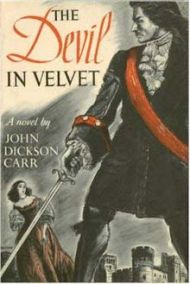 In fact, the plot as a whole is something of a mess. Every time Carr tries to turn it into something resembling a mystery, or to steer the intrigue around Old Nick and his machinations, the background of history seems to resist and simply override him…which is oddly fitting given Lucifer’s assertion that history cannot be changed, and would qualify as a sort of meta-consideration were it not abundantly clear that Carr simply wants to write about the time of Charles II and wishes everyone would stop harping on about his detective novel prowess. This is the deeply personal acoustic album that all hard rock frontmen wish they could record, and you need to know that going in or you’re in for a disappointment.
 Not all of it works, though. As with …Newgate, we have a hero who must choose between two perfect women, and here Carr sticks his elbow in to stir a plot that is not for stirring. There’s a revelation in this branch of events that should change everything, but it really just happens, throws in yet another aspect out of nowhere, and then really pretty much sits there until the end of the book requires some sort of action. Indeed, the two women here provide as much distraction from the plot for the reader as they do for Fenton — he spends most of his time often literally chasing after one or the other (including a kinky masked sex maze interlude…yeah, no, you didn’t misread that) and then when they’re done with the chasing they tend to retire to bed for a lie down. I mean, I assume they’re having a lie down. What else could they be doing?

That’s a pretty fair and balanced review. It was obviously a book Carr really really wanted to write and he obviously enjoyed doing so. I found it to be quite enjoyable. That might be because it was one of the first Carr novels I read so I had no idea what to expect.
LikeLiked by 1 person
Yes, I’d agree that if you’re going to get the most out of this then you need to approach it in one of two ways: 1) have no particular expectation of Carr, or 2) be fully aware that this is not your typical Carr by any measure. I’m hoping to inform 2) enough so that people who might otherwise pick this up and be disappointed will in fact just relax into it and see hoe great it is 🙂
LikeLike
FIRE, BURN is the one that I always liked the most. I remember liking this quite a lot when I first read this, but … that was in about 1984! (Probably before you were born JJ, right?) So I have a sneaking suspicion that you are probably very right about this – entertaining, but flawed. I suppose that, at the time, it seemed like such a major departure (though clearly indicated in previous work) that he may have been a bit tentative about it all? Either way, my review of HAG’S NOOK goes live on the 30th as part of the celebrations mate.
LikeLiked by 1 person
I can definitely see here how his uncertainty over how to deal with Lucifer informed the decision about the explanation of Fire, Burn!’s time-swap, as I said, and I think this is probably what he wanted The Bride of Newgate to be but felt he couldn’t just jump straight in so had to soften people up first. F,B is the one that juggles the elements of all three most succesfully, I’d say, but taken as a trilogy they offer a wonderful insight to an author’s process, intent, and choices. Hmmm, maybe there’s a post in that at some point…
And I was very much alive in 1984, Sergio, but certainly not of an age to be reading any Carr (or anything else, come to that…). Looking forward to your Hag’s Nook post, thanks for getting involved!
LikeLiked by 1 person
It seems like this particular title has garnered many positive reviews, so it’s refreshing to read a less-than-glowing take. 😛 Incidentally, I’ve just finished ‘Hag’s Nook’, which features, in quite pleasing doses, some of the tricks and traits that come to characterise the later, stronger works.
I’m keen to see what you make of Lorac – to date I’ve only read ‘Murder by Matchlight’, which had a better investigative narrative than a resolution to the crime.
LikeLike
P.S. In response to your post on Puzzle Doctor’s blog review of ‘Hag’s Nook’, I think I can see why it might be regarded as an impossible crime – in the same way why ‘Red Widow Murders’ or even ‘Constant Suicides’ might be classified as one. But it’s definitely clearer in ‘Red Widow’ than in ‘Hag’s Nook’…
LikeLike
I would agree that HAG’S NOOK shouldn’t really be considered an impossible crime – it’s a bit like DEATH ON THE NILE, say – only ‘impossible’ because it turns out that a solid alibi was in fact breakable … I think an ‘impossible’ crime should also appear to be thus from the get go … not that I want to sound too rigid about this 🙂
LikeLiked by 1 person
I’m glad someone else will be reviewing ‘Hag’s Nook’ as it would be interesting to read an alternative perspective. 🙂
I wasn’t really thinking about the alibi, insofar as to bill it as an impossible crime on these grounds would be to do so retrospectively. And the novel certainly does not set itself up in an inverted/ let’s-deconstruct-the-alibi fashion.(Which is also one reason why I struggle when one of Ayatsuji Yukito’s novels is described as an impossible crime in terms of identifying the culprit.)
I was thinking more along the lines of the mythical/ supernatural implications that surround the set-up/ scene-of-crime. And right up to the examination of the scene-of-crime, ‘Hag’s Nook’ appears to set itself up to be like ‘Constant Suicides’ and ‘Red Widow Murders’ – with only one set of door keys given to the victim, as well as the main entry point being subject to surveillance.
But since the door in Hag’s Nook was not locked, and witnesses were too busy chasing down the corpse to testify that nobody emerged out of the room – I agree that ‘Hag’s Nook’ shouldn’t be viewed as an impossible crime. But up till then the vibe given would have been fairly close to the ‘impossible supernatural agent’ of ‘Constant Suicides’ and ‘Red Widow Murders’.
Ah, I shouldn’t allow myself to ramble on, and should save it all up for the review. 😛
LikeLike
The use of myth and rumour to inform the sense of dread around the crime scene in Hag’s Nook is indeed fabulous, and one of the strongest uses of it in Carr’s early career (he did the same thing with The Red Widow Murders, as you say and I discussed the other week). I’d never really thought about applying the same idea to Constant Suicides, but you make an excellent point — will be very interested in what else you draw out of Hag’s Nook for next week.
LikeLike
Coincidentally, I’m writing a review of Hag’s Nook at the moment – I hope I’m not perceived as stepping on toes. The more the merrier!
I have to admit though, this thread questioning the impossible nature of the crime caught me off guard. And yet, I think you guys are right – there is plenty of opportunity for a killer to have slipped out. I guess I just dotingly accepted the presence of an impossible crime given that I was reading a Carr novel! This is probably due to it being the first Carr book that I’ve read. Since then I’ve become fairly critical as to whether one of his stories includes an impossibility or not.
LikeLike
I see what you are saying and I agree – the supernatural element absolutely. The atmosphere is incredibly this in this one.
LikeLike
Yeah, where’s this “Hag’s Nook is an impossible crime” coming from all of a suden? Honestly, I turn my back for two hours…
LikeLiked by 1 person
😛 Well, I was doing some research on ‘Hag’s Nook’ and espied a comment you made on Puzzle Doctor’s blog post on ‘Hag’s Nook’… No more spoilers/ digressions!
LikeLiked by 1 person
I can remember as a young teenager reading 20 or 30 JDC novels and then coming to Bride of Newgate and thinking, “Wow, is there ANOTHER writer named John Dickson Carr?” I remember at this far remove being amused by the time-traveling protagonist’s invention of the toothbrush and regular bathing, although I may have mixed this up with another one of JDC’s historicals.
“Taken as a trilogy they offer a wonderful insight to an author’s process, intent, and choices. Hmmm, maybe there’s a post in that at some point…” Oh, I’d definitely like to read your thoughts on that.
LikeLiked by 1 person
Yeah, this is the one where he invents the toothbrush — another of the many wonderful touches it contains. And I know exactly what you mean about there being two John Dickson Carrs, it’s so very, very different even to ….Newgate and Fire, Burn.
Goddamn I’d love to sit down and pick his brains about this book…perhaps if I made a deal with the Devil…
LikeLike
This is one of the all too many Carrs I have left to read. I don’t choose a book, the book chooses me and this one and others keep rejecting me. Also, I’m quite wary of his historicals on the basis of my few dismal experiences with them. Your review confirms my suspicions about this book and I’ll know what to expect and not expect when/if I finally read it.
The historicals I think were a dead-end from the start; Carr may have found them a way to rejuvenate his work and find the joy of writing again – an escape from a hated present, too – but none of them is a match on his glorious work before and during the war. Just my opinion and not one shared by my fellow-compatriots as FIRE BURN won the French Grand Prix de Littérature Policière in 1968 (tied with THE DAUGHTER OF TIME, no less!)
LikeLike
I’be not read read enough of Carr’s historical mysteries to be able to comment, but seeing how quickly he improved his focus from …Newgate to ….Burn, I think it’s fair to say that they revived a flagging interest after 20-odd years of dreaming up plots. If you’re not a fan, imagine how bad the books could have been without even that to keep him engaged!
LikeLike
Ignoring the time travel and crime aspects of both The Devil in Velvet and Fire, Burn, how would you compare them in terms of historical story telling? Fire, Burn had a great sense of adventure and moved along well despite the lack of a real impossible crime. I gobbled up the historical aspect, and I’m sure that will apply for TDIV as well.
LikeLike
I’d say that the reason to read TDiV is the hstorical detail. Fire, Burn! does a wonderful job of taking that detail and turning it to the purposes of a plot with detection, bafflement, and a nice line in the fore-knowledge of its protagonist. …Velvet is even written in an era-appropriate way, and so concentrates far more fuly on the elements of history that Carr wants to communicate.
TDiV is also set about 150(?) years earlier than FB, so there’s even more of a disconnect to allow for and consequently even more detail in the text. So the earlier book is the one for pure historical story-telling, even if the later one arguably uses it to a better and more clearly-defined purpose.
LikeLiked by 1 person
I think your review really nails the weak points in a book that I’d call an enjoyable, fascinating failure. I read it only last month, but while a lot of the atmosphere Carr was great at creating has stayed with me, I can’t even recall how Fenton got out of his deal with the devil. I only remember it seeming very fudged, and rushed through, and there was no last minute turning of the tables, which like you I was expecting, and hoping, to see.
While I agree with you that the mystery aspect of the novel was a bit of a mess, I was a bit more forgiving as the revelation at the end genuinely surprised me, Saying that, Carr surprises me 99% of the time, so I don’t wonder he could do it again, even in one of his weaker efforts.
In terms of his historical novels, I prefer Captain Cut-throat to this one, and to Fire, Burn- though Captain Cut-throat is a bit of a mess too- a spy/love story/murder mystery/thriller, which doesn’t really gel, but is great fun. Not having a time-travel element in Captain Cut-throat to further confuse genres helps raise the book above the other two, for me.
If I can go off topic for a second- I just finished Magpie Murders. Wonderful. The GA pastiche was excellent, and satisfying- the framing story slightly less so, though the thing I liked most was the complex character of the mystery writer Alan Conway- and the various asides on detective fiction. I loved the last few pages, and the various clever puzzles woven into the book. It put me in mind a bit of Nabokov’s ‘Pale Fire’? Do you think that is something you would consider reviewing? It’s a mystery novel unlike any other- in the form of a 999 line poem, commentary and index. (It’s rarely classed as a mystery, but I always think of it as being one- there are various secrets and twists that unfold throughout the text, and a violent death).
LikeLiked by 1 person
PS I do realise that Pale Fire might be too much of a stretch, review wise, as it has no impossible crime- and was published in 1962. But you stretched your policy to include ‘Magpie Murders’ so I thought it was worth a go!
😃
LikeLike
You remember correctly — the ending extrication from the deal is fudged; it’s pretty much “Oh, he forgot about you and now you have this body permanently — now let’s go to France and have lots of sex!”. I’m going to work through his historicals (those that I have) chronologically now, since I can see them almost as a separate career. Captain Cut-Throat is one of them, so I look forward to disucssing them when I reach it.
Glad you enjoyed MM, it’s a lot of fun — like Noah said in his post yesterday, there are contemporary authors who are capable of doing the GA thing well, and it’s great to see Horowitz turn his twisty mind upon it with such strong results. I do not know Pale Fire, but it sounds interesting (a biit Greene Murder Case-ish, eh?) — shall do some research and sees what I makes of it, many thanks!
LikeLike
Pingback: Hag’s Nook – The Green Capsule
Pingback: #169: The Tuesday Night Bloggers – Man and Superman: Refining the Protagonist in John Dickson Carr’s Historical Mysteries | The Invisible Event
Pingback: #171: JDC OOP – WTF? | The Invisible Event
Pingback: The Witch of the Low Tide – The Green Capsule
Pingback: “The Devil in Velvet” by John Dickson Carr – Tangled Yarns