- Comment
-
Subscribe
Subscribed
Have a WordPress.com account? Log in now.
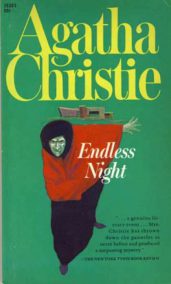
 But here, with Endless Night, we have a wholesale celebration of Youth, of twenty-two year-old Michael Rogers and his sudden, all-consuming romance with twenty year-old Fenella ‘Ellie’ Guteman. “If this is a love story — and it is,” Rogers insists early in his narrative, “why not begin with when I first saw Ellie standing in the dark fir trees of Gipsy’s Acre.” And, indeed, Gipsy’s Acre becomes the focus of the entire undertaking: the wild fancy of youth desiring, then achieving what it desires, and then living with what it has achieved. “When youth begins to pass, fun isn’t fun any longer,” Rogers tells us, and so the two of them get caught up in the fun of making a life together in the face of adversity, and the sheer joy of being young and free of restrictions sings through everything they achieve together.
 It is also this middle section that gives us much of the adversity I mentioned above, and it is the provenance of most of that adversity that again supports this as a young person’s book: old gypsies, old lawyers, old and possibly untrustworthy businessmen, old and grasping nearly-relations…everyone over a certain age (Ellie’s stepmother is forty, and is well beyond this boundary) is against them. Even the elderly characters not involved directly in the plot have a part to play in their negativity: witness the couple Michael drives to Hamburg early on, only to become sick of them and ditch the job, only find his way back to Gipsy’s Acre and meet Ellie… without a shadow of a doubt, the older generations herein are being viewed with the same hesitation that has been poured onto the younger generation in the books leading up to this.
 But consider that ending if you know it, and you’ll know that Agatha Christie is, in many ways, the only author who could get away with it: for anyone else, it isn’t really an option. And in this regard it makes the entire novel about youth as it’s a celebration of — and a wink towards, if you will — Christie’s own youth, those happier, younger days when she was free to get away with what she liked without all the attention upon her…not (ahem) unlike Ellie here. Now Ellie is far less and author-insert character than Aunt Jane at this stage, and I’ll stop short of my always-questionable meta-analysis of the events herein as a comment on Christie’s own feelings about this stage of her career (it’s not something I fully believe in this time, anyway…), but it’s wonderful to see the old girl enjoying herself one last time.

I like this one a lot and with its roots in an early Marple short story it feels like a fascinating late flourishing with an eye on both last and present
LikeLiked by 1 person
Totally agree. There’s a big wink there at the end, no doubt, and it’s a fascinating combination of both sides of her writing — it could almost be a Mary Westmacott book but for the crime and then the obvious need for a solution to that crime.
LikeLiked by 1 person
Glad you liked this one, though unlike you I was fooled – you’ll know what I mean. Think you’re right in that this book feel like it is from an earlier writing period in some ways. Not having one of her serial sleuths in the book probably helped to make this so, as I’m not sure whether it would have been as good if they were in. Definitely wouldn’t have worked with Poirot in it.
LikeLike
Yeah, she appears to have learned the lesson of The Hollow with this one…!
LikeLike
This is actually based on an earlier Miss Marple short story published far back in 1941.
LikeLike
Thanks for your review, and your comment about the slow-moving, even deliberate, middle section resonated with my reading experience. For some reason the ending didn’t catch me by surprise… I can’t quite remember why, but I think ever since I read something else I’ve been on a lookout! I still think it’s a good novel, even if not one of Christie’s strongest. 🙂
LikeLiked by 1 person
I like “The Case of the Caretaker” more. This feels stretched out for a novel, and your comments on the middle section justify that feeling for me. Although it’s odd: the TV version installs Miss Marple into the mix, having her befriend Michael and helping him sort out the terrible events happening around him. Her presence is intrusive, and the film is unwatchable. The Hayley Mills movie is just odd, with the worst Bernard Herrman score I’ve ever heard.
What really stands out for me is the complete change in tone for a Christie novel. There is always a certain emotional remove in her standard mysteries so that she can present her characters as pleasant, interesting and/or eccentric people without giving away that one of these sets of qualities masks a murderer. If you think about it, (SPOILERS OF A SORT) the solution to this book bears striking similarities to those of A Caribbean Mystery, Evil Under the Sun, Death on the Nile, even stretching as far back as Styles. But this book feels like no other because Christie is more interested here in the emotional and psychological shenanigans going on. I can understand why you would thus equate it with a Mary Westmacott novel.
I think the whole thing is supposed to be haunting and dreamlike (“In the end is my beginning”); unfortunately, I just find it dreary and, worse, sometimes dull. It’s interesting that in most Christies you have an odious victim surrounded by people who wished him or her dead. Here, the only character I found likable was the victim. Still, I applaud Christie being experimental here. If you truly haven’t read past this one, you have some rough going ahead, although the path isn’t entirely barren and you do get those two little jewels of Curtain and Sleeping Murder as a prize at the end.
LikeLike
The ‘drawn out middle section’ brought Five Little Pigs to mind, though thankfully without the agonisingly needless repetition of every single piece of evidence from the first part that renders that book so hideous for me. Here it just felt rather more like verisimilitude….she wanted you to by into this young couple being happy and in love, with the occasional threat hanging around them nebulously and occasionally made real. That sense of youth and the establishment of Michael and Ellie as a couple in it together is obviously very key to the workings of this, and here she’s very much playing that up in the second part.
I did really appreciate the experimental element of it – it’s not “who was where exactly when and what this means” once you get to the solution, it’s much more “Aaah, well, this is waht was going on nad how these things happened” — she’s much more relaxed about it, deliberately constructing something looser and so something that feels more real (to me, at least). Possibly it gets a little bogged down in this at times, but you can’t fault her for trying.
And even if it is hard going ahead, I’ve got Ellery Queen to get me through, right? And I found some Carrs I hadn’t read today, and I’ve got plenty still to get through on my TBR. I guess I’m saying that there’s plenty of support available, which seems fair given how many duff books I’ve read in the past and then gone “Geez, I really need to read something spry and entertaining after that….” and reached for the next Christie… 🙂
LikeLiked by 1 person
Ah, if only I could find some Christie’s I hadn’t read! Which Carr’s haven’t you read?
LikeLike
By my reckoning I’ve read about half of Carr. I was keeping a check on it, but lost interest a couple of years ago when I couldn’t find much by him, so now I don’t know exactly where I am. At a guess, I’d say….42 books. That feels about right. Should probably sit down and work it out for certain at some point, though.
LikeLike
And, hey, there’s always the Sophie Hannah Poirot books if you want more ‘Christie’, right 😉
LikeLiked by 1 person
As The Puzzle Doctor said about Batman Vs. Superman, better to sandpaper your eyeballs.
LikeLike
Like Brad, I like the original short story better. The trouble with this book for me is that I can’t engage with any of the characters – I find them all unlikeable in different ways. Ellie is a poor little rich girl and (SPOILER) Michael never gets beyond being a young man on the make. I guessed the ending before I reached it – no kudos to me; I’d already read the earlier short story.
I think it was Mike Grost who said that his favourite dream is being in a library and finding some Christies that he has not yet read. Mine too; and no, Sophie Hannah’s attempts do not cut it for me. I think the trick is not to try to write like Christie, but rather, to be as good as Christie was at her best. And IMHO, no-one has achieved that yet, although others will probably disagree. It’s perfectly OK to take classic characters in new directions – there’s a wealth of new Sherlock Holmes stories out there which do exactly that – but the storytelling voice should be the author’s own, not an attempt to write like somebody else.
LikeLiked by 1 person
Ha, don’t worry, I was joking about the Sophie Hannah books — nothing could induce me to pick them up, either. I totally get that some people will be very excited about them, but I do not count myself amog these people and am happy to leave them to their lives.
LikeLiked by 2 people
I, however, will take a bullet, read it and review it with malice dripping from my (virtual) pen!
LikeLike
Seems a shame to waste your time, effort, and money…spend it on something you’re likely to enjoy, why not? Buying it just escalates the problem…
LikeLiked by 1 person
Good point! Maybe I’ll just check it out of the library.
LikeLike
Could you go to the acro blog site and add this for me please? I am travelling and can’t do it from my iPad. Thanks.
LikeLike
I meant acrc site
LikeLike
Gladly, thanks for reminding me!
LikeLike
Pingback: #335: Stand Not Upon the Order of Your Going – Do You Get the Most Out of an Author by Reading Them Chronologically? | The Invisible Event