- Comment
-
Subscribe
Subscribed
Already have a WordPress.com account? Log in now.
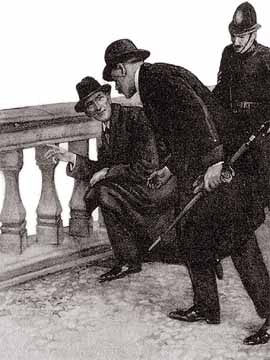
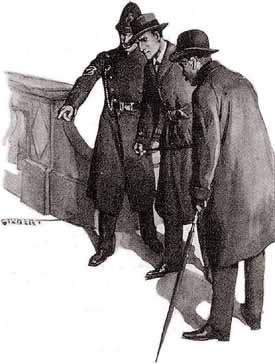 ‘The Problem of Thor Bridge’ gives us the classic impossible crime setup of a body that has been shot in the head but without any sign of a weapon to hand…and then manages to appear not at all impossible by finding the murder weapon hidden in the most likely suspect’s room, also throwing in a note from the suspected murderer arranging to meet the victim at the place of their demise and at around the time they are suspected of being having died. True, there are no footprints anywhere near the body, but – before you get too excited – “The ground was iron-hard, sir. There were no traces at all.” Oh, so that takes care of that, then.
 A few interesting points that I can discuss do occur, though, the first of which being the fact that no-one appears to have heard the murderous gunshot, though Conan Doyle doesn’t appear to bothered about that (don’t worry, it’s not a repeat of ‘The Adventure of the Empty House’). The second is the mention of the “travel-worn and battered tin dispatch box…crammed with papers, nearly all of which are records of cases the illustrate the curious problems that Mr. Sherlock Holmes had at times to examine.” Not only is this a dangling carrot now that Conan Doyle definitely has the end of his great detective in sight, but following hard upon this revelation is a mention of the case “of Mr. James Phillimore, who, stepping back into his own house to get his umbrella, was never more seen in this world.” – notable here for being an impossible disappearance tale written up as the marvellous story ‘The Adventure of the Highgate Miracle’ by John Dickson Carr
  The Invisible Event
Thanks for your kind mention.
LikeLike
I like “The Problem of Thor Bridge,” but hate the type of solution it popularized, because it ruined many interesting and promising (impossible) detective stories by modeling the plot around such a solution – which are rarely satisfying.
Interestingly, Melville Davisson Post published a locked room story in the same as year “Thor Bridge” and the explanations practically identical. But Post went all the way with the impossible-aspect offered by the situation. On the other hand, C.P. Snow used this explanation as a satisfying false solution a decade later in Death Under Sail.
I’m not sure which real-life case was referred to in that article, but I detailed such a real-life locked room case from the 1830s in a post on my blog, which was solved by a policeman interpreting a type of clue you’re only suppose to encounter in fiction. It seems to have been the origin for this gambit: in both real-life and crime-fiction.
LikeLiked by 1 person
It weasn’t that example, no, it was one that was exactly Thor Bridge – on a bridge and everything – just without Holmes (the exact same clue that gave away the workings and everything). Thanks for the link, too, I’d forgotten how good Captain Disillusion is!
LikeLike
The Puzzle Doctor once expressed his annoyance that a particular novel by Ellery Queen is often referred as a locked room mystery, whereas it is locked room/impossible crime for only one person and thus this is a spoiler.
SPOILER ALERT
Similarly the story of Thor Bridge is an impossible crime for only one person and that person turns out to be the killer !
LikeLike
Pingback: Review: The Problem of Thor Bridge by Arthur Conan Doyle | A Crime is Afoot
Pingback: ‘Crack out the railway timetables’: #1922book results | Past Offences Classic Crime Fiction