Rue Morgue Press


#193: Sailor, Take Warning! (1944) by Kelley Roos
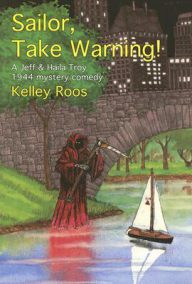 Sometimes you just have to bite a bullet: following the exceptionally sad loss of the Rue Morgue Press, this is the final Jeff and Haila Troy novel currently available, but, well, let’s enjoy it, eh? Audrey and William Roos did such a great job with so many aspects of the writing in these first four books — the dialogue is genuinely funny, the plots mostly move at a great pace, the mysteries are intriguing, and third book The Frightened Stiff is a genuine genre classic for all time — that we shouldn’t get too weighed down with lamenting their unavailability. Common sense will prevail, they’re too good to let go out of print for any length of time, and this won’t be the last we see of the Troys. Right?
Continue reading
#181: The Tuesday Night Bloggers – Strangers in Strange Lands: When East Comes West…
Alongside classic detective fiction and locked room/impossible crime mysteries of every date, stripe, and hue, I read a moderate amount of both classic and modern SF. And as much as I rejoice in the closedness of the ‘rules’ of detective fiction, I take equal delight in the free-form craziness that can open up in front of you in excellent SF.
Continue reading
#133: Everything is Rather Frightening in The Black Rustle (1943) by Constance and Gwenyth Little
Over at the excellent and superbly-titled Exploring the History of Women in Mystery blog, wrangler “Unpredictable Notes” recently put up this brief summary of the EIRF school as outlined in Jacques Barzun and Wendell Hertig Taylor’s A Catalogue of Crime (1971). EIRF is a step on from HIBK (Had I But Known) and stands for Everything is Rather Frightening:
In fact, since the modern psychological novel has devoted itself to exploring the abnormal and oddly alarming, no great originality was needed to raise the emotional pitch of the murder another notch and made HIBK into EIRF – Everything is Rather Frightening.
This is a new one on me but, by the same serendipity that seems to manifest itself throughout my blogging, I was reading The Black Rustle — one of the middle period novels from the Little sisters — when I encountered this lexicon, and it struck me how perfectly all the Littles’ books fall into this categorisation.
Continue reading
#115: “You can’t change a person’s nature, especially at the end of a long life” – Perceptions of the elderly in Death at Crane’s Court (1953) by Eilís Dillon
Old age, and the perceptions thereof, is endlessly fascinating to me. I don’t really know why and have no intention of going on the importance of recognising the experience of the individual rather than lumping an entire socio-economic group together — that’s how wars get started, after all — or maundering on about mortality. Instead, following on from Agatha Christie’s reflections in the unexpectedly-enjoyable A Caribbean Mystery, I wanted to use Eilís Dillon’s debut novel, Death at Crane’s Court, as a counter-point because it takes an alternative view that makes the comparison worthwhile. Hopefully.
Continue reading
#97: If the Shroud Fits (1941) by Kelley Roos
 There are times when it’s possible to pinpoint the exact moment when a novel doesn’t fulfil its promise, and given the intricacy of many novels of detection these can sometimes be very keenly felt. Perhaps the detective is an absolute duffer (an accusation frequently levelled at Freeman Wills Croft’s Inspector French), or the guilty party comes disappointingly out of nowhere (as in John Dickson Carr’s The Blind Barber), or perhaps the solution offered up to a brilliant problem is a shade on the simplistic side (the disappearance from the locked bathroom in John Sladek’s otherwise-superb Black Aura springs to mind). For this second novel by husband and wife team Kelley Roos, I’d say the main problem is in the selection of the victim: the setup is excellent, the characters are a delight, and come the murder…the most obvious victim is selected and the book never quite recovers.
Continue reading
#86: Where has all the classic detective fiction gone…?
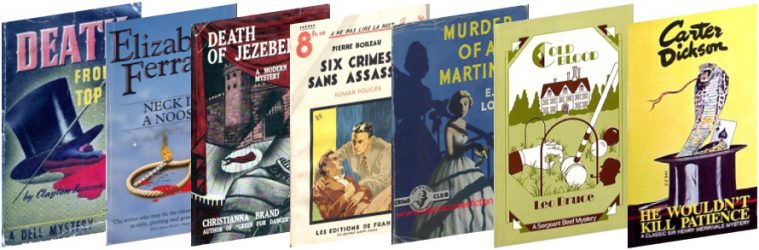
If you’re anything like me, well, firstly my condolences, but also you have a list of books not printed any time in the last few decades that you spend hours scouring secondhand bookshops, book fairs, online auction sites, and other people’s houses in the hope of finding. A lot of them – in my case, say, The Stingaree Murders by W. Shepard Pleasants – are rather obscure and so their lack of availability is understandable, but in other cases it just seems…baffling.
Continue reading
#80: Murder on Wheels (1932) by Stuart Palmer
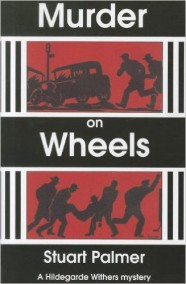 A little charm goes a long way – ask any bank teller or helpline operative, or indeed any fan of Golden Age crime fiction. Because, while a lot of absolutely wonderful books came out of this genre at that time, the fact is that a lot of what was published then and is popular now adhered to a particular school of writing and runs on very familiar rails. But the key thing is that so much of it is charming without having to innovate, and once you jettison any notions about every single book from the Golden Age being a complete game-changer you find a lot of joy there. Which astonishingly back-handed praise brings us to my first (but the chronological second) Hildegard Withers mystery by Stuart Palmer, possibly the first book I’ve really enjoyed for a long time in 2016 even though it does very little new or surprising.
A car crashes on a busy New York street, but the driver is not in evidence by the time the nearest policeman reaches it. Far from having fled the scene, a witness tells him, the driver actually jumped from his car long before the crash. And sure enough, a body is found back in the direction of the car’s origin…though with a noose around its neck and clearly dead from hanging. This setup, I have to say, is very arresting, but also probably the last point that the book displays any genuine originality. The dead man is part of a wealthy family, there’s a fiancée and a cousin and an elderly matriarch, and yes you pretty much know what you’re gonna get.
Continue reading
#65: On the Loss of the Rue Morgue Press – an open love letter
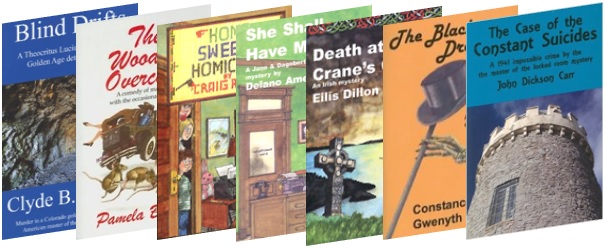
A little while ago, via TomCat over at Beneath the Stains of Time, I learned to my immense sadness that the Rue Morgue Press has officially shut down and will no longer be publishing books. If you don’t know RMP, then you’ve been missing out: set up by Tom and Enid Schantz, they have kept in print the kinds of classic detective novels that give the Golden Age such a deserved reputation while big-hitters like Agatha Christie and Dorothy L. Sayers hog all the limelight. The cessation of their endeavours is a tremendous loss, and what follows is an attempt to explain what they’ve meant to me as a reader for several years now.
 So, from one Australian author last week – the entertainingly bonkers world of Max Afford’s Owl of Darkness – to two this week – the entertainingly bonkers world of the Little Sisters. This is my first foray into the
  The Invisible Event