Pastiche
 “The impulse for this novel,” says Adam Roberts “was a desire to collide together some of the conventions of ‘Golden Age’ science fiction and ‘Golden Age’ detective fiction, with the emphasis more on the latter than the former.” Well, count me in! Sure, the authors he then cites (Margery Allingham, Ngaio Marsh, Dorothy L. Sayers, Michael Innes) don’t all fill me with delight, but this is a collision of my two favourite genres plus impossible crimes — how could I pass it up?! And it would have passed me by entirely had not blog-commenter ravenking81 brought it to my attention, so my most genuine thanks for that; at its best it’s a fascinatingly successful attempt at merging the two genres in a way that recalls both Isaac Asimov and John Dickson Carr, who, y’know, are the two finest authors to have worked in their respective genres. So that’s a good thing. By definition, however, it is not always at its best.
 #90: The Tuesday Night Bloggers – Running Around with the Circus in Leo Bruce’s Case with Four Clowns (1939)

For my final post in this month’s Tuesday Night Bloggers focus on travel in Golden Age crime novels, I thought I’d deviate from the implicit notion of holiday in travel and instead look at itinerancy as explored in Leo Bruce’s fourth Sergeant Beef novel, Case with Four Clowns. Last week I wrote about how John Dickson Carr made the aspect of travelling central to the mystery he created with ‘Cabin B-13’, and arguably Bruce does a similar thing here, albeit coming from a slightly different perspective and playing up to the travel aspect in a slightly more subtle way.
#84: The Tuesday Night Bloggers – The Sherlockian Impossibilities of John Dickson Carr – II: ‘The Adventure of the Sealed Room’ (1953)
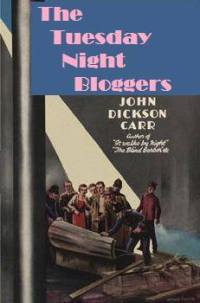
I’m guilty of sedition here: this isn’t technically part of the Tuesday Night Bloggers – they’re looking at travel in classic crime this month – but rather my own delayed TNB post on John Dickson Carr from March before I was sidelined. But, y’know how it is, it’s the second one looking at Carr’s Sherlock Holmes stories and so I feel I should probably post it on a Tuesday if only for internal consistency…my apologies for any confusion (though I suppose I cam writing about a Carr trip…). Just look upon this as my Never Say Never Again.
I talked about the origin of these stories in my first post on this topic, so let’s get straight on with it: this story is built on the reference to a case “of Colonel Warburton’s madness” made at the start of ‘The Engineer’s Thumb’ and so it’s appropriate that it begins in much the same way: someone in distress seeks out Watson (then for his doctoring, now seemingly because he knows Holmes) and is thus ushered into the Great Presence. It’s here that the story plays its most interesting card, as Holmes is rather short with the unfortunate Cora Murray who has just had a Colonel Warburton seemingly shoot himself and his wife while locked together in his study in the house where they all reside:
Continue reading