Pastiche
#161: Hawk & Fisher (1990) by Simon R. Green
 As a parody of the detective novel, the maverick cop genre, and the low Fantasy genre, Simon R. Green’s Hawk & Fisher takes quite some beating — it is an honestly hilarious take on the tropes of three. I don’t think I’ve laughed so much since reading…well, possibly anything; almost every page contains some wonderful joke or savage undercutting of the false sincerity of the situations encountered, not unlike William Goldman’s timeless The Princess Bride. For instance, Hawk is supposedly an expert in hand-to-hand combat with an axe, but he has only one functioning eye and therefore must lack any depth perception; it’s an absolutely genius piece of subversion, and such examples are rife. The only problem is that I have a sneaking suspicion — only a sneaking one, mind — that this book is in fact supposed to be taken seriously. Very Seriously Indeed.
Continue reading
#121: On the Many Wonderful Faces of Dr. John H. Watson, MD – Part 2 of 2

So, as established yesterday, there’s much more scope in Watson than there is in Holmes. The obvious question then becomes: So what do you do with this?
Take the simple cosmetic changes out of the equation — the casting of Lucy Liu as Dr. Joan Watson in the US series Elementary, for instance, easily one of the least disruptive changes it’s possible to get away with — and what you’re left with is the fact that Watson, being our entry into the Holmesiverse, is allowed to do anything that reflects the experience and perspective of the reader. As discussed yesterday, there are aspects of the character, the constants I referred to, that don’t become him — making him the proprietor of a burgeoning dog-walking business, or a respected scholar of nineteenth century Gothic poetry, or giving him a form of OCD which means he must always cross his legs in the opposite manner to Holmes unless it’s a Tuesday in which case…, etc — but let’s put this aside as given and look at the way certain authors have expanded on Watson without desecrating him beyond all recognition.
Continue reading
#120: On the Many Wonderful Faces of Dr. John H. Watson, MD – Part 1 of 2
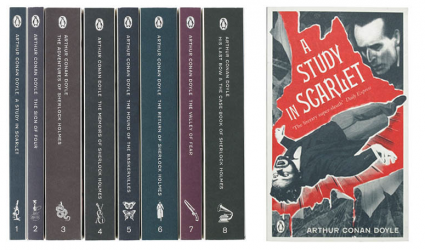 Lately I’ve read an unusually high concentration of Holmes pastiches — Caleb Carr’s The Italian Secretary (not good), Stephen King’s ‘A Doctor’s Case’ (not terrible), Colin Dexter’s ‘A Case of Mis-Identity’ (extremely good), Michael Kurland’s The Infernal Device (loadsa fun), Steve Hockensmith’s Holmes on the Range (fabulous) and a superb piece of unpublished fan fiction sent to me via email — and it’s made me realise that while Watson, and specifically the Watsonian voice, is vital in undertaking Holmes, no-one can quite agree what Watson is, how he should be written, and this makes him far and away the more interesting of the two men when it comes to analysis.
Continue reading
#118: Jack Glass (2012) by Adam Roberts
 “The impulse for this novel,” says Adam Roberts “was a desire to collide together some of the conventions of ‘Golden Age’ science fiction and ‘Golden Age’ detective fiction, with the emphasis more on the latter than the former.” Well, count me in! Sure, the authors he then cites (Margery Allingham, Ngaio Marsh, Dorothy L. Sayers, Michael Innes) don’t all fill me with delight, but this is a collision of my two favourite genres plus impossible crimes — how could I pass it up?! And it would have passed me by entirely had not blog-commenter ravenking81 brought it to my attention, so my most genuine thanks for that; at its best it’s a fascinatingly successful attempt at merging the two genres in a way that recalls both Isaac Asimov and John Dickson Carr, who, y’know, are the two finest authors to have worked in their respective genres. So that’s a good thing. By definition, however, it is not always at its best. Continue reading
#90: The Tuesday Night Bloggers – Running Around with the Circus in Leo Bruce’s Case with Four Clowns (1939)

For my final post in this month’s Tuesday Night Bloggers focus on travel in Golden Age crime novels, I thought I’d deviate from the implicit notion of holiday in travel and instead look at itinerancy as explored in Leo Bruce’s fourth Sergeant Beef novel, Case with Four Clowns. Last week I wrote about how John Dickson Carr made the aspect of travelling central to the mystery he created with ‘Cabin B-13’, and arguably Bruce does a similar thing here, albeit coming from a slightly different perspective and playing up to the travel aspect in a slightly more subtle way.
#84: The Tuesday Night Bloggers – The Sherlockian Impossibilities of John Dickson Carr – II: ‘The Adventure of the Sealed Room’ (1953)
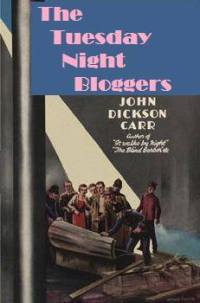
I’m guilty of sedition here: this isn’t technically part of the Tuesday Night Bloggers – they’re looking at travel in classic crime this month – but rather my own delayed TNB post on John Dickson Carr from March before I was sidelined. But, y’know how it is, it’s the second one looking at Carr’s Sherlock Holmes stories and so I feel I should probably post it on a Tuesday if only for internal consistency…my apologies for any confusion (though I suppose I cam writing about a Carr trip…). Just look upon this as my Never Say Never Again.
I talked about the origin of these stories in my first post on this topic, so let’s get straight on with it: this story is built on the reference to a case “of Colonel Warburton’s madness” made at the start of ‘The Engineer’s Thumb’ and so it’s appropriate that it begins in much the same way: someone in distress seeks out Watson (then for his doctoring, now seemingly because he knows Holmes) and is thus ushered into the Great Presence. It’s here that the story plays its most interesting card, as Holmes is rather short with the unfortunate Cora Murray who has just had a Colonel Warburton seemingly shoot himself and his wife while locked together in his study in the house where they all reside:
Continue reading

 The Invisible Event