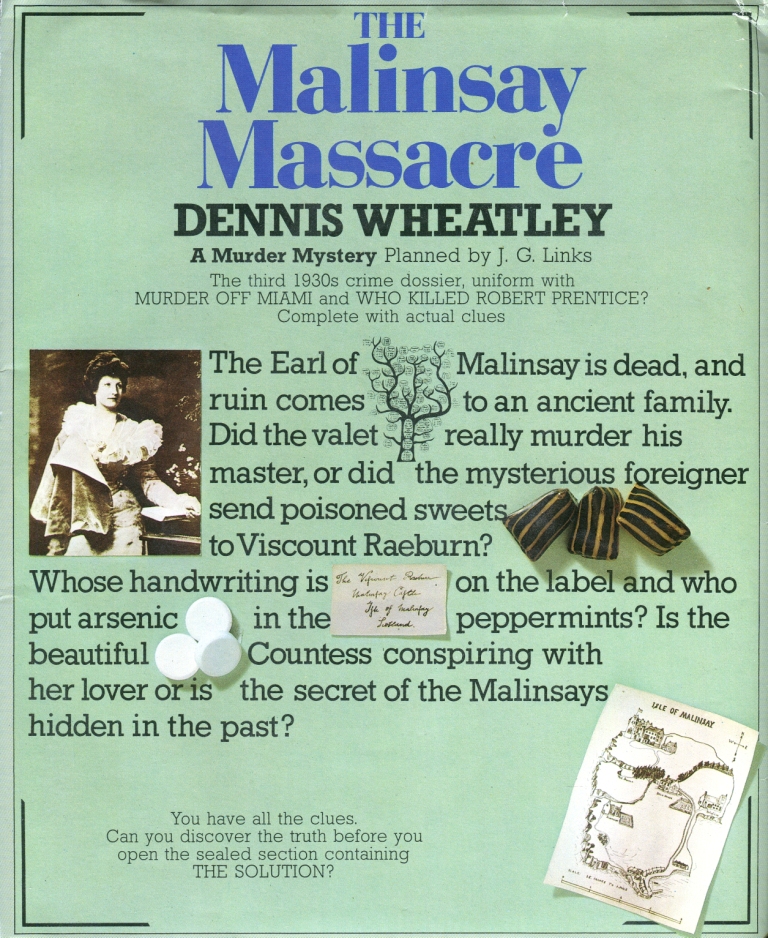
I may have called this week of The Malinsay Massacre (1938) “the investigation” but, in reality, I’m just working through the second half of the case in a manner uncannily reminiscent of how what like I did last week.
Continue readingOOP
#896: The Malinsay Massacre (1938) by Dennis Wheatley and J.G. Links: Week 2 – The Problem
So, how best to explore The Malinsay Massacre (1938) by Dennis Wheatley and J.G. Links?
Continue reading#895: “There are some jokes, young man, that are not permitted here.” – Speak of the Devil [rp] (1994) by John Dickson Carr [ed. Tony Medawar]
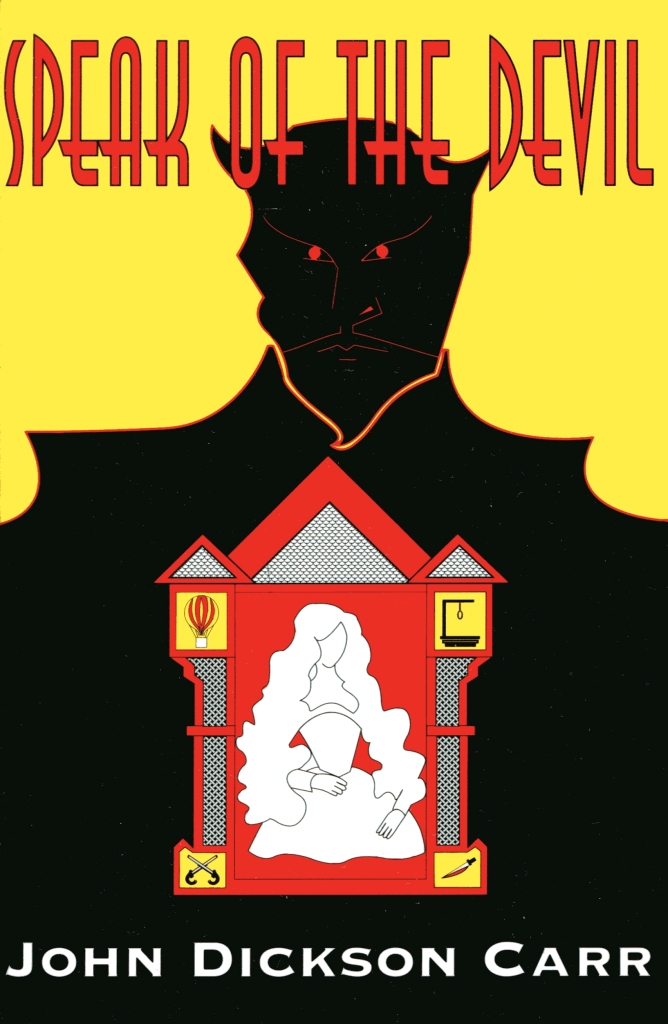
The recently-published The Island of Coffins (2020) brought several of John Dickson Carr’s previously-unavailable radio plays to public attainability, and gave many of us the chance to appreciate the Master in a slightly different milieu. Shortly after reading that wonderful volume, I was lucky enough to acquire Speak of the Devil (1994), the script for the eight-part radio serial Carr wrote for broadcast in 1941, and it is to that which we turn today.
Continue reading#893: The Malinsay Massacre (1938) by Dennis Wheatley and J.G. Links: Week 1 – The Dossier
Whether or not you agree with the concept of detective fiction being a game, there can be little doubt that much has been done to play up to the game-esque elements of murder mysteries for well-nigh the last century.
Continue reading#889: “He must just continue his patient investigations…” – The Death of Laurence Vining (1928) by Alan Thomas

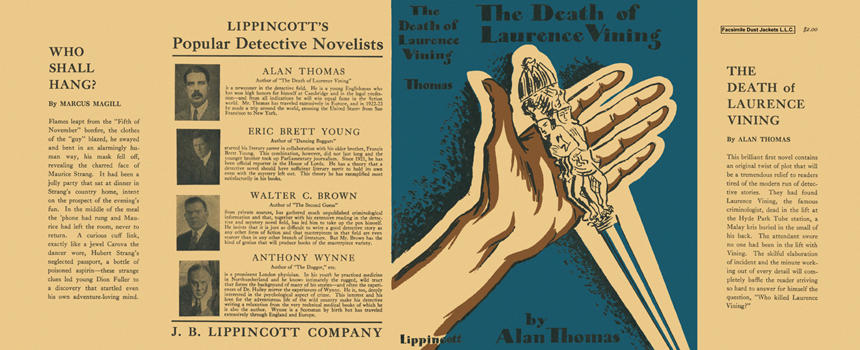
Among the books which have — through a combination of small print runs, lapsed rights, and enthusiasm among those who know the genre intimately — taken on an apocryphal aspect, The Death of Laurence Vining (1928) by Alan Thomas has been my white whale for quite some time. So when a fellow fan offered me a loan of their copy…well, c’mon.
Continue reading#888: A Graveyard to Let (1949) by Carter Dickson

![]()
![]()
![]()
![]()
![]()
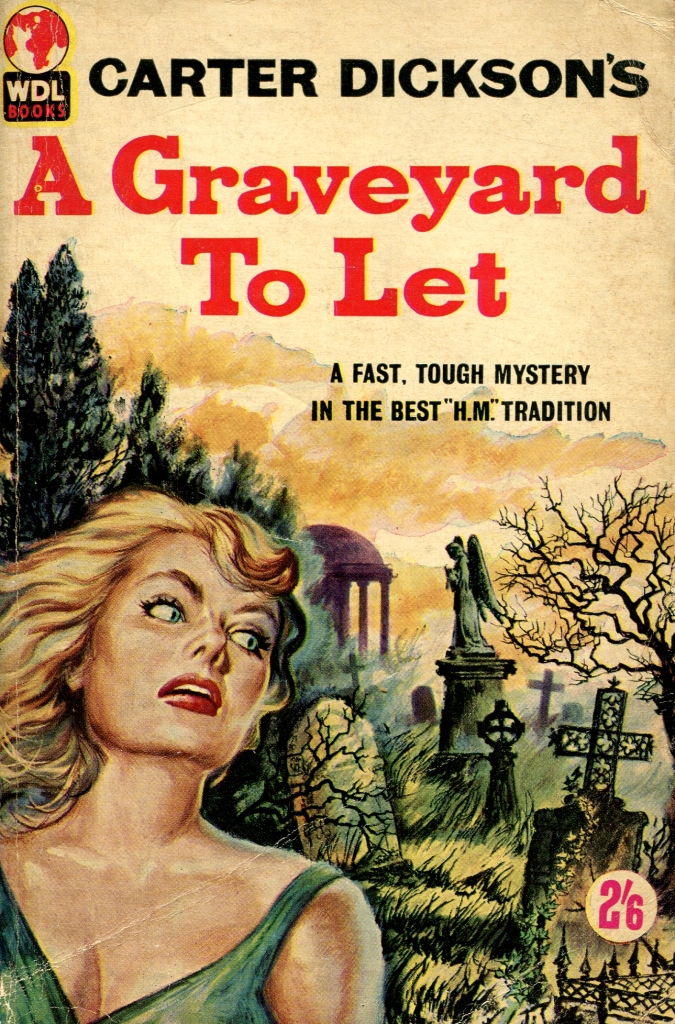
Sir Henry “H.M.” Merrivale, having travelled over to the United States aboard the Mauretania (I guess Maurevania was already taken) on his way to business in the nation’s capital, is summoned by telegram to the home of Frederick Manning. “WILL SHOW YOU MIRACLE AND CHALLENGE YOU TO EXPLAIN IT” runs that missive, a challenge H.M. cannot possibly pass up. And a miracle we get: Manning jumping, fully clothed, into his swimming pool and said clothes coming to the surface without his presence within them. So, howdunnit? And howlinkit to stories of financial skulduggery in Manning’s charitable foundation, plus rumours of his running around with a much younger woman — his first romantic attachment since his wife’s death 18 years earlier?
#879: The Corpse Steps Out (1940) by Craig Rice

![]()
![]()
![]()
![]()
![]()
One of the joys of this blog is sharing the excitement of discovery with people who understand. I like to think that I would have come to the work of Freeman Wills Crofts, R. Austin Freeman, Cornell Woolrich and others in due course, but having my exposure to and growing excitement for their fictional endeavours charted here among fellow fans makes it feel even more special. Add to that list Georgiana Ann Randolph Craig, whose work as Craig Rice I’m now three novels deep into and who is someone can confidently say I’m going to love even more in the years ahead. I mean that in all earnestness: Craig Rice and I are going to be friends for a long time.
#866: Little Fictions/The Cornerstones – The Amateur Cracksman, a.k.a. Raffles [ss] (1899) by E.W. Hornung
As discussed previously, Tuesdays in February will feature four collections of short stories on the Haycraft-Queen Cornerstones list, selected on account of my ever-growing interest in what the genre looked like before the advent of the Golden Age in (no arguments here…) 1920. Confusingly, my 1950 green Penguin paperback of gentleman thief Raffles stories by E.W. Hornung shown above contains 14 tales, only the first eight of which concern us today, comprising as they do the first collection to feature the character, The Amateur Cracksman (1899).
Continue reading#851: “But soon the rumours became darker…” – Mr. Diabolo (1960) by Anthony Lejeune
There are Advent calendars in the supermarkets, but I’m sticking to my guns and committing October to a study of the eldritch and shiversome in detective fiction. We have zombies stalking through, Tuesday was ghosts, Thursday was spiders, and today we’ll look at the legend of Mr. Diabolo.
Continue reading