#1243: The Judas Window, a.k.a. The Crossbow Murder (1938) by Carter Dickson

The Judas WIndow

star filledstar filledstar filledstar filledstar filled
One of many classic detection titles I read before I started this blog, The Judas Window (1938) is arguably among the most popular books John Dickson Carr ever wrote, under his nom de plume Carter Dickson or otherwise. The seventh book to feature his barrister-detective Sir Henry ‘H.M.’ Merrivale, and the only time H.M. enters the courtroom in all his cases, this was actually the first Merrivale book I read, way back when, and so a revisit seemed on the cards, especially with the British Library Crime Classics adding Dickson’s The Ten Teacups, a.k.a. The Peacock Feather Murders (1937) to their stable next month. Might this one follow suit? Lord knows it deserves to.

Continue reading

#1241: The Sunday Pigeon Murders (1942) by Craig Rice

Sunday Pigeon Miurders

star filledstar filledstarsstarsstars
Having published five books about lawyer John J. Malone and his friends Jake Justus and Helene Brand between 1938 and 1941, Craig Rice evidently felt the need for change. Consequently, only one of the four books she published in 1942 featured that triumvirate. I’ve been unable to track down Telefair, a.k.a. Yesterday’s Murder (1942) or The Man Who Slept All Day (1942) — the second published under the nom de plume Michael Venning — but I do have The Sunday Pigeon Murders (1942), the first of two novels Rice would complete about Robert Emmett ‘Bingo’ Riggs and Boniface ‘Handsome’ Kusak. And, as a fan of Rice’s writing, I can comfortably say that, well, I found this one a little flat.

Continue reading

#1230: Crows Can’t Count (1946) by A.A. Fair

Crows Can't Count

star filledstarsstarsstarsstars
How do you go about discussing a book you couldn’t even be bothered to finish? The tempting thing is not to review it at all, but I’m committed to certain undertakings on this blog — the complete works of Freeman Wills Crofts, the complete John Thorndyke stories of R. Austin Freeman, more Walter S. Masterman than most people will ever consume — and the full Cool & Lam by A.A. Fair, nom de plume of Erle Stanley Gardner, is one of them. So how to write about Crows Can’t Count (1946), the tenth published Cool & Lam novel, and the first time this normally lively and entertaining series has draaaaaaagged me into the doldrums of an almost spiritual level of indifference?

Continue reading

#1202: The Piccadilly Murder (1929) by Anthony Berkeley

Piccadilly Murder Penguin

star filledstar filledstar filledstar filledstars
As has recently been remarked elsewhere, the superb modern raft of Golden Age reprints has been very kind to Anthony Berkeley. The form’s arch Innovator-in-Chief has seen some excellent titles brought back to public availability — The Poisoned Chocolates Case (1929), Murder in the Basement (1932), Jumping Jenny (1933) — and one, in The Wintringham Mystery, a.k.a. Cicely Disappears (1927), rescued from the sort of obscurity that had reduced its existence almost to rumour. Still yet to see the light of day, however, is The Piccadilly Murder (1929), so a reread seemed due to see if it really was as good as I remember. And, yes, it very nearly is — except in one key regard, in which it’s even better.

Continue reading

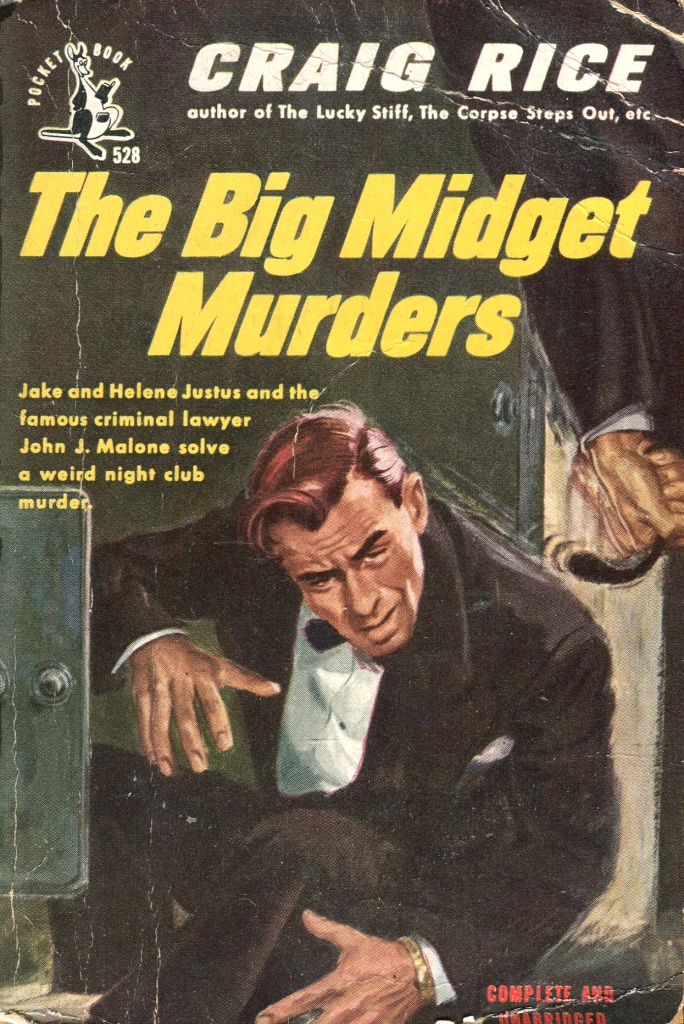
#1170: The Big Midget Murders (1942) by Craig Rice

Big Midget Murders

star filledstar filledstar filledstar filledstars
Though Jay Otto is “less than three feet high…his proportions were almost exactly the same as those of a full-sized man; his head was not too large for his body; his arms and legs were proportionately the right length”.  The man is also a gifted mime, proving quite the hit at the opening night of Jake Justus’s new nightclub, the Casino. Which means it’s a blow for Jay and Jake alike when this “big midget” is found hanged in the wardrobe in his dressing room from a rope made of eleven mismatched stockings. And it’s even more of a blow for Jake, his wife Helene, and their lawyer friend John J. Malone when Jay’s body vanishes after they hide it to protect the reputation of the night spot.

Continue reading

#1168: Patrick Butler for the Defence (1956) by John Dickson Carr

Patrick Butler for the Defence

star filledstar filledstar filledstarsstars
It is perhaps fitting — though, I assure you, completely accidental — that a locked room murder in a novel by John Dickson Carr, doyen of the apparently undoable nevertheless rationally explained, is the focus of the 500th post on this blog to be tagged “impossible crimes“.  Sure, upon realising this I could have chosen one of Carr’s acknowledged masterpieces to reread, but I enjoyed the divisive barrister Patrick Butler, K.C. at first encounter, and was intrigued to see how the character fared without the support of Carr’s frequent and best sleuth, Dr. Gideon Fell. And, having given up on the two Carr novels I tried to read prior to this, I’m pleased to report that I enjoyed a fair amount of what Carr did here.

Continue reading

#1165: Cats Prowl at Night (1943) by A.A. Fair

Cats Prowl at Night

star filledstar filledstar filledstar filledstars
Look, I can’t swear to it, but I have a suspicion that Cats Prowl at Night (1943), the eighth published book in Erle Stanley Gardner’s series featuring Bertha Cool and Donald Lam, written under this A.A. Fair nom de plume, just might be the first title of his I ever read. Reading it now, some 20 years later, it tickled enough memory buttons to be tauntingly familiar while also furiously out of reach, but the distinct aspect that separates this book from its brethren — namely the absence of pocket dynamo Donald Lam from its pages — feels familiar, if only because I get the sense I started these books with no sense of Lam as a character.

Continue reading

#1132: The Case of the Smoking Chimney (1943) by Erle Stanley Gardner

Case of the Smoking Chimney

star filledstar filledstar filledstarsstars
While you’ve hopefully been enjoying the regular reviews on The Invisible Event, I’ve been sweating bullets over the fact that I hit a seeming unpassable patch of reader’s block and haven’t read anything for nearly a month. Then Brad suggested that some Erle Stanley Gardner might help me out as it has done recently for him and, well, here we are. Mistakenly believing The Case of the Smoking Chimney (1943) to be the first of Gardner’s two novels featuring the disreputable Gramps Wiggins I picked it up and spent a very happy day in its pages, and while it reaffirmed much of what I like about Gardner’s writing the book also bears many of the man’s flaws.

Continue reading

#1124: Bats Fly at Dusk (1942) by A.A. Fair

Bats Fly at Dusk

star filledstar filledstar filledstar filledstars
With considerations of the era taking Donald Lam out of the Cool and Lam Detective Agency, Bertha Cool is left to fend for herself when a blind man wishes to hire her services in tracking down a young woman who, he claims, has disappeared. It’s an unusual jumping-off point in itself, but the real delight here is how intelligently Erle Stanley Gardner, writing under his A.A. Fair nom de plume, explores and explains the way the blind man is able to identify so many different people — and how intelligently he is able to come to conclusions about the woman whose wellbeing is his concern. And then others start to express an interest in the same woman; and then someone is murdered…

Continue reading

#1121: Follow As the Night, a.k.a. Your Loving Victim (1950) by Pat McGerr [a.p.a. by Patricia McGerr]

Follow as the Night

star filledstar filledstarsstarsstars
Having finally achieved all he has so long dreamed of, Larry Rock has just one lingering problem: one of the women from his chequered past must die in order to not stand in the way of his continued success. Realising that the balcony of his swank new apartment represents the perfect opportunity to kill someone and make it look like an accident, Larry throws a dinner party and invites his ex-wife, his soon-to-be ex-wife, his mistress, and his fiancée…and the whole city sits back and waits for the fur to fly while we, the reader, wait to find out whose body it was that dropped out of the sky in the prologue. As set-ups go, Follow As the Night (1950) by Pat McGerr takes some beating.

Continue reading