OOP

#357: Dead Man Control (1936) by Helen Reilly
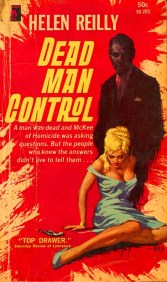


We are 30 pages into Dead Man Control (1936) when the case is sealed up beyond any doubt: a millionaire shot dead in his study, the door locked and bolted on the inside, his new, much younger wife unconscious on the floor (her fingerprints on the gun, too), no hiding places, and freshly fallen snow on all the window-ledges to preclude the clandestine exit of anyone else who could have been present. Clearly the wife dunnit, and everyone can go home early today. So therefore Inspector Christopher McKee has to be summoned back to New York from his holiday in England because…er, it looks too easy? And as he investigates, secrets there was no reason to suspect begin to spill out…
Continue reading
#356: Minor Felonies – Young Robin Brand, Detective (1947) by Freeman Wills Crofts

Image via Facsimile Dust Jackets
The thirty-first novel Freeman Wills Crofts published in his career was this novel for younger readers. Let that sink in a moment. Captain Dryasdust encroaching on Enid Blyton’s territory seems about as likely as Blyton herself trying her hand at Raymond Chandler’s metaphor-laden hard-edged novels of moral decay…the difference being that Crofts actually tried it.
Continue reading
#355: Change a Letter, Alter the Plot

If you’ve been paying attention, especially to my comments left both here and elsewhere, you’ll be aware that my typing is rather famously variable. 90% of the time I’m good, but that other 10% — man, some errors there are. Writing something recently, I made reference to the novel Five Little Pugs by Agatha Christie and then — catching myself in time to correct it — I had a thought…
Continue reading
#350: The Men Who Explain Miracles – Episode 4.2: The Edward D. Hoch ‘Best Impossible Crime Novels’ List of 1981 (Books 10 to 6)

Continuing our examination of the 15 best impossible crime novels of all time as compèred by Edward D. Hoch in 1981, here is the second of three episodes looking at the titles in question from Dan and myself in our occasional podcast The Men Who Explain Miracles.
Continue reading
#348: Golden Age Detection 101 – The Setting

Following on from last week’s unveiling of the previously-unknown ‘Everythyne I Know About Detectyve Fiction’ (1925) by Captain Sir Hugh J. Lee Boryng-Payne Q.C. A.B.V. and his perspectives on the writing of an amateur sleuth, I thought I’d share the second section of this pamphlet on the perks and perils of the setting of a typical GAD novel of detection.
Continue reading
#346: The D.A. Draws a Circle (1939) by Erle Stanley Gardner
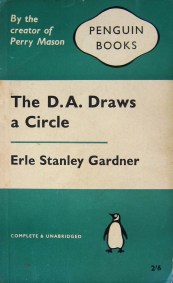
The third Doug Selby book from Erle Stanley Gardner sees an escalation in the puzzle aspects that make this series such a joy. You may come in expecting small town shenanigans and lazy Evil Big Business villains shown up by scrappy, dogged, local hero Selby, but you get a man killed in baffling circumstances with a semi-impossible twist, or a bindle-stiff gassed in equally nonsensical conditions with an elaborate scheme behind it, or — as here — a naked corpse shot twice in the same wound and spiralling accusations of complicity in murder plots that parallel and snake around each other in a particularly lethal dance. Dammit, Gardner is my go-to when I need a lift, I can’t deny it.
Continue reading
#343: He Wouldn’t Kill Patience (1944) by Carter Dickson
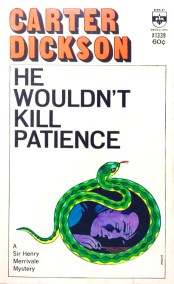
The result of a challenge between John Dickson Carr and magician-turned-author Clayton Rawson to write a murder in a room whose inaccessibility is assured by paper taped across the inner door jamb, He Wouldn’t Kill Patience (1944) also has GAD brethren in Freeman Wills Crofts’ zoo-set, poisonous-snake-centric Antidote to Venom (1938). Carr and Rawson take more puzzle-oriented routes, of course, and both happen to feature magicians, but the Reptile House subgenre is off to a good start with these two novels in it. And since you’re going to ask, in the head-to-head of this and Rawson’s ‘From Another World’ (1948), Carr wins. Boy, does Carr ever win.
Continue reading
#334: The Chinese Orange Mystery (1934) by Ellery Queen

Sure, laugh it up. Just a few short months ago I stated my intention to read the entirety of the output of Manny Lee and/or Frederic Dannay under the Ellery Queen nom de plume, and here I am — some struggles later — jumping ahead to a more warmly-perceived title. I’m not happy about it myself, I much prefer to do these things chronologically, but equally I want to want to read their books again. I’ve loved some, been unaffected by others, and abominated a handful, and as such Queen remains a problem child for me. So here I am, back on the horse in a different town, mixing metaphors with the best of ’em. And the result…?
Continue reading
#318: The Sinister Six – Murder Begins at Home in ‘Behind the Screen’ (1930)
 The Invisible Event