OOP

#484: The D.A. Calls a Turn (1944) by Erle Stanley Gardner


Thanksgiving evening, Sheriff Rex Brandon receives a call from a contrite drunk claiming to have stolen a car, and heads over to pick him up along with D.A. Doug Selby. Arriving too late to prevent an accident in which the man is killed, a chance observation by Selby leads to an identity different to one the man had claimed This in turn brings Brandon and Selby to Carmen Freelman, who had been called away from dinner with her new husband’s family that evening by her boss…who just happens to be the man killed in the crash. So run the first twenty-four pages of The D.A. Calls a Turn (1944) by Erle Stanley Gardner. Strap in for a wild ride…
Continue reading
#482: A Sea-Change Into Something Rich and Strange for The Secret of Skeleton Island (1966) by Robert Arthur
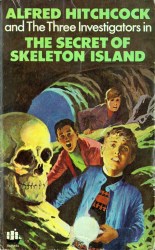
Quite a week it’s been: a humdinger of a self-published impossible crime novel, then a low-key classic from John Dickson Carr…if the best things come in threes, it seems only sensible to finish with another case — the sixth, as I continue my way through this series chronologically — for Jupe, Pete, and Bob, a.k.a. The Three Investigators.
Continue reading
#470: Remembering Noah Stewart

Today I am due to suggest a book for the Reprint of the Year awards organised by Kate at CrossExaminingCrime. However, the sudden death of fellow blogger Noah Stewart earlier this week is somewhat forefront in my mind and I wish to remember him.
Continue reading
#448: The Hanging Captain (1933) by Henry Wade
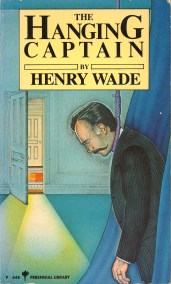
When The Murder Room, the ebook-only arm of publishing house Orion, announced a couple of years ago that they’d be releasing a bunch of Henry Wade’s novels I got quite excited and then proceeded to buy none of them. Instead, I eventually acquired three hard-to-find Wade novels in paperback — The Duke of York’s Steps (1929), The Hanging Captain (1933), and the apparent classic Heir Presumptive (1935) — and proceeded to read none of them, too. So, as I v-e-r-y-s-l-o-w-l-y make my way through these, I’m pleased to report that here it certainly seems Wade has learned a lot from that earlier book and grown significantly as an author in four short years.
Continue reading
#439: Nine – and Death Makes Ten, a.k.a. Murder in the Atlantic, a.k.a. Murder in the Submarine Zone (1940) by Carter Dickson
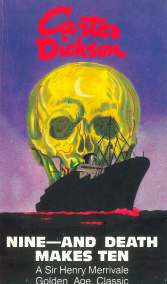
Yes, this was supposed to be The Spanish Cape Mystery (1935) by Ellery Queen in preparation for the forthcoming spoiler-filled look at Halfway House (1936). Yes, you all warned me that book was awful, and you were correct. Let’s instead board a cruise ship stuffed with munitions at the outset of the Second World War and watch the eight — or is it nine? — passengers slowly get to know each other until one of them is found murdered in their cabin, the corpse peppered with fingerprints which do not match those of anyone on board. Aaah, I feel better already — man, I love the work of John Dickson Carr; the idea of having never discovered it makes me feel a little unwell.
Continue reading
#437: Murder on Safari (1938) by Elspeth Huxley
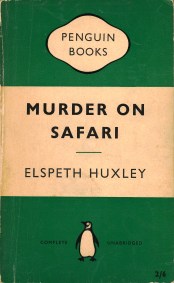
Lightning could strike twice, right? I went into Max Murray’s The Voice of the Corpse (1948) last week knowing nothing about it and that turned out rather well, and no less authorities than Xavier Lechard and Nick Fuller had enthused about this in recent weeks. Plus, in the comments on that above post, TomCat — who knows my standards pretty well, I feel — called Murder on Safari (1938) “a wonderfully written detective story with a splendid backdrop, [that] plays scrupulously fair with the reader”. So, despite (deliberately) knowing nothing about this one either, this wasn’t a risk at all. Kick back, and let the good times roll.
Continue reading
#431: The D.A. Cooks a Goose (1942) by Erle Stanley Gardner
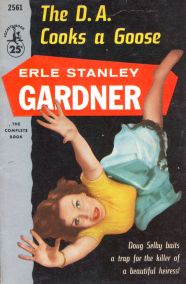
It is slightly over a year since I decided to reread the Doug Selby novels of Erle Stanley Gardner, and while I sort of imagined I’d be done by now — nine books into twelve months goes fairly easily — I had not counted on how much I enjoyed the ones I’d read first time around, and so how I would draw out this revisiting so as to enjoy them equally now. And, even more fun, it turns out that I hadn’t read this one (side note: does anyone actually read the synopses of authors they love in advance of reading the book? You’re gonna read it anyway, right, so why would it matter what it’s about?) — so it felt like a new Doug Selby novel even though, yes, no, I’m aware it isn’t.
Continue reading
#429: The Men Who Explain Miracles – Episode 7.2: The Ages of John Dickson Carr

 The Invisible Event