OOP
#525: Going Home – Dead Meat (1993) by Philip Kerr
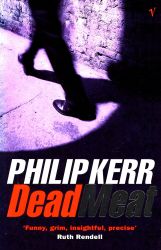
For the second look at novels which I suspect put me on the route to my persistent craving of a classic detection fix, we go back to an author I adored during what were probably his lean years and had moved on from once he regained his youthful popularity.
Continue reading
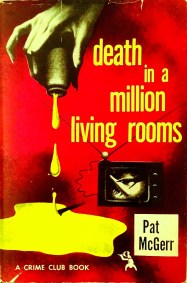
#523: Death in a Million Living Rooms, a.k.a. Die Laughing (1951) by Patricia McGerr


Quite apart from having the best damn title ever, Death in a Million Living Rooms (1951) by Patricia McGerr employs one of my favourite conceits of classic-era detection: the Live On Air Murder. With The Dead Are Blind (1937) by Max Afford, Murder in the Melody (1940) by Norman Berrow, and And Be a Villain (1948) by Rex Stout giving us death on the radio, McGerr turns to the television studio to kill her poor victim live in front of the several million who tune in to Podge and Scottie’s weekly comedy show, with — as in Stout’s take — poison in the sponsor’s drink responsible. That you know it’s coming makes it no less horrible, so whodunnit?
Continue reading
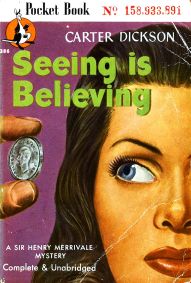
#520: Seeing is Believing, a.k.a. Cross of Murder (1941) by Carter Dickson


Socialising is difficult, isn’t it? One minute you’re making polite dinner party conversation about jobs with someone you’ve only just met, the next a hypnotist performs a few mesmeric passes and goads a wife into stabbing her husband with a knife everyone knows is fake but which — awks — actually turns out to be real and, oh my god, she’s killed him. We’ve all been there, and we all know how tricky it can be to factor this sort of thing into one’s TripAdvisor rating. An unexpected, impossible murder can dampen the mood somewhat — especially when so many people seem to be operating at cross-purposes — but remember you did say the canapés were lovely…
Continue reading
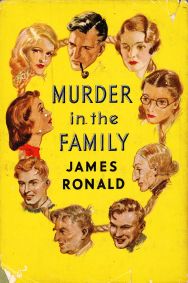
#517: Murder in the Family, a.k.a. The Murder in Gay Ladies (1936) by James Ronald


I’m nowhere near Puzzle Doctor/Brian Flynn levels of adoration yet, but there’s a good chance James Ronald could turn out to be one of my very favourite unheralded authors. Sure, he wrote in quite a range of genres — from ‘a family’s struggles in an unfamiliar environment’ to incident-packed impossible crime novels and, presumably, just about anything in between — and the frank unavailability of so many of his books is going to make tracking him down long and, given the spread of genres, at times possibly unrewarding work, but when he’s good, boy is he good. As in the case of the Osborne Family Murder — with ‘family’ being very much the key word here.
Continue reading
#516: Minor Felonies – The Clue of the Marked Claw (1950) by Bruce Campbell

Man, things were simpler in the 1950s. Back then, the fourth book in a series of juvenile detective adventures could centre around lobster fishing and the series could still run for a further 14 titles. Kids those days, eh?
Continue reading
#514: About the Murder of a Startled Lady (1935) by Anthony Abbot


This is another title brought to my attention via the Roland Lacourbe-curated list of one hundred (well, 114) notable impossible crime novels. If I’m honest, I still don’t know what to make of that list — containing as it does some wonderful books that aren’t impossible crimes, some poor books that aren’t impossible crimes, and some thoroughly glorious impossible crimes that would otherwise have passed me by. This one is…fine. While the impossibility isn’t up to much, there’s enough interest in the approach taken to commend it if you can find a copy. Would I put it among the hundred best, however? Er, no…
Continue reading
#513: Minor Felonies – The Case of the Missing Message (1959) by Charles Spain Verral

The Three Investigators had Jupiter Jones, the Five Find-Outers had Fatty, and the Benton and Carson International Detective Agency had Barclay ‘Brains’ Benton. Welcome to the first of their six cases, from the same Whitman stable that brought us The Power Boys from a fortnight back.
Continue reading
#511: The Stingaree Murders (1932) by W. Shepard Pleasants


Thirteen people — a publisher and his two grown children, a newspaper editor, a retired General and his wife, a career politician and his bodyguard, a scientist, a lawyer, two servants, and our Everyman narrator — on a houseboat in the Louisiana bayou, intent on a few days of fishing, swimming, and relaxation. Though, naturally, the worries of everyday life never really vanish: a threat against the state Governor hangs over his head, as does his professional association with the scientist, which seems a little strained. With just enough time to get complacent, tragedy strikes, and then there were twelve. And then there were eleven…
Continue reading
#509: Fair-Play/Cipher – The Baffle Book (1930) by Lassiter Wren and Randle McKay [ed. F. Tennyson Jesse] Problems 1 to 7