Impossible Crimes
#112: The Howling Beast (1934) by Noël Vindry [trans. John Pugmire 2016]
Disclosure: I proof-read this book for Locked Room International in April 2016.
 After many years reading, talking about, reviewing, and now blogging on the subject of detective fiction I am presented with a real difficulty here: I honestly don’t know quite what to write about Noel Vindry’s classic The Howling Beast for fear of giving anything away. It is a balancing act of a book that, while probably not completely successful by today’s standards, is hugely enjoyable and absolutely something that those who count themselves as puzzle fans or lay claim to an interest in the emergence and development of detective fiction really should read. And I’m not just being vague here because I don’t want to criticise it — I really enjoyed it, and there’s one key thing it does absolutely brilliantly, and I’m especially keen to preserve that for those of you who should experience this pure. So, with that out of the way, here goes.
Continue reading
#110: The Dead Are Blind (1937) by Max Afford
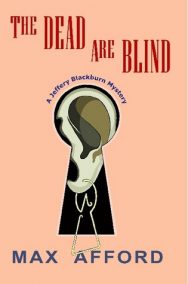 I believe the philosopher John Francis Bongiovi, Jr. said it best: “Keep the faith”. The Dead Are Blind is the third novel by Max Afford I’ve read and, having hugely enjoyed the other two, I found myself struggling to maintain interest through the opening chapters. Certainly from a historical perspective they have plenty to offer – our lead characters are invited to tour a radio studio on its opening night, something of a gala event at the time, and so this is chock-full of fascinating tidbits from Afford’s own experience of working in radio. But the mix of dense description and fixation on minute details that are hugely unlikely to become relevant later puzzled even my will and left me a bit apathetic by the end of chapter two.
Continue reading
#109: The Tuesday Night Bloggers – The Problem with Poison via ‘Poison Can be Puzzling’ (1944) by Max Afford
It’s Max Afford Week on The Invisible Event…not through any design, but purely because I selected his novel The Dead Are Blind (1937) as my review this coming Thursday and the Tuesday Night Bloggers’ chosen topic of ‘Poison’ gives me the chance to look at one of the three short stories in the Ramble House collection Two Locked-Room Mysteries and a Ripping Yarn. But, hey, that’s no bad thing, as Afford is one of my discoveries of the last year or so and it’s always nice to shine a little light his way.
Continue reading
#106: Death from a Top Hat (1938) by Clayton Rawson
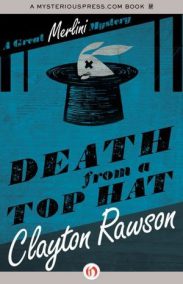 Well, where to start? Locked room murders (plural!), magicians, a hefty dose of self-reference, an extended John Dickson Carr homage-cum-lecture, a sprinkling of magical and mystical esoterica, and some really quite awesomely clever solutions…to be honest this — Rawson’s first novel to feature magician detective The Great Merlini and his Watson, journalist Ross Harte — should be a shoo-in for my favourite book of all time. Something about the conflation of conjuring and seemingly-impossible crimes just gets me all a-giggle with excitement, and Rawson wrote one of my favourite impossible crime short stories of all time (‘Off the Face of the Earth’, since you asked) so has previous with me, but this just comes up a little short to call it the masterpiece it probably should be.
Continue reading
#104: The Tuesday Night Bloggers – The Light and Shade of Gervase Fen
Okay, so I’m going to do my best to stay on-task today; none of these wild flights of fancy. A discussion of Golden Age academic mystery and nothing more. And since I already have my post sorted for next Tuesday, and that’s the final week in June, it has to be now that I engage in some discussion about Edmund Crispin and the irrepressible Gervase Fen. Continue reading
#103: Paul Halter Day – III: The Round-Up

Well, as 60th birthdays go, I hope mine is this much fun. And so as Paul Halter Day comes to an end – and given that you’ve already checked out my two posts on the beginning of the Locked Room International enterprise and then some unapologetic fanboying on Halter’s impossible crime mantle-bearing – here’s the round-up of what others who were generous enough to get involved had to say.
~
First up, and with thanks for his not taking legal action over me stealing his Crimes of the Century round-up idea for this post, Rich at Past Offences tackled The Demon of Dartmoor, his first toe into the Halter Pool (see what I did there?), and liked what he found:
Continue reading
#102: Paul Halter Day – II: The Impossibility of More Impossibilities

Declaring that the detective novel was the only form of literature that put the reader to work, [S.S. van Dine] argued that “a deduction game emphasising fair play within a limited setting” would be the story structure with the best potential to result in masterpiece mystery stories […] But when the elements of the game are too severely limited and the building materials are all the same, only the first few builders will get all the glory and there will be an over-abundance of similar novels…
—Soji Shimada, in his introduction to The Moai Island Puzzle
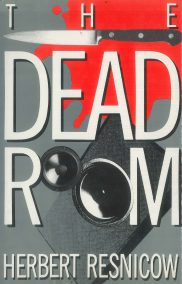 When the unpopular patriarch of a family is found stabbed to death in his locked study, it’s clear that one of the six family members gathered at the ancestral pile must be the murderer (the servants, of course, are excluded immediately). It’s up to our plucky amateur detective team to work out how he was killed and beat the police to the killer before it’s too late while also beginning to realise how they really feel about each other… So far, so Golden Age. Now substitute the following nouns: patriarch/inventor, family/hi-fi company, study/anechoic chamber (sound-testing room, if you will), family members/company executives, ancestral pile/company studio, and servants/technicians. What you have now is the plot of Herbert Resnicow’s The Dead Room. It’s that simple a switch – but for the trappings of its location, this could not be more of a Golden Age detective story, and the entire enterprise is undertaken in the same spirit as those classics.
  The Invisible Event