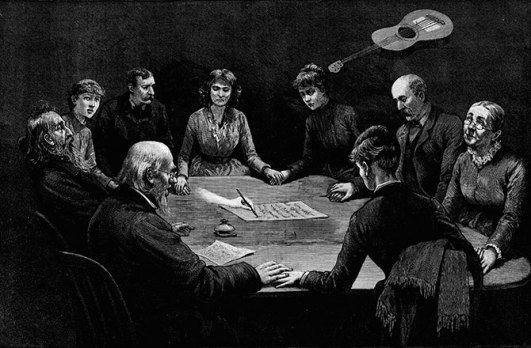
Flying lute? Check. Ghostly disembodied hand? Check. Okay, ladies and gentlemen, let’s call this meeting to order…
Flying lute? Check. Ghostly disembodied hand? Check. Okay, ladies and gentlemen, let’s call this meeting to order…
 I am swiftly approaching the point where I will be reluctant to read any more Rupert Penny; he published a mere nine books, of which Policeman in Armour is the fifth I’ve read, and I don’t want to find myself in a situation where there’s no new Rupert Penny to pick up and lose myself in. I still have plenty to be getting on with — half of Carr, 10 Christies, 17 Berrows, countless undiscovered gems — but Penny holds a special significance for me because he is such a superb classicist and produced detective plots that walk the fine line between several stools without tripping and getting trapped between any of them (I apologise for any pain that mixed metaphor may have caused you).

 Writing a decent novel of detection is difficult enough, as evinced by the fact that the form virtually died out by the 1960s, so taking the classic detective story and turning into a pastiche of itself is even harder again — it has to be both a story of crime and detection and a cunning vehicle for transcending the tropes thereof while simultaneously wallowing in them. Leo Bruce did this near-perfectly in Case for Three Detectives (1936) and a great many luminaries of the form dipped their toe into such conceits with aspects of their books, plots, or characterisation, but for a full-length novel to take this on successfully is something of a challenge that it would be beyond the abilities of most mortals.

 Benjamin Disraeli had it right when he said “there are three kinds of lies: lies, damn lies, and publishers’ breathless comparisons to the classics”. I’ve been bitten once by this recently, so was doubly shy of the promise on the reverse of Warren B. Murphy’s sole detective novel to feature Dr. David Vincent Leonardo that it would introduce “a splendid new addition to the ranks of Holmes, Poirot, [and] Dupin”. To be upfront about it, obviously that’s not the case, but despite some flaws in the rendering of our genius amateur — of which more later — this is honestly a lot of fun, and joins the ranks of Hmmmm, What If They’d Written More of These? because, yeah, it lacks in artistry, but if you want a swift, reasonably smart, and engaging unheralded locked room puzzle you could do a damn sight worse.

 The Invisible Event