#38: Five to Try – Short Story Collections

Following my torrent of Sherlock Holmes I was tempted to do a ‘Five to Try’ on the short story collections, picking my favourite story from each.  But it’s not as if the Holmes canon doesn’t have enough words dedicated to it already, and thus I thought I’d opt for collections by other authors instead.

So, the rules: collections of short stories by a single author (no compendiums, wherein the quality always varies horrendously), readily available today…that just about covers it.  And so, alphabetically by author, we have:

Fen Country (1950-79) by Edmund Crispin

Fen CountryThe second of Crispin’s two short story collections, published posthumously.  My choice of the two because of the way a lot of the stories hinge on a very simple core idea – homonyms, for example – that might come across a gimmicky but manage in about six or seven pages to communicate setting, setup, event, outcome and misdirection.  Frankly no small feat! Yes, consequently the characters tend to suffer (the ebullient Fen is a curiously neutered presence in the stories in which he features) but for sheer inventive interpretation after inventive interpretation this is hard to beat.  And as an example of Crispin’s tight hold on the reins of his plots (which could, let’s face it, get a bit beyond him in his novels) this reinforces his reputation in a form that has often proved the undoing of lesser talents. [Available in ebook and thoroughly unattractive print form from Bloomsbury]
Recommended reading: ‘Death and Aunt Fancy’, ‘The Hunchback Cat’, ‘Outrage in Stepney’ Continue reading

#36: The Impossible Crimes of Sherlock Holmes – III: The Problem of Thor Bridge
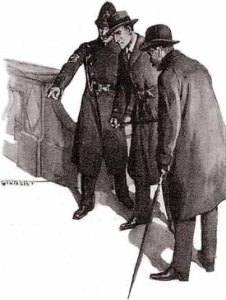
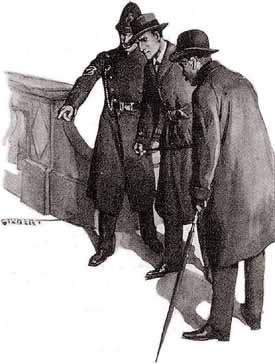
Thor Bridge 1‘The Problem of Thor Bridge’ gives us the classic impossible crime setup of a body that has been shot in the head but without any sign of a weapon to hand…and then manages to appear not at all impossible by finding the murder weapon hidden in the most likely suspect’s room, also throwing in a note from the suspected murderer arranging to meet the victim at the place of their demise and at around the time they are suspected of being having died.  True, there are no footprints anywhere near the body, but – before you get too excited – “The ground was iron-hard, sir.  There were no traces at all.”  Oh, so that takes care of that, then.
Continue reading

#35: The Language of Sherlock Holmes – A Study in Consistency
Holmes profile

In an attempt to broaden my approach to this blogging lark, I thought I’d turn my hand to some linguistic analysis.  This presents a problem in the form of my being a qualified mathematician and therefore acutely aware of how easy it is to skew any set of data based on the interpretation it’s given, and thus how pointless it becomes to really bother.  Nevertheless, I shall sally forth into the Sherlock Holmes canon with a quick sweep over some of the main points, and I can always come back to it later if I feel it warrants further investigation.

Continue reading

#33: The Killing Needle (1871) by Henry Cauvin [trans. John Pugmire 2014]

Killing NeedleIt is difficult to believe that Arthur Conan Doyle ever intended for his Sherlock Holmes stories to be as influential as they have proven to be.  Not only are we still churning out variations on his characters in print and on radio, television and film but such is the fascination with his detective that something published before Conan Doyle even put pen to paper can achieve retrospective interest because of the similarities between the two.   And so Locked Room International published this translation of Henry Cauvin’s debut novel The Killing Needle, wherein a skeleton-thin genius master of disguise who shuns social norms, declares “In my case, the brain dominates everything and is continually boiling over.  This fire is eating me up and doesn’t leave a moment’s peace.  The mind!  The mind is a vulture that’s eating me alive” and takes opium (though in this case “to help me get some much-needed sleep”) has his adventures in crime-solving related by a doctor who becomes his confidant after being introduced by a mutual friend …yeah, okay, that’s a lot of overlap right there.

Continue reading

#32: The Impossible Crimes of Sherlock Holmes – I: The Adventure of the Speckled Band

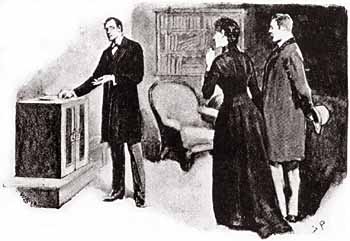
Speckled Band 1Since I can’t quite go the Full Sherlock – he’s out of my era, after all – I thought I could at least have a look at the three Arthur Conan Doyle-penned short stories that comprise the (official) entirety of his impossible crimes: ‘The Adventure of the Speckled Band’, ‘The Adventure of the Empty House’, and ‘The Problem of Thor Bridge’ (I’m excluding novella The Valley of Fear because it’s not technically an impossible crime, and remains a mystery for all of about six lines).  It’s also a lovely excuse to get some of Sidney Paget’s gorgeous illustrations out for airing, too, and I don’t think anyone is going to mind that.  So, first up going chronologically, is my least favourite of these three: nonsense-fest ‘The Adventure of the Speckled Band’.

Continue reading

#31: Mycroft Holmes (2015) by Kareem Abdul-Jabbar and Anna Waterhouse

Things are going a bit Holmesian here at The Invisible Event for the next week or so: a post every other day on something Sherlock-oriented.  Why?  For the simple reason that I feel like doing it.  I should probably wait for the BBC special at Christmas to theme it up a bit more, but Christmas is a busy time and so I’m doing it now instead.

Mycroft HolmesI wouldn’t call myself die-hard Sherlockian enough to immediately sign of up for anything produced in that universe – material enough to consume more than one lifetime – but the character and context retain so much potential that I will dip in where I believe someone might do something worth checking out.  The reference-filling short stories written by Adrian Conan Doyle both with and without the help of John Dickson Carr, the entertaining Professor Moriarty books by Michael Kurland, the tales by short story specialist Ed Hoch, Laurie R. King’s Mary Russell books, Caleb Carr’s The Italian Secretary, and Anthony Horowitz’s Holmes pastiche The House of Silk and universe-widening Moriarty (among others like Colin Dexter’s sole Holmes story ‘A Case of Mis-Identity’) all testify to the presence of life in the old dog yet, and Arthur Porges wrote a couple of pastiches I’d like to track down, so there’s still more to try.

Continue reading

#27: The Crooked Hinge (1938) by John Dickson Carr – A Triple-Decker Review

Crooked HingeThe heart of John Dickson Carr’s The Crooked Hinge – previously voted the fourth-best impossible crime of all time – is this: a man standing alone at the edge of a pond surrounded by sand has his throat slit, and the two witnesses who had him in their sight both swear no-one was anywhere near him at the time.  It is, of course, impossible.  But then the incidence of that which cannot be done is the bailiwick of Dr. Gideon Fell…  Something a little different this week, as two venerable gentlemen of the blogosphere – Puzzle Doctor of In Search of the Classic Mystery Novel, and Sergio of Tipping My Fedora – have kindly agreed to allow me to append my thoughts to their own joint review of this title from last year by way of providing some alternative perspectives on what is a hotly-debated topic: just how classic is The Crooked Hinge?

Continue reading

#19: Five to Try – Starting John Dickson Carr

John Dickson Carr wrote just shy of 80 books and, since he is the finest practitioner of detective fiction the world has ever seen, you would like to know where to start in this cavalcade of brilliance (because some of them are bound to be, er, unbrilliant).  I am here to help.

Just to be clear on the rules: novels that are readily available, as always, restricted to impossible crimes because that’s why we love him, and presented in order of recommended reading (so, start with the first one). That is all, here we go…

Constant SuicidesThe Case of the Constant Suicides (1941) Hey, you; yes, you, with the cup of tea.  I want you to write a book about people inexplicably hurling themselves out of a window when sleeping alone in a room at the top of a tower.  I want it to be creepy, I want it to be fast-moving, I want it to have an undertone of threat; it also has to be fairly-clued, the culprit responsible must be a complete surprise and you can kill as many characters as you like.  Oh, and make it funny.  Make it laugh out loud, technicolour funny, but light enough to take up residence in your brain without leaving so much as a shadow and without undoing the threat mentioned above.  What’s that?  It’s already been done?  Oh, forget it, then I’ll just read that book instead.  [Available from Rue Morgue Press in print only, the recommended version as some other publishers inexplicably and unforgivably give away key points in their cover art]

Continue reading

#17: The Hollow Man, a.k.a. The Three Coffins (1935) by John Dickson Carr

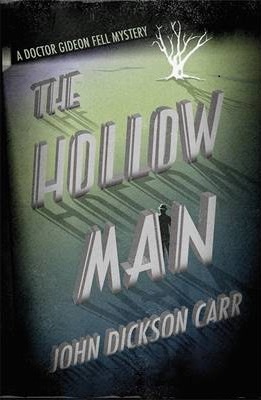
Hollow ManWhile I technically popped by blog Carr cherry a few weeks ago in recommending Death-Watch, it was at best a passing thumbs-up to the man and his achievements.  And, following the disappointment of my intended novel under review, the time is probably ripe to dive in, get the first Carr review up and prop open the floodgates.  And why not The Hollow Man (a.k.a. The Three Coffins)?  Carr’s most well-known work, an arguable masterpiece of detective and impossible crime fiction, surely the most widely written about impossible crime novel on the internet…why not trot out the usual platitudes, recommend it unreservedly and fill the gap in my schedule?

Except, and here’s the different perspective I’m hoping to bring to this, the first time I read The Hollow Man I hated it.  I hated it.  It was published as part of Orion’s Crime Masterworks series and that alone stimulated sufficient interest for me to give it a go but, being in my nonage of classic crime fiction, I couldn’t really tell you what an ‘impossible crime’ was and so didn’t know what to expect.  I somehow knew of Carr vaguely (the internet was not quite so well-informed then as now), had ten or so Agatha Christies to my name – including Murder in Mesopotamia, which I failed to recognise for the impossible crime it is – and figured that alone meant I would be in for a similar kind of experience and knew what I was doing.

Continue reading