Genius detective
 I haven’t reviewed (or read, come to that) a short story collection for a while, and it’s
 #121: On the Many Wonderful Faces of Dr. John H. Watson, MD – Part 2 of 2

So, as established yesterday, there’s much more scope in Watson than there is in Holmes. The obvious question then becomes: So what do you do with this?
Take the simple cosmetic changes out of the equation — the casting of Lucy Liu as Dr. Joan Watson in the US series Elementary, for instance, easily one of the least disruptive changes it’s possible to get away with — and what you’re left with is the fact that Watson, being our entry into the Holmesiverse, is allowed to do anything that reflects the experience and perspective of the reader. As discussed yesterday, there are aspects of the character, the constants I referred to, that don’t become him — making him the proprietor of a burgeoning dog-walking business, or a respected scholar of nineteenth century Gothic poetry, or giving him a form of OCD which means he must always cross his legs in the opposite manner to Holmes unless it’s a Tuesday in which case…, etc — but let’s put this aside as given and look at the way certain authors have expanded on Watson without desecrating him beyond all recognition.
Continue reading
#120: On the Many Wonderful Faces of Dr. John H. Watson, MD – Part 1 of 2
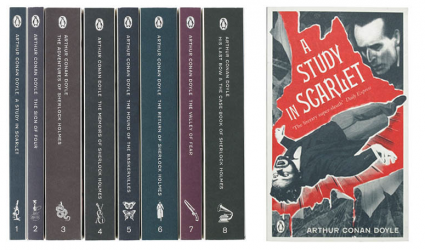 Lately I’ve read an unusually high concentration of Holmes pastiches — Caleb Carr’s The Italian Secretary (not good), Stephen King’s ‘A Doctor’s Case’ (not terrible), Colin Dexter’s ‘A Case of Mis-Identity’ (extremely good), Michael Kurland’s The Infernal Device (loadsa fun), Steve Hockensmith’s Holmes on the Range (fabulous) and a superb piece of unpublished fan fiction sent to me via email — and it’s made me realise that while Watson, and specifically the Watsonian voice, is vital in undertaking Holmes, no-one can quite agree what Watson is, how he should be written, and this makes him far and away the more interesting of the two men when it comes to analysis.
Continue reading
#117: The Tuesday Night Bloggers – The Underwhelming Origins of Ellery Queen in The Roman Hat Mystery (1929)
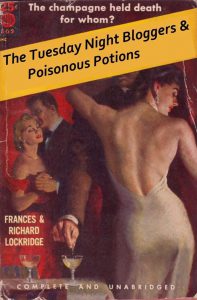
General summer unavailability is resulting in the Tuesday Night Bloggers having August off (that’s what they’ve told me, anyway…) and so this final week of ‘Poison’ posts is an opportunity to right a wrong and launch on a new undertaking in my reading life. In short, to restart the Ellery Queen canon — all 40 (by my count) novels that had input from Dannay and/or Lee — from the very beginning, starting here with their first novel, the poisoning tale The Roman Hat Mystery.
Continue reading
#114: Till Death Do Us Part (1944) by John Dickson Carr
 People hold weird beliefs: that the moon landings have all been faked, for instance, or that the moon is hollow, or that the phases of the moon have anything at all to do with your love life or finances. Some people might even hold weird beliefs not about the moon. Here’s one: I firmly believe that for the remainder of human history there will never again be anyone who writes the detective novel as well as did John Dickson Carr at his peak. When I eventually narrow my ten favourite detective novels of all time down to a list that is actually ten books long, there’s a real chance all ten of them will be by Carr. And, I’ll tell you now, it will definitely feature The Problem of the Green Capsule, which in my current mood I consider to be the pinnacle of the form.
Continue reading
#94: Death in Five Boxes (1938) by Carter Dickson
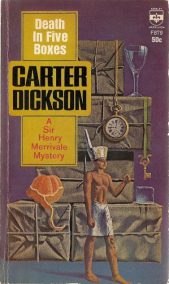 Four people are discovered sitting around a table as if at a dinner party, each with only a glass in front of them. Three of the four have been poisoned into a catatonic state and the fourth has been murdered by being run through with a narrow blade. Of the three who remain alive, one has two bottles of poison in their bag, one has the workings of an alarm clock in their pocket, and the third is carrying four pocket watches in various pockets about their person. At this point you are three chapters into the eighth Sir Henry Merrivale novel written by John Dickson Carr under his Carter Dickson byline and we haven’t even touched upon the revelation that greets you at the end of that chapter…suffice to say, boy are you in for a ride!
Continue reading
#84: The Tuesday Night Bloggers – The Sherlockian Impossibilities of John Dickson Carr – II: ‘The Adventure of the Sealed Room’ (1953)
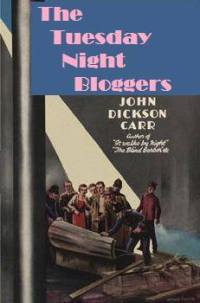
I’m guilty of sedition here: this isn’t technically part of the Tuesday Night Bloggers – they’re looking at travel in classic crime this month – but rather my own delayed TNB post on John Dickson Carr from March before I was sidelined. But, y’know how it is, it’s the second one looking at Carr’s Sherlock Holmes stories and so I feel I should probably post it on a Tuesday if only for internal consistency…my apologies for any confusion (though I suppose I cam writing about a Carr trip…). Just look upon this as my Never Say Never Again.
I talked about the origin of these stories in my first post on this topic, so let’s get straight on with it: this story is built on the reference to a case “of Colonel Warburton’s madness” made at the start of ‘The Engineer’s Thumb’ and so it’s appropriate that it begins in much the same way: someone in distress seeks out Watson (then for his doctoring, now seemingly because he knows Holmes) and is thus ushered into the Great Presence. It’s here that the story plays its most interesting card, as Holmes is rather short with the unfortunate Cora Murray who has just had a Colonel Warburton seemingly shoot himself and his wife while locked together in his study in the house where they all reside:
Continue reading
#79: The Tuesday Night Bloggers – The Sherlockian Impossibilities of John Dickson Carr – I: ‘The Adventure of the Highgate Miracle’ (1953)

In the early 1950s, John Dickson Carr collaborated with Sir Arthur Conan Doyle’s youngest son Adrian on six stories featuring Sherlock Holmes and Dr. John Watson. These were published in various magazines before being collected together and published as either The Exploits of Sherlock Holmes (as my edition – featured below – is, also containing six stories solely from the pen of Conan Doyle, Jr.) or The Further Exploits of Sherlock Holmes, separate from Conan Doyle, Jr.’s stories which were themselves published as The Exploits. Are you keeping up?
Continue reading
#70: Five to Try – Starting Paul Halter
After the fun of jointly analysing Paul Halter’s The Seven Wonders of Crime with Kate at CrossExaminingCrime, there’s now collateral damage to tidy up. Namely, that the inevitable question for anyone eager to take the plunge with the French maestro des impossibilités (and, frankly, how can you not be?) will be: Where do I start? Well, start wherever you like, of course, but if I had to pick my first five of the eleven currently available they’d look something like this:
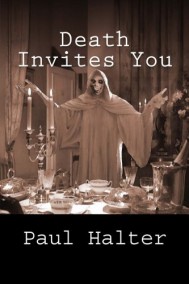
Death Invites You (1998) [trans. 2015]
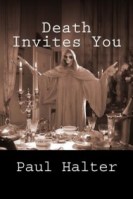 As I said in my review the other week, if you’re starting completely new with Paul Halter and/or impossible crimes then this is the perfect place to do it. The balance of plot and character is just right, the contortions for the murder of a man over a table set for a meal in his locked study – matching exactly the novel he was writing – are not too outré for the novice and, while the locked room element isn’t completely original, there’s no excess of foliage to obscure your view of what’s going on. This was the first book to feature Archibald Hurst and his harried genius amateur Alan Twist together, and it’s a relationship that feels natural from the very first page of them discussing impossible crimes while drinking in a pub. If Hurst ends up rather abject following his expressed desire for some “really meaty” case to get involved with, the reader is treated to the beginnings of a rather special relationship that will bring a great many hours of reading pleasure.
Continue reading
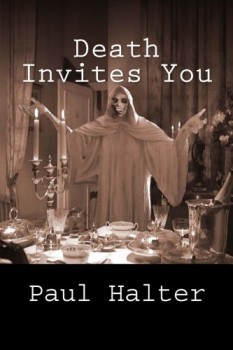
#62: Death Invites You by Paul Halter is now available!
 The Invisible Event