
#157: The Tuesday Night Bloggers — A Background of History in The Red Widow Murders (1935) by Carter Dickson

tnbs-history

“The story of the Widow’s Room…begins in the month of August, and in the city of Paris, and in the year 1792.  It begins with the Terror, but it has not ended yet.”
Upon reflection, it’s fairly astounding that John Dickson Carr published novels for 20 years before finally writing his first ‘true’ historical tale with The Bride of Newgate in 1950.  Throughout so much of his early work there is a miasma of the past pushing through, and a revelling in the detail of such times that threatens to overload the present story as Carr seems far more interested in dumping as much detail as possible from, say, the French Revolution upon you so that the Weight of History can be added to the press of his peculiarly heady tales of mystery and imagination.

Continue reading

#94: Death in Five Boxes (1938) by Carter Dickson

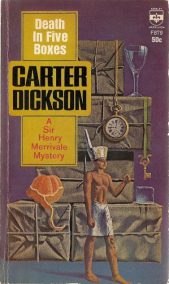
Death in Five BoxesFour people are discovered sitting around a table as if at a dinner party, each with only a glass in front of them.  Three of the four have been poisoned into a catatonic state and the fourth has been murdered by being run through with a narrow blade.  Of the three who remain alive, one has two bottles of poison in their bag, one has the workings of an alarm clock in their pocket, and the third is carrying four pocket watches in various pockets about their person.  At this point you are three chapters into the eighth Sir Henry Merrivale novel written by John Dickson Carr under his Carter Dickson byline and we haven’t even touched upon the revelation that greets you at the end of that chapter…suffice to say, boy are you in for a ride!

Continue reading

#77: The Tuesday Night Bloggers – An appeal to the senses in Carter Dickson’s ‘Blind Man’s Hood’ (1938)

The Tuesday Night Bloggers, you’ll doubtless be aware, is an opt-in group of Golden Age crime fiction enthusiasts who look at the work of a different classic author each month.  And with (Colonel) March being dedicated to John Dickson Carr – the single finest proponent of detective fiction ever to take up the craft, no arguments – I thought it about time I rolled up my sleeves and contributed something to this superb endeavour (also, two people asked me if I was going to get involved and I am nothing if not helpless in the face of my own vanity).

The difficulty is knowing quite where to start.  I am an avowed disciple of Carr, but a lot of his work is still ridiculously out of print and so if I’m recommending something you then have to search for months to find it may dampen your enthusiasm for it somewhat.  And then I remembered that the recently-published compendium of impossibilities that is The Black Lizard Big Book of Locked Room Mysteries contains two stories by Carr and that the second of these – ‘Blind Man’s Hood’, first published in 1938 under his Carter Dickson pseudonym – highlights much of what I love about his writing.

Continue reading

#45: The Kings of Crime – I: John Dickson Carr, the King of Hearts

King Carr

Bookends: It Walks by Night (1930)/The Hungry Goblin (1971)

Books published 1920-59: 64

The Case for the Crown

Diversity: In a career spanning 41 years John Dickson Carr published seventy-six novels and collections of short stories, wrote a raft of mysteries for radio (many of which can be found here), penned the official biography of Arthur Conan Doyle and a non-fiction account of the mysterious murder of magistrate Edmund Godfrey, wrote a column for Ellery Queen’s Mystery Magazine, and was made a member of the Detection Club as well as a Grand-Master of the Mystery Writers Of America.  He created two long-running and dearly-loved sleuths, and in his later career branched out into exquisitely-researched and detailed historical mysteries that weren’t afraid to veer into the nonsensical – the time travel element of Fire, Burn! (1957) – or the fantastical – invoking a deal with the Lucifer himself in The Devil in Velvet (1951) – if they served his purposes.

Continue reading

#19: Five to Try – Starting John Dickson Carr

John Dickson Carr wrote just shy of 80 books and, since he is the finest practitioner of detective fiction the world has ever seen, you would like to know where to start in this cavalcade of brilliance (because some of them are bound to be, er, unbrilliant).  I am here to help.

Just to be clear on the rules: novels that are readily available, as always, restricted to impossible crimes because that’s why we love him, and presented in order of recommended reading (so, start with the first one). That is all, here we go…

Constant SuicidesThe Case of the Constant Suicides (1941) Hey, you; yes, you, with the cup of tea.  I want you to write a book about people inexplicably hurling themselves out of a window when sleeping alone in a room at the top of a tower.  I want it to be creepy, I want it to be fast-moving, I want it to have an undertone of threat; it also has to be fairly-clued, the culprit responsible must be a complete surprise and you can kill as many characters as you like.  Oh, and make it funny.  Make it laugh out loud, technicolour funny, but light enough to take up residence in your brain without leaving so much as a shadow and without undoing the threat mentioned above.  What’s that?  It’s already been done?  Oh, forget it, then I’ll just read that book instead.  [Available from Rue Morgue Press in print only, the recommended version as some other publishers inexplicably and unforgivably give away key points in their cover art]

Continue reading