#155: Ye Olde Book of Locked Room Conundrums – Publication Day!

yobolrc-launch

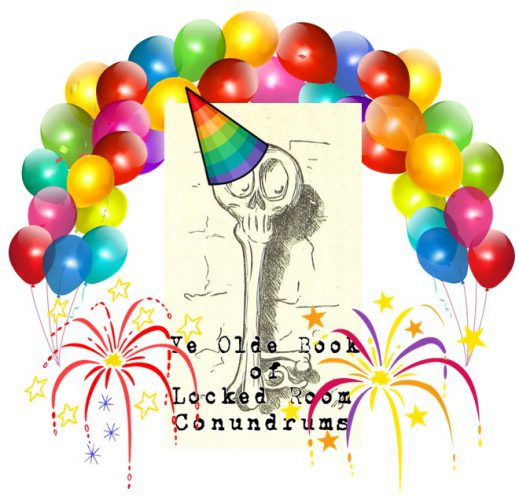
It’s finally here!

Nearly 3 months after being announced, running to 15 stories and 115,421 words, Ye Olde Book of Locked Room Conundrums is finished, and this post is here to announce that it’s ready for you to download for free!

And, yes, you read that correctly — all 15 of the original stories are included, thanks to a frankly amazing intervention by John Grant (he of the massively entertaining Noirish blog) who offered his help in sorting out the two stories I wasn’t going to have the time to get into shape…and then managed to do them in, like, zero seconds flat.

Continue reading

#153: The Tuesday Night Bloggers – Five to Try…But What’s the Theme?

tnbs-costume

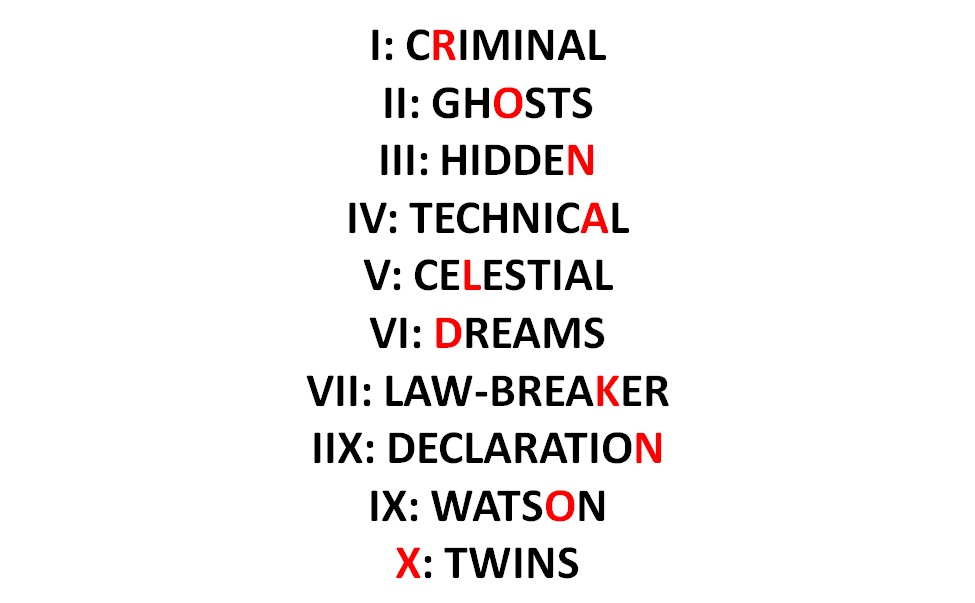
In what might actually be the first time I’ve contributed to a full month of TNB posts — woo! Mr. Commitment! — I thought I’d finish off with my first Five to Try in a little while on the subject of Crime in Costume.  But, this being a blog about detective fiction, I thought I’d leave it up to you to deduce the theme inside of this framing which links all these books together.

The first person to correctly work it out gets…a prize of some sort.  Tell you what, they’ll win a pre-publication copy of Ye Olde Book of Locked Room Conundrums, personally emailed to them by me.  So as, y’know, to save them waiting an extra three or four days and having to click on a link to download it themselves.  I know, I know, I’m too kind.  Tell you what — to make it nice and unique, I’ll even add a bit to the introduction about how this was won in a competition on the blog.  That makes it a bit more special, eh?

Continue reading

#132: When Inspiration Becomes Theft

Plagiarism

Zing!

The other day, I posted this dismissal of Raymond Knight Read’s The Third Gunman which is really nothing more than a rewriting of John Dickson Carr’s The Hollow Man, and then John Grant over at his superb Noirish blog posted this look at the 1934 film The Ninth Guest which follows rather closely the premise of Agatha Christie’s And Then There Were None…except the film predates Christie by five years, so technically ATTWN follows it closely, much to my amazement.

Continue reading

#121: On the Many Wonderful Faces of Dr. John H. Watson, MD – Part 2 of 2

Sherlock Holmes collection covers

So, as established yesterday, there’s much more scope in Watson than there is in Holmes.  The obvious question then becomes: So what do you do with this?

Take the simple cosmetic changes out of the equation — the casting of Lucy Liu as Dr. Joan Watson in the US series Elementary, for instance, easily one of the least disruptive changes it’s possible to get away with — and what you’re left with is the fact that Watson, being our entry into the Holmesiverse, is allowed to do anything that reflects the experience and perspective of the reader.  As discussed yesterday, there are aspects of the character, the constants I referred to, that don’t become him — making him the proprietor of a burgeoning dog-walking business, or a respected scholar of nineteenth century Gothic poetry, or giving him a form of OCD which means he must always cross his legs in the opposite manner to Holmes unless it’s a Tuesday in which case…, etc — but let’s put this aside as given and look at the way certain authors have expanded on Watson without desecrating him beyond all recognition.

Continue reading

#120: On the Many Wonderful Faces of Dr. John H. Watson, MD – Part 1 of 2

Sherlock Holmes collectionLately I’ve read an unusually high concentration of Holmes pastiches — Caleb Carr’s The Italian Secretary (not good), Stephen King’s ‘A Doctor’s Case’ (not terrible), Colin Dexter’s ‘A Case of Mis-Identity’ (extremely good), Michael Kurland’s The Infernal Device (loadsa fun), Steve Hockensmith’s Holmes on the Range (fabulous) and a superb piece of unpublished fan fiction sent to me via email — and it’s made me realise that while Watson, and specifically the Watsonian voice, is vital in undertaking Holmes, no-one can quite agree what Watson is, how he should be written, and this makes him far and away the more interesting of the two men when it comes to analysis.

Continue reading