Amateur Detective
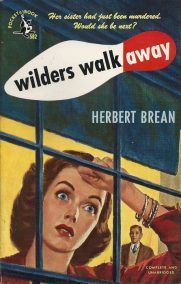 At some point between 1940 and 1960, puzzle-oriented detective fiction began an inexorable shift into what has now become know as crime fiction, wherein plot machinations took a back seat and character, setting, and ambience became more prevalent. Where detective fiction was mostly interested in the fiendish puzzle, crime fiction was more about the challenge to the status quo, and the effect this has on the people involved. And Wilders Walk Away, Herbert Brean’s debut novel, might just be the perfect peak between the two, because I do not remember having read a puzzle that was so intricately invested in the status quo. What emerges is necessarily a little confused about what it wants to be.
#247: The Sister Ursula Stories of Anthony Boucher (1943-45)
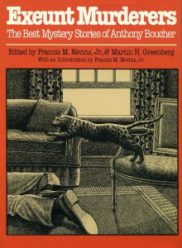
Having worked my way through Anthony Boucher’s short stories featuring the alcoholic yet still razor-sharp ex-cop Nick Noble, I’m now onto the second section of his collected short stories, comprising those featuring crime-solving nun Sister Mary Ursula of the Order of Martha of Bethany from Boucher’s locked room novels Nine Times Nine (1940) and Rocket to the Morgue (1942).
Continue reading
#244: A Little Help for My Friends – Finding a Modern Locked Room Mystery for TomCat Attempt #1: Murder in the Oval Office (1989) by Elliott Roosevelt
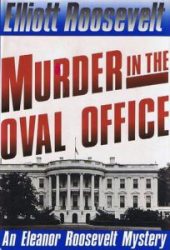
When I first realised that impossible crime fiction was a thing — oh, happy day! — I did an internet search and came up with two priceless resources: this variety of lists on Mystery*File with an excellent introduction by John Pugmire (who went to form Locked Room International) and this list of recommended books from locked room conoisseur TomCat.
Continue reading
#234: The Baddington Horror (1934) by Walter S. Masterman
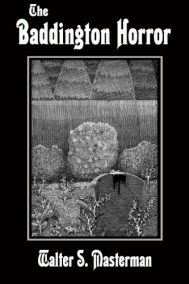 I love a country house mystery, especially those with a body on page one. So when the murder of ex-judge Sir Ernest Ferber in his private garden by man he sentenced harshly and the subsequent suicide of his assailant at the scene is communicated in the opening ten lines of The Baddington Horror, we’re off to a very good start. To my understanding, Walter S. Masterman wrote as many ‘weird tales’ as he did novels of detection, and so it was always a little uncertain what I was going to get here. But the first chapter could not be more Golden Age detection if it tried: murdered aristocrat, retired amateur detective who takes an interest, two big coincidences, and away we go…
Continue reading
#213: On Audacity and How to Prepare for It, via John Russell Fearn’s Thy Arm Alone (1947)

Sometimes someone is so taken with a book that you can’t help but stop and take notice yourself. So when TomCat was full of praise for this impossible crime, it hopped up my TBR pile with the effortlessness of a mountain goat on an escalator. I was promised audacity, and I love a bit of authorly audaciousness where an impossible crime is concerned — indeed, the boldness of such schemes as employed in John Dickson Carr’s The Man Who Could not Shudder (1940) or John Saldek’s Invisible Green (1977) make them firm favourites of mine, and if a book of this ilk has chutzpah enough to make TomCat and John Norris sit up and pay attention, then surely you must be onto a good thing.
Continue reading
#182: The Poisoned Chocolates Case (1929) by Anthony Berkeley
 The setup of The Poisoned Chocolates Case is rightly very famous: a lady is killed when a box of chocolates given to her husband by another member of his gentlemen’s club — who himself received them unsolicited through the mail — turns out to have been laced with poison. The police, with no culprit in sight, allow six amateurs with a fascination for real life crimes to theorise and present their own solutions, each one appearing watertight until someone finds a flaw that brings the edifice down. For this conceit alone, and the genius way Berkeley uses his different sleuths to unpick the sparse and simple known facts, this book has passed into near-legend in detective fiction circles.
Continue reading
#181: The Tuesday Night Bloggers – Strangers in Strange Lands: When East Comes West…
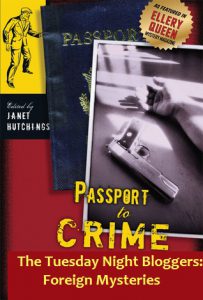
Alongside classic detective fiction and locked room/impossible crime mysteries of every date, stripe, and hue, I read a moderate amount of both classic and modern SF. And as much as I rejoice in the closedness of the ‘rules’ of detective fiction, I take equal delight in the free-form craziness that can open up in front of you in excellent SF.
Continue reading
#174: Adventures in Self-Publishing – The Mysteries of Reverend Dean [ss] (2008) by Hal White
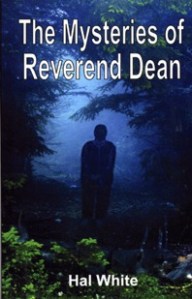
Continuing the grand old tradition of crime-solving clergy — I refer, of course, to The Father Dowling Mysteries — Hal White’s collection of impossible crime stories featuring the retired octogenarian Reverend Thaddeus Dean gives us six takes on vanishing murderers, no footprints in the snow, impossible alibis, and more classic staples of my most-beloved of sub-genres. And, no small praise, it bears the stamp of approval from Bob Adey…so, are the stories any good? Well, as part of my continued trek to find something in the realms of self-published detective fiction that’s actually worth your time, let’s have a look…
Continue reading
#133: Everything is Rather Frightening in The Black Rustle (1943) by Constance and Gwenyth Little
Over at the excellent and superbly-titled Exploring the History of Women in Mystery blog, wrangler “Unpredictable Notes” recently put up this brief summary of the EIRF school as outlined in Jacques Barzun and Wendell Hertig Taylor’s A Catalogue of Crime (1971). EIRF is a step on from HIBK (Had I But Known) and stands for Everything is Rather Frightening:
In fact, since the modern psychological novel has devoted itself to exploring the abnormal and oddly alarming, no great originality was needed to raise the emotional pitch of the murder another notch and made HIBK into EIRF – Everything is Rather Frightening.
 John Sladek is better known these days as a furiously inventive author of decidedly loopy SF — and I mean that as a compliment — but he did publish two detectives novels in the 1970s that each contained several impossibilities. The first,
