Agatha Christie
#286: A Conscious Regiment of Women? – The Queens of Crime™, Representation, and the Golden Age
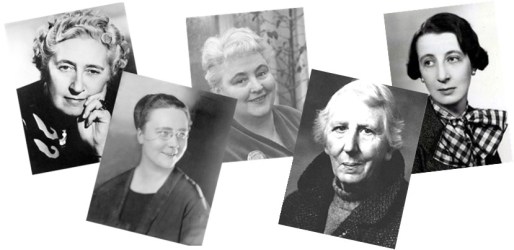
It is tremendously difficult to write about gender these days without appearing to be trying to sneak through some (usually unpleasant) agenda. If anything in the following causes any reader jump to such a conclusion about my intentions, I urge that hypothetical reader to take a glance through any selection of posts on this site — all written by the author of what you’re reading now — to assure themselves that this in no way features in my plans. I am simply, out of curiosity, asking a question that happens to involve gender.
And the question is this: Has Golden Age Detective fiction been subjected to a deliberate feminisation? And, if so, to what end?
Continue reading
#281: “Twelve different solutions to everything, most of them not very probable…” – in Partial Defence of Hallowe’en Party (1969) by Agatha Christie
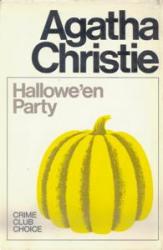
If you came to me at this precise moment in time and expressed both an ignorance of and an interest in the work of Agatha Christie, these are the ten books I’d recommend picking one to start from (presented chronologically, let’s not play Favourites):
Continue reading
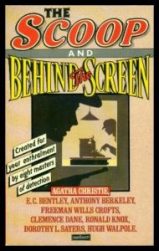
#278: Six Were Present – A Collaboration of Titans in ‘The Scoop’ (1931)

Most fans of Golden Age detective fiction (GAD) will be aware of the portmanteau novel The Floating Admiral (1931) in which many luminaries of the form each contributed a chapter in turn to a murder mystery plot (pity poor Anthony Berkeley, who had to unravel all the clues and events to provide a coherent solution in the final chapter). I’m imagining that slightly — but only slightly — fewer of you will be aware of the precursors to this novel written in the preceding year, where the same sort of approach was taken for two mysteries to be broadcast on radio.
Continue reading
#259: ‘The Yellow Book’ (2017) by Paul Halter [trans. John Pugmire 2017] and Categorising No Footprints Murders
Of late, I have found myself surrounded by invisible men. Entirely fictional, of course, but there have been a lot of them: shooting someone in an empty room in You’ll Die Laughing (1945) by Bruce Elliott, disappearing into darkness in I’ll Grind Their Bones (1936) by Theodore Roscoe, vanishing from rooms and beaches in Thursday’s forthcoming Wilders Walk Away (1948) by Herbert Brean, performing miracle appearances and disappearances as I reread Rim of the Pit (1944) by Hake Talbot…everywhere I look, people are vanishing.
Continue reading
#241: Fair-Play Detective Fiction 101 – The Results!
You suggested the titles, you voted, and now here we are: these are the top ten novels demonstrating fair-play in detective fiction as selected by nearly 500 votes on 40 titles. Except there are twelve of them, because we had a few ties. So, alphabetically by author we have…
Continue reading
#229: Carr vs. Christie…the Follow-Up
Last week we discussed the merits of what all y’all voted the two finest books by John Dickson Carr and Agatha Christie in full spoiler style. This week, Brad — who magnanimously locked horns with me — is hosting a follow-up where we air yet more of our favourite napery regarding these two and…well, go to his site and check it out…
Come back here next week for another follow-up where we’ll be…nah, I’m kidding. We’re not going to flog this horse any more.
Are we, Brad?
#226: Spoiler Warning 2 – Death on the Nile (1937) by Agatha Christie vs. He Who Whispers (1946) by John Dickson Carr
In the second of my semi-occasional series where caution is thrown to the wind when it comes to naming names, we are here today to discuss the two finest detective novelists of all time at their popular peak. Christie aficionado, good friend, and best teacher ever Brad of AhSweetMysteryBlog kindly agreed to go head-to-head over our favourite authors and then exchange some thoughts on aspects of the precise details and workings of the books, and the results of our efforts are below. Suffice to say, if you click to read more of this, there are guaranteed massive spoilers from this point on; don’t say I didn’t warn you.
Continue reading
#224: Coming Soon – Death on the Nile (1937) vs. He Who Whispers (1946): Some (Optional) Pre-Reading…

As Brad and I gear up for the comparison of what you — yes, you — decreed the very best individual novels by Agatha Christie and John Dickson Carr, I thought you may appreciate a bit of reading to get in the appropriate frame of mind (besides the books themselves, I mean…).
Continue reading
#217: Depth, Discovery, and the Detective Novel, via Death on the Nile (1937) by Agatha Christie

 The Invisible Event