#544: Murder by Matchlight (1945) by E.C.R. Lorac
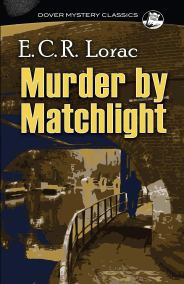


Back when E.C.R. Lorac was a semi-forgotten also-ran, I snapped up this Dover Press reissue before I figured the book would vanish into oblivion, hoping I’d smartly acquired an obscure gem. Skip forward a mere couple of years and the British Library Crime Classics series continues its exemplary work in reviving a wide range of authors and texts, and Murder by Matchlight (1945) has been dragged from its dusty and semi-overlooked corner into the full glare of publicity. Goddamn it, there goes half my retirement plan; oh, well, fingers crossed that the bottom doesn’t fall out of the fidget spinner market any time soon…
Continue reading
#543: Adventures in Self-Publishing – Flatline (2018) by Robert Innes

Prior to reading Robert Innes’ work I honestly did believe that there was quality content out there in this non-trad route (and I was right) but after more than a few low quality samples of this stream — a fair portion of which I opted not to write about on this blog, since it seemed self-defeating to my intended aim — I remained less optimistic about finding it.
Continue reading
#542: One Man’s Trash is Another Man’s Treasure in The Mystery of the Fiery Eye (1967) by Robert Arthur
The human mind is obsessed with patterns, because by spotting them we make sense of nature; be it the golden ratio in the seed spirals in the head of a sunflower, fluid dynamics in the formation of sand dunes, or the growing box office returns of successive Fast & Furious movies, patterns are hard to resist.
Continue reading
#541: The Late Monsieur Gallet, a.k.a. Maigret Stonewalled (1931) by Georges Simenon [trans. Anthea Bell 2013]
It’s been a number of years since I last read any Georges Simenon — the stark nihilism of The Stain on the Snow (1953) and the diaphanous erotic tragedy of The Blue Room (1964) left an impression if not exactly a desire to read further. Simenon is hard to ignore, however, partly because he wrote so many damn books and partly because Penguin have done such a fine job of reissuing them lately that they take up about 40% of the shelf space in most bookshops. I’ve always been of the impression that he is far more about people than plot…which is probably just as well, since on the evidence of this early effort he can’t plot for toffee.
Continue reading
#540: Adventures in Self-Publishing – The Boy Who Played Rama [ss] (2017) by Sharath Komarraju

In my experience, self-published impossible crime fiction doesn’t produce much in the way of short story collections.
Continue reading
#539: The Origin of Evil – Contrasting Malice Aforethought (1931) by Francis Iles with The Colour of Murder (1957) by Julian Symons

Genre is essentially the formalisation of deja vu. Those of us who return to — or avoid — particular genres do so because of the essential ingredients that recur there, whether through implicit rules or otherwise.
Continue reading
#538: The Cask (1920) by Freeman Wills Crofts

If I asked you to name the debut novel of a hugely influential detective fiction author that was originally written in 1916, published four years later, featured a character called Hastings, and had its ending rewritten at the publisher’s request to remove a courtroom/trial sequence…you’d no doubt be surprised just how much The Mysterious Affair at Styles (1920) by Agatha Christie and The Cask (1920) by Freeman Wills Crofts had in common. The intervening century has been kinder to Christie than to Crofts in both literary reputation and availability, and their divergence from these surface-level similarities is no doubt a part of that.
Continue reading
#537: Adventures in Self-Publishing – The Murder at Redmire Hall (2018) by J.R. Ellis

When might a self-published novel not be a self-published novel? That’s the quandary I face with J.R. Ellis’ third book, Murder at Redmire Hall (2018). See, it’s technically published by Thomas & Mercer, but they’re simply an imprint of Amazon Publishing and the line between what’s different about this and simply uploading it to Amazon oneself gets blurrier the more you look at it.
Continue reading
#536: The Futile Alibis – These Daisies Told: The Casebook of Professor Ulysses Price Middlebie [ss] (1962-75) by Arthur Porges


